The span of fancy wedding cakes runs from a single heart-shaped tier for fifty guests to a 28-foot cherry-laden showpiece, and the choice comes down to whether your priority is the cutting photograph or what guests actually taste.
Tiramisu improves when built a day ahead; buttercream demands skilled hands the morning of.
1. Classic Buttercream Cakes
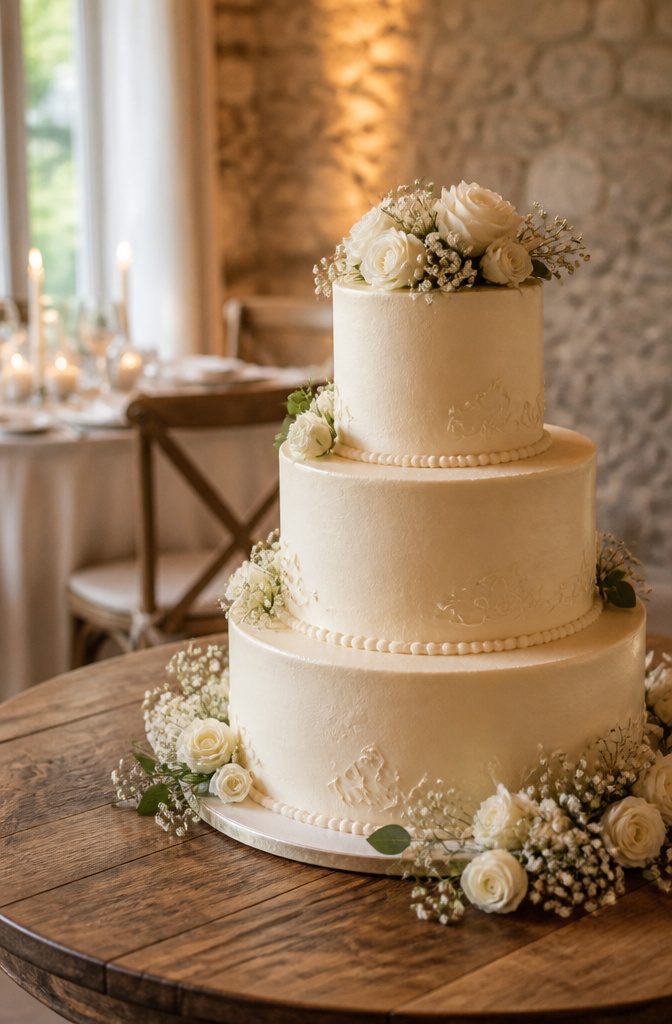
Buttercream holds up better than most wedding cake options when weather turns unpredictable, which matters more than couples expect for outdoor ceremonies.
The finish can run smooth and contemporary or carry rosettes, intricate piping, or clean minimalist lines, so the same base material adapts to nearly any aesthetic without forcing a style choice.
Flavor customization is where buttercream separates itself from the pack. Vanilla bean, rich chocolate, and salted caramel are the starting points, and bakers can work in strawberry, lemon lavender, or anything else a couple requests.
Swiss or Italian meringue buttercream carries a silkier, less-sweet texture that reads as noticeably more luxurious than standard American buttercream, and it is worth the specific ask.
Color takes beautifully in buttercream, whether matched to a palette or worked into ombré transitions.
Champagne finishes and black-and-white combinations both land with sophistication. Buttercream is the safest base for a wedding cake.
It tastes good to nearly everyone, takes color and piping well, and most bakers can fix surface flaws the morning of. Buttercream painting and elaborate piping demand skilled hands; a rushed job shows every swirl.
2. Berry Beautiful Cakes
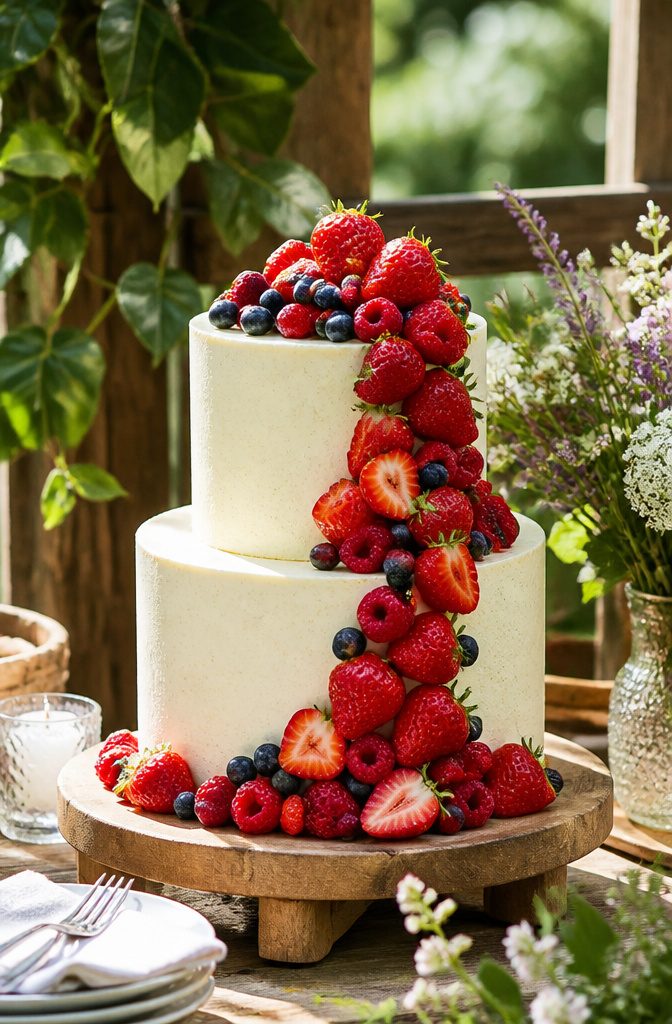
Fresh berries turn a wedding cake into something that looks like it grew in the garden rather than came from a bakery.
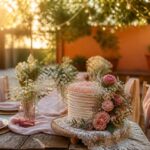
Strawberries, blueberries, raspberries, and blackberries cascade down tiers in organic patterns that need no fondant sculpting to feel finished. The color comes straight from the fruit itself, which means the palette shifts naturally with the season.
Spring through early fall is when berries hit peak flavor and hold their shape, so timing the wedding to the harvest matters more than with sugar flowers.
A lemon cake layered with strawberry compote, or vanilla bean with mixed berry medley, gives guests something light after a full dinner without sacrificing indulgence.
Berry-infused buttercream carries the theme through every bite instead of leaving the fruit as decoration only. For outdoor or garden weddings, the look feels intentional rather than rustic by default.
The one trade-off is timing: berries soften, so the cake finishes close to the reception start. Fresh fruit photographs best in natural light, where the gloss catches and reflects in a way sugarwork rarely matches.
3. Rectangular Long Cakes
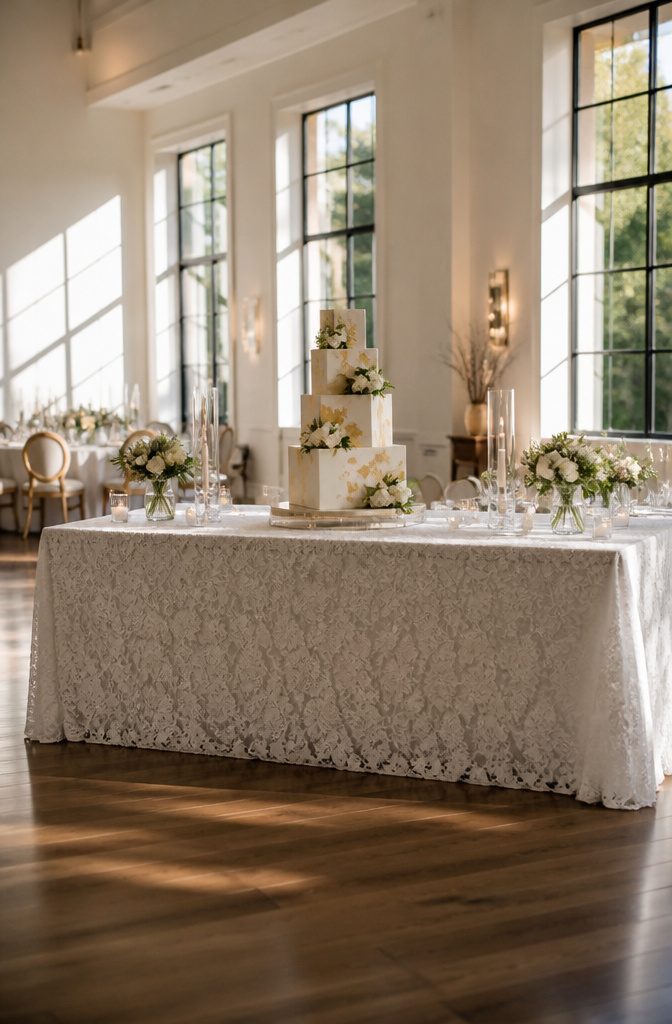
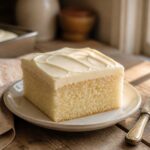
Rectangular long cakes give you more clean slices per tier than any round design, which matters when your guest list hits 150 and the caterer starts counting.
The geometry is straightforward: a 9-by-13-inch single layer yields roughly 24 standard portions, and stacking those dimensions in stepped tiers keeps the math simple without looking basic.
I like these for the sharp lines modern photographers can actually use. The flat planes take geometric patterns, clean floral placement, or deliberate negative space in ways curved tiers resist.
Stepped heights work; one long single-tier cake running the length of the head table works too, especially if you want the cake to double as its own dessert station.
A rectangular cake breaks from the round-tier tradition guests expect, which some couples want and others do not.
Round tiers signal "wedding" on instinct, and some guests will register a rectangle as corporate event or birthday before their brains catch up. For me that hesitation lasts about half a second once the decoration is intentional rather than apologetic.
But if your venue leans country estate or your grandmother is already frowning at your dress, the rectangle adds one more note of modernity to justify.
Slicing is genuinely easier: straight edges, no radius to negotiate, portions that line up in rows. Your catering staff will finish faster and waste less.
4. Tiramisu Wedding Cakes
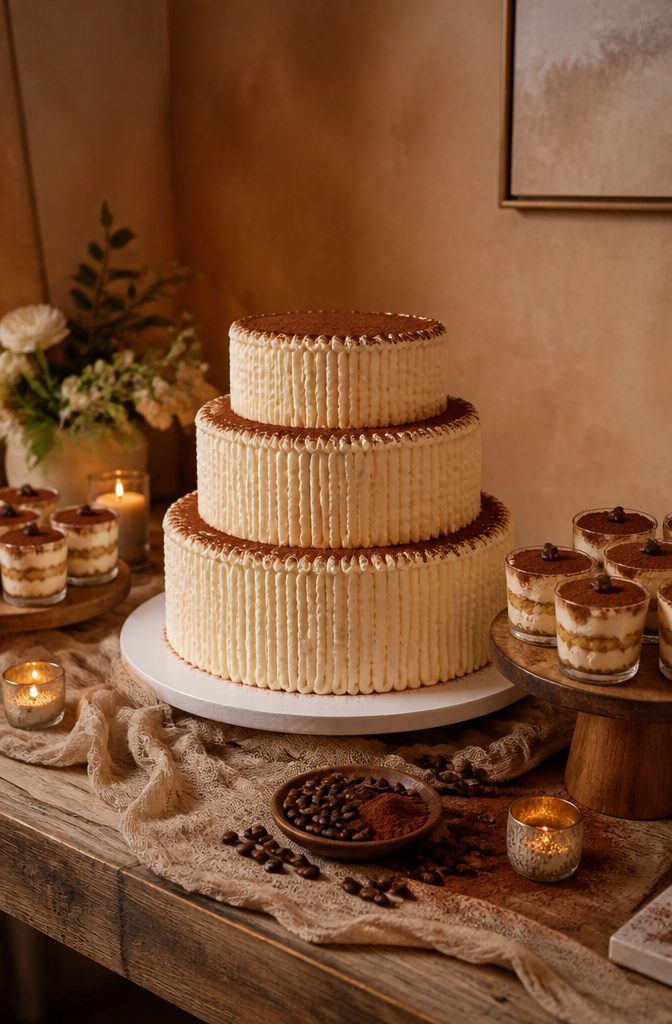
Tiramisu wedding cakes solve a real logistical problem most couples overlook: the flavor actually improves when assembled a day ahead, so the coffee and mascarpone have time to meld into something deeper than the sum of their parts.
For couples who care more about how the dessert tastes than about preserving cake-cutting tradition, this is the direction I would push.
The structure stays faithful to the Italian original. Coffee-soaked ladyfingers give it body, the mascarpone brings richness without heaviness, and the cocoa dusting on top keeps the finish bitter enough to balance the sweetness.
What makes it wedding-appropriate is the execution. Piped mascarpone can look architectural rather than rustic, and bakers who work in chocolate detailing or subtle gold accents can push the presentation into formal territory without losing the dessert’s essential character.
One practical option worth considering: individual tiramisu portions arranged as a larger display.
You keep the visual impact of a traditional tiered cake, but every guest gets the authentic layered experience rather than a slice of something adapted to hold its shape.
Tiramisu layers are soft and wet, so the cake needs internal supports that a standard sponge does not.
Tiramisu does not stack or transport like buttercream, and it needs that advance day to hit its peak. Plan the timeline around it, though, and you get a dessert that feels both celebratory and genuinely good to eat.
5. Vintage Grandeur Cakes
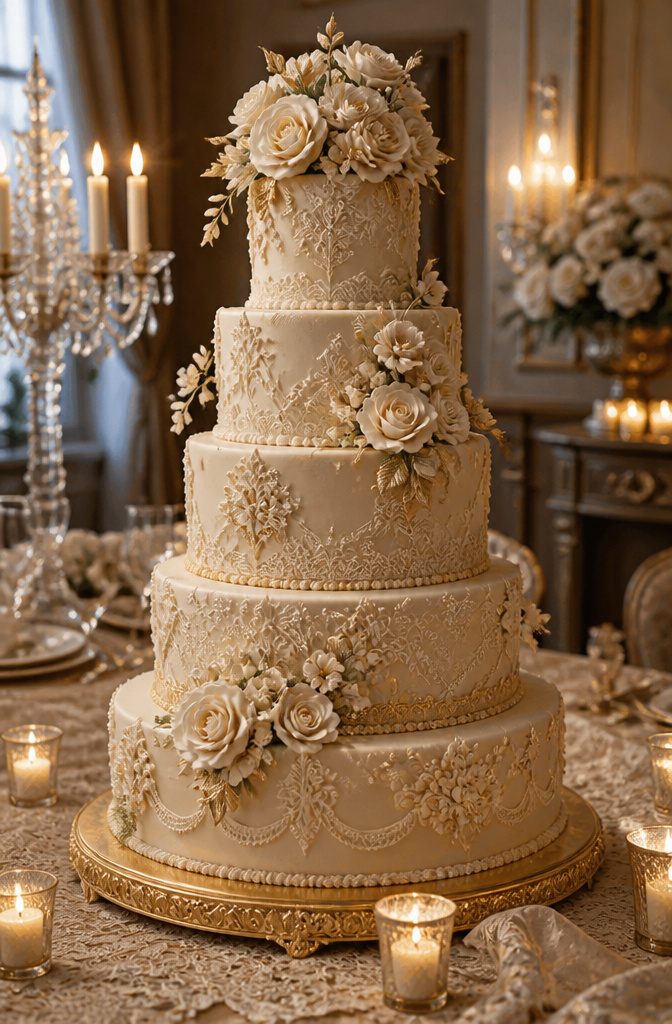
A vintage-inspired wedding cake carries the weight of real craftsmanship that most modern designs skip entirely.
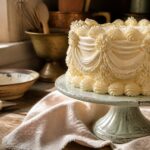
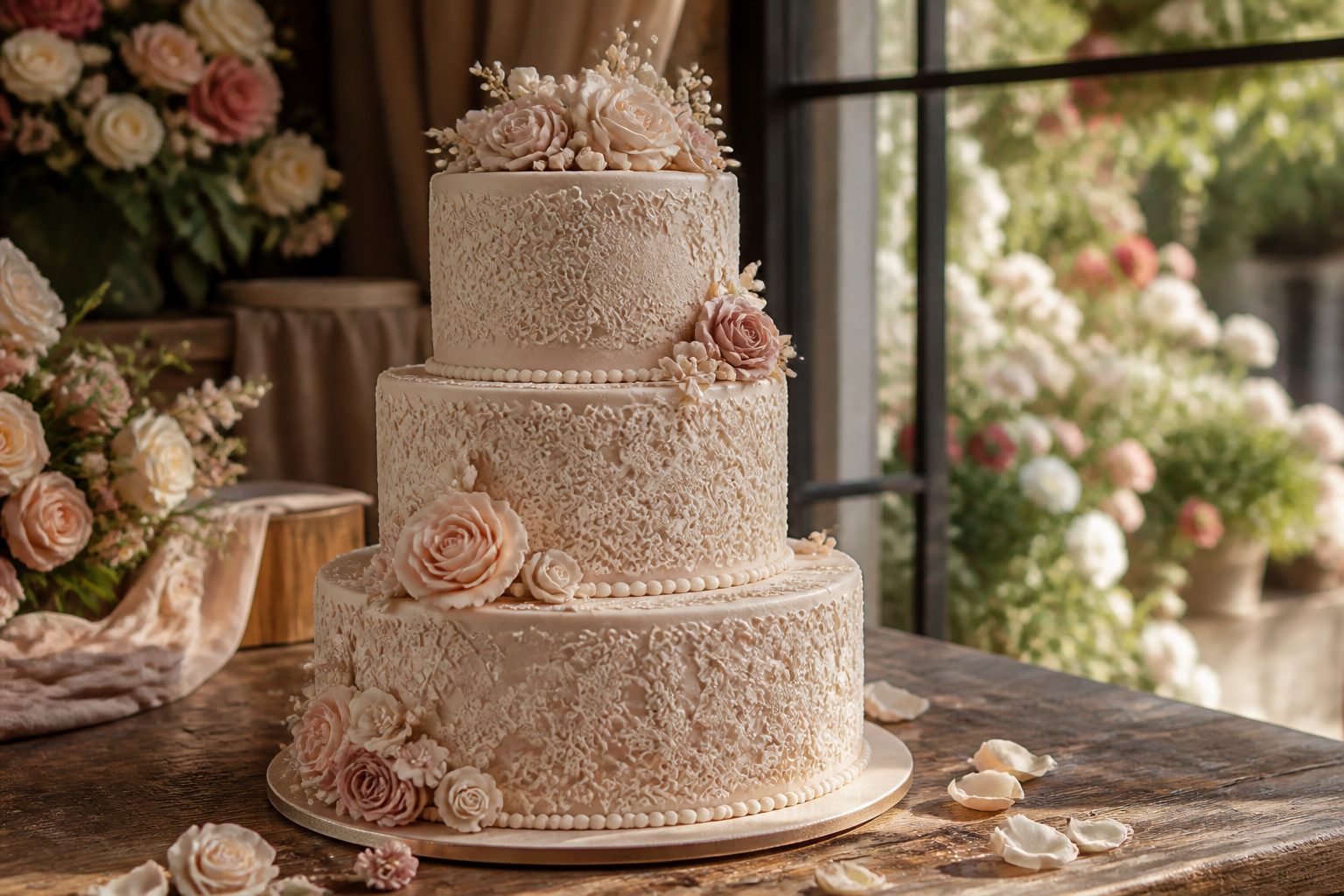
Piped royal icing creates lace patterns dense enough to read as fabric, not frosting, and sugar roses built petal by petal reward the close inspection guests actually give a centerpiece dessert.
The contrast with minimalist styles is sharp.
Where a single-tier buttercream cake reads as intentional restraint, these multi-tiered constructions announce that someone spent hours on brooch work, scrollwork, or architectural details like edible gold leaf and pearl accents that catch reception light.
The effect is formal, not fussy, and it suits historic venues in a way clean lines rarely do.
Period specificity matters here. Victorian styling leans on elaborate sugar roses and intricate scrollwork; Art Deco brings geometric patterns and bold gold lines; 1950s elegance keeps softer ruffles and pastel palettes.
Each era asks a different skill set from the baker, and the cost reflects that time. For a wedding where the cake needs to hold its own against ornate décor, the extra expense is justified.
For a loft ceremony with concrete walls, the same cake looks misplaced, almost apologetic. Match the cake to the venue’s existing grandeur, or choose a simpler section entirely.
6. Pastel Tenderness Cakes
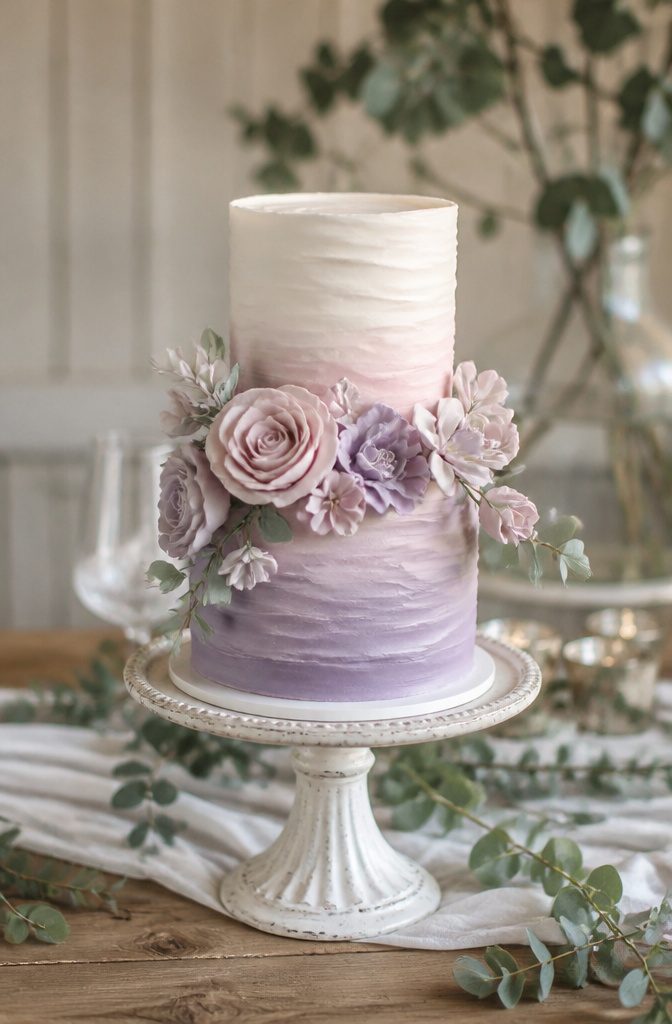
Soft color palettes carry a wedding cake without shouting for attention. Blush pink, lavender, sage green, butter yellow, and pale blue read as romantic rather than timid, and they leave room for the decorative technique to do the varied work.
An ombré buttercream fade feels current and unfussy; watercolor brushwork gives the same palette an organic, slightly undone edge that photographs well in natural light. Delicate sugar flowers in matching tones add dimension without clutter.
These colors travel across seasons better than bolder choices. Spring and summer feel obvious, but dusty rose or sage green in fall pick up the muted side of autumn foliage rather than competing with it.
The pairing matters more than the shade itself: a smooth buttercream with pearl border keeps the look restrained, while rough textured lines or Swiss dots add tactile interest that still reads as refined.
I would skip metallic accents with pastels; gold or copper against these tones tips toward trendy and dates the cake faster than the couple might like.
Subtle tinting in the buttercream itself, built up in thin layers, creates depth that reads as sophisticated rather than busy.
7. Croquembouche Towers
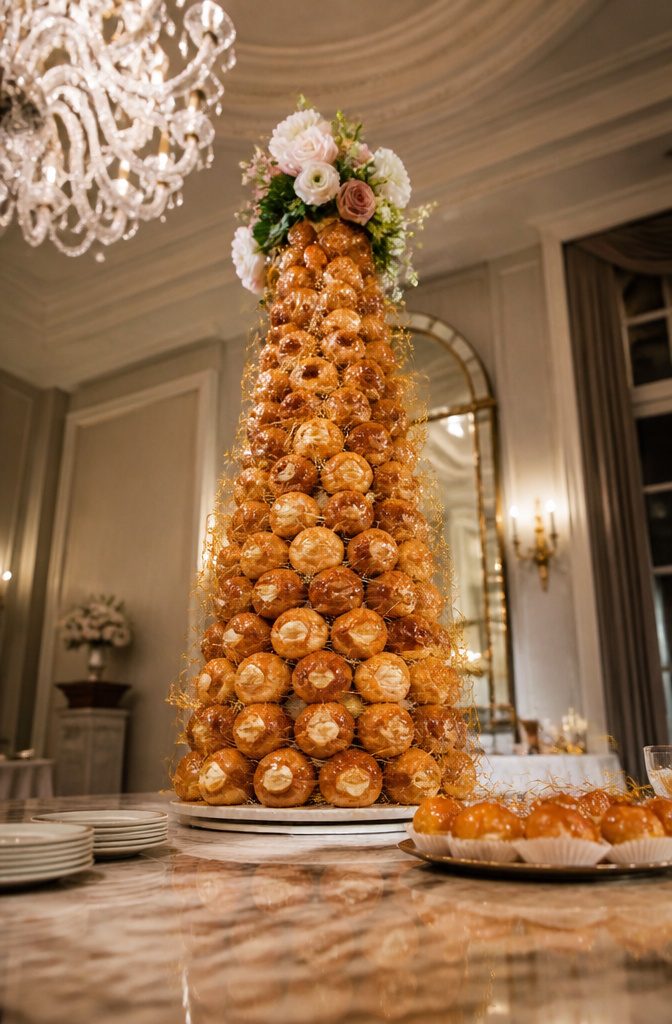
A croquembouche replaces the sliced cake ritual with something guests actually watch happen.
The tower of cream puffs bound with spun caramel is assembled on site, then pulled apart or snipped with kitchen shears at the table. That interaction is the point: people remember the moment more than a plated wedge.
Flavor options run from traditional vanilla pastry cream to chocolate, raspberry, or champagne-infused cream if you want the dessert to nod toward the toasts.
Fresh flowers at the base or colored caramel variations keep the visual tone consistent with the rest of the reception.
Multiple smaller croquembouche towers beat one giant centerpiece if you want different flavors in play or need to serve several tables without the parade-to-one-spot bottleneck.
This needs someone comfortable with hot sugar work, not just a baker who delivers and leaves.
8. Heart-Shaped Cakes
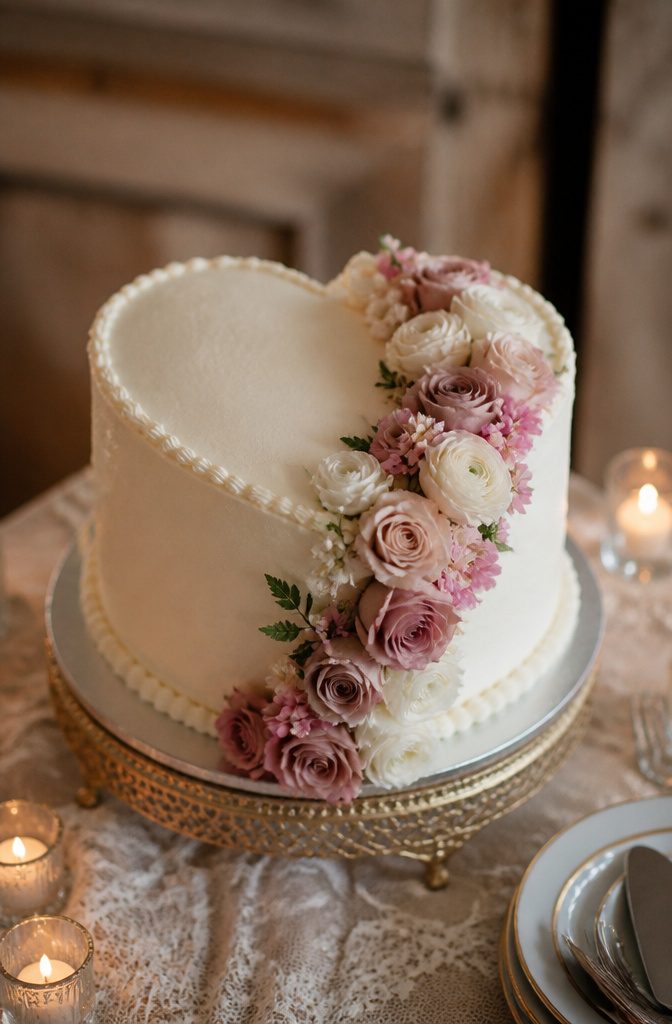
A heart-shaped cake carries immediate symbolism that no round tier can match, and bakers are finding ways to make it feel intentional rather than novelty.
The shape works best for intimate weddings where the guest count sits below fifty, letting the design read as romantic rather than oversized.
For a larger celebration, a single heart tier placed above standard rounds keeps the gesture without dominating the display.
The current revival leans on restraint. Geometric piping, exposed layers with cascading fresh flowers, or a cluster of smaller heart cakes arranged at varied heights each avoid the cutesy pink-frosting associations that defined the 1980s version.
Naked cakes in this shape feel particularly current, the rustic texture offsetting the literal heart outline with something more architectural.
Single-tier heart cakes suit the companion-cake role perfectly.
They cost less to decorate than a stacked standard cake of the same diameter, since one surface carries the design rather than three, and they disappear at dessert tables instead of returning half-uneaten.
Without tiers, you lose vertical presence in a large venue. Place it on a raised stand or keep it as the smaller cake beside a traditional main tier, and the silhouette still photographs well during the cutting moment.
9. Cloud-Like Bliss Cakes
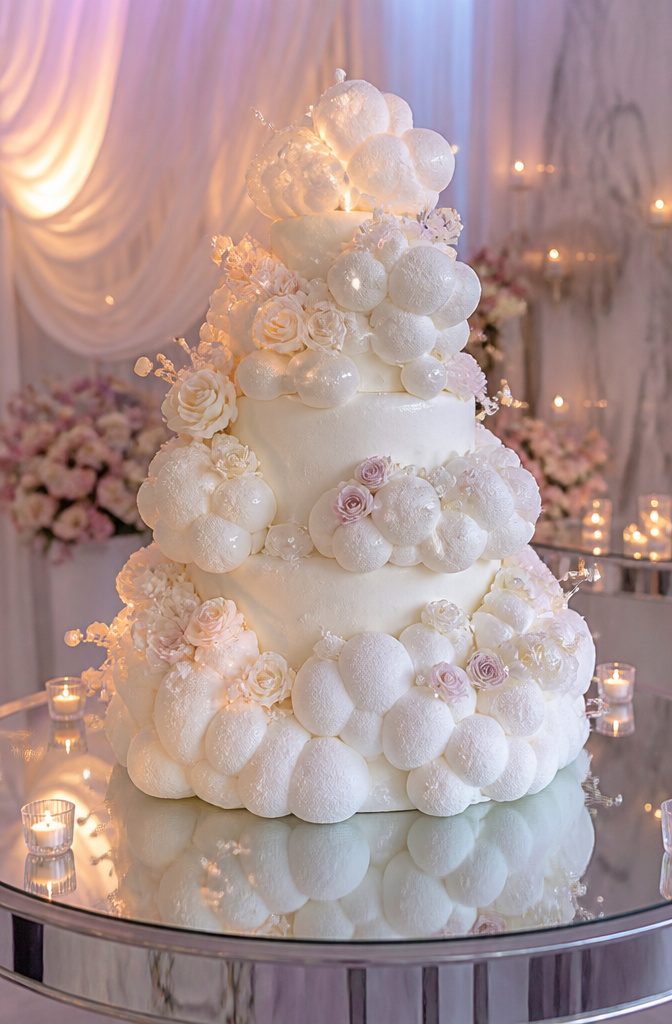
Marshmallow and meringue textures give a wedding cake volume without the heaviness of traditional fondant draping. Bakers build this look by working with egg-white structures that hold air, then finishing with soft edges rather than sharp corners.
The result reads as billowy and almost weightless, especially under warm reception lighting where the matte white surface catches glow rather than reflecting it like satin icing would.
Some versions go literal: entire tiers covered in toasted marshmallows for texture that photographs with real depth. Others use marshmallow fondant to get that same dreamy smoothness, or pipe meringue clouds that appear to float between tiers.
The Il Robbiano cake that Sabine Ghanem and Joseph Getty commissioned took a different angle, pairing meringue with cream and a crown of fresh fruit on a flat top. It shows the range here, from sculptural to restrained.
Flavor follows the same fork in the road. A s’mores build with chocolate cake and graham cracker elements leans into the campfire nostalgia.
Vanilla with soft pastels keeps everything ethereal. Lighting matters more on these cakes than on most: overhead spots flatten the texture, while side wash or candlelight lets those soft edges cast their own shadows and actually look like clouds.
10. Cherry Perfection Cakes
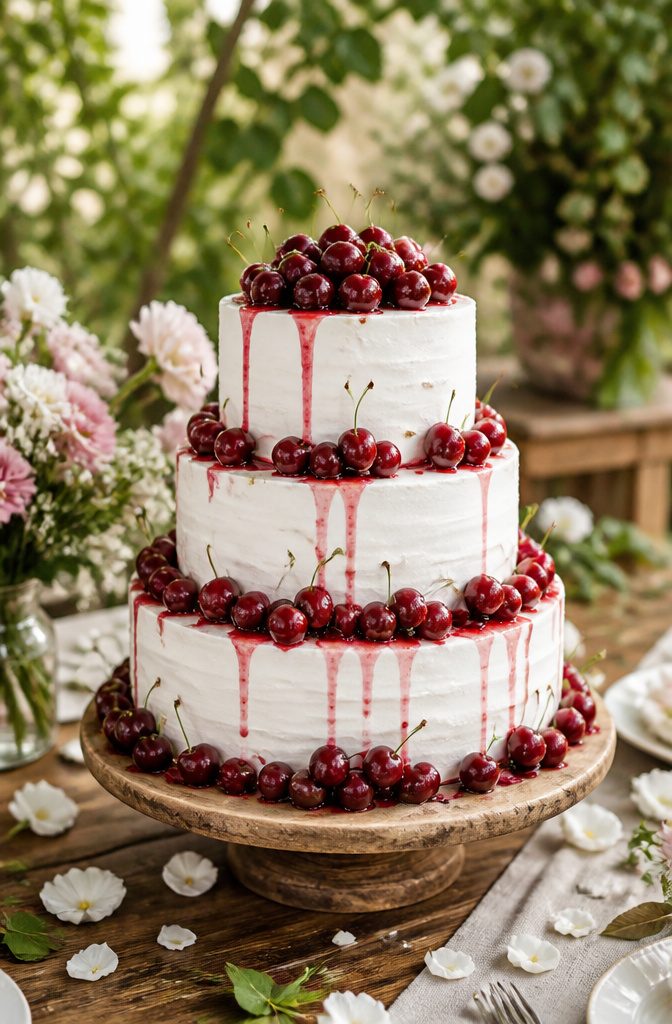
Cherries carry a built-in symbolism that works harder than most decoration.
The fruit’s association with good fortune and new beginnings gives a wedding cake meaning beyond the visual, and that deep red against white or ivory frosting delivers the single most reliable pop of color in pastry work.
Fresh cherries offer the strongest impact when the season aligns. Their natural shine and deep tone read as both rustic and elegant depending on arrangement, cascading down tiers or clustered in controlled patterns.
The limitation is real: fresh fruit wilts, and a summer wedding in a warm venue can outpace even careful refrigeration.
Candied cherries or maraschino varieties remove that pressure entirely, keeping their color and shape for the full event. Some bakers build sugar-crafted cherries that read as fresh from a distance but survive any timeline.
Flavor integration matters as much as appearance. A cherry-vanilla cake with cream cheese frosting or chocolate layers with cherry compote between them gives guests something to remember after the visual moment passes.
For her wedding at her childhood home in Westchester, baker Stefanie Nass made her own cake that doubled as decor. The 28-foot-long creation was adorned with cherries and ranunculus flowers.
— Vogue
That scale is extreme, but the principle holds: cherries scale from a single accent to a dominant motif without losing their effect. The choice between fresh, preserved, or candied comes down to season and stamina, not aesthetics.
11. Silver Elegance Cakes
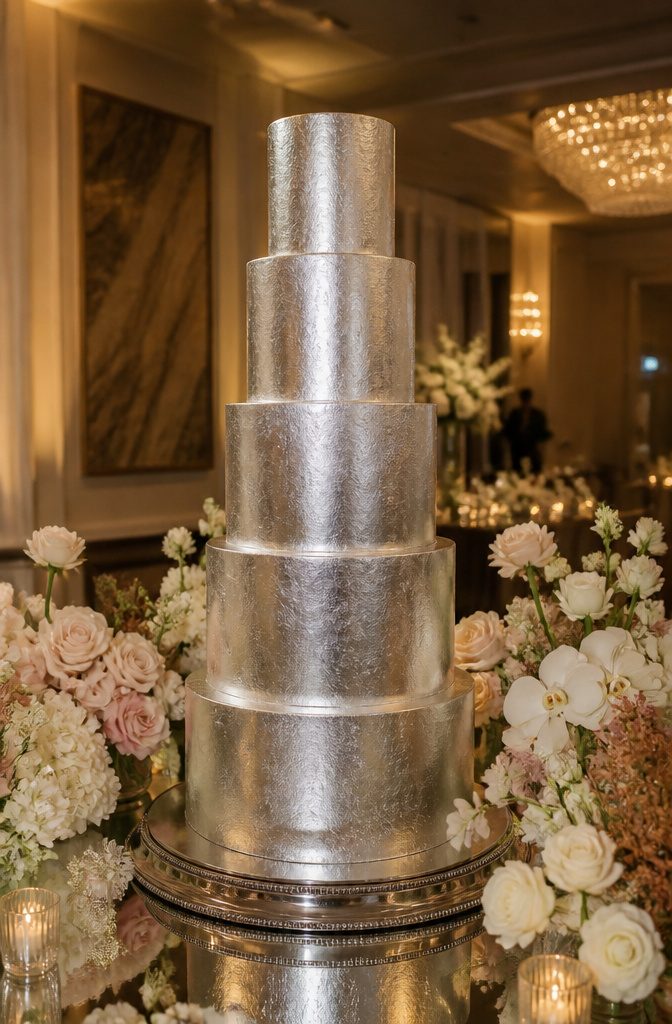
Silver leaf reads cold and deliberate under daylight, but it turns liquid under warm reception lighting and can outshine the rest of the room if the tiers are fully covered.
I would keep full silver coverage to evening weddings where the dimmer controls the effect; for afternoon garden receptions, painted shimmer or silver dragées on white buttercream gives you the accent without the glare.
The technique demands precision. Edible silver leaf tears if your hands are warm or the fondant underneath is even slightly tacky, and buttercream needs a crusted surface or the leaf will sink.
Painted shimmer is more forgiving: mix luster dust with a high-proof alcohol and brush it on in thin layers.
I have watched bakers lose whole sheets of leaf to a single fingerprint, so if your kitchen runs warm, paint is the safer bet.
Silver pairs with practically any palette, which is half its value. It sharpens navy and emerald, cools blush without clashing, and reads as neutral against gold if you want mixed metallics.
The risk is industrial chill: one fully silver tier against concrete or steel venue details can feel like a machine shop. Softening with sugar flowers or a semi-naked base tier brings back the warmth most couples actually want.
Cake Tasting and Consultation
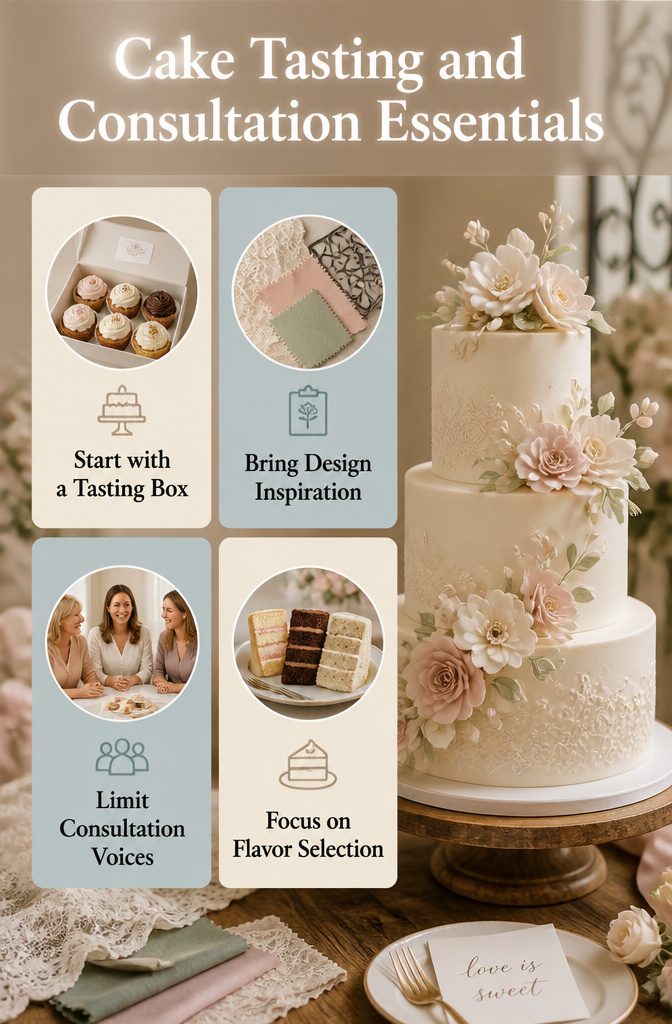
A tasting and consultation appointment is where the Pinterest board meets the plate. Most bakeries require this step for weddings serving 100 guests or more, and smaller events often start with a tasting box mailed to your door.
Either way, this is your chance to move from "fancy wedding cakes" you liked online to flavors and finishes that fit your actual day.
I have found that the best consultations happen when you bring more than a color swatch. The dress lace, the venue’s ironwork, a fabric sample from the bridesmaid dresses: these give the baker something concrete to translate into sugar work.
Some couples arrive with a full theme; others figure it out together once they see how a champagne cake batter pairs with elderflower buttercream versus straight vanilla.
The guest list matters here too. A consultation usually includes the couple plus one or two others, often the mother of the bride or a bridesmaid with strong opinions.
If a groom’s cake is on the table, the mother of the groom tends to join. More than three voices and the decisions slow down; fewer and you risk missing the one relative who will complain later.
Flavor selection runs the show, but the consultation is really about editing.
You have already gathered inspiration. Now you learn what costs more than it looks, which details survive a summer tent, and whether that metallic finish tastes as good as it photographs.
The baker’s job is to hand you back a cake that is both stunning and sturdily built for your particular room, season, and guest count.
Decorative Techniques
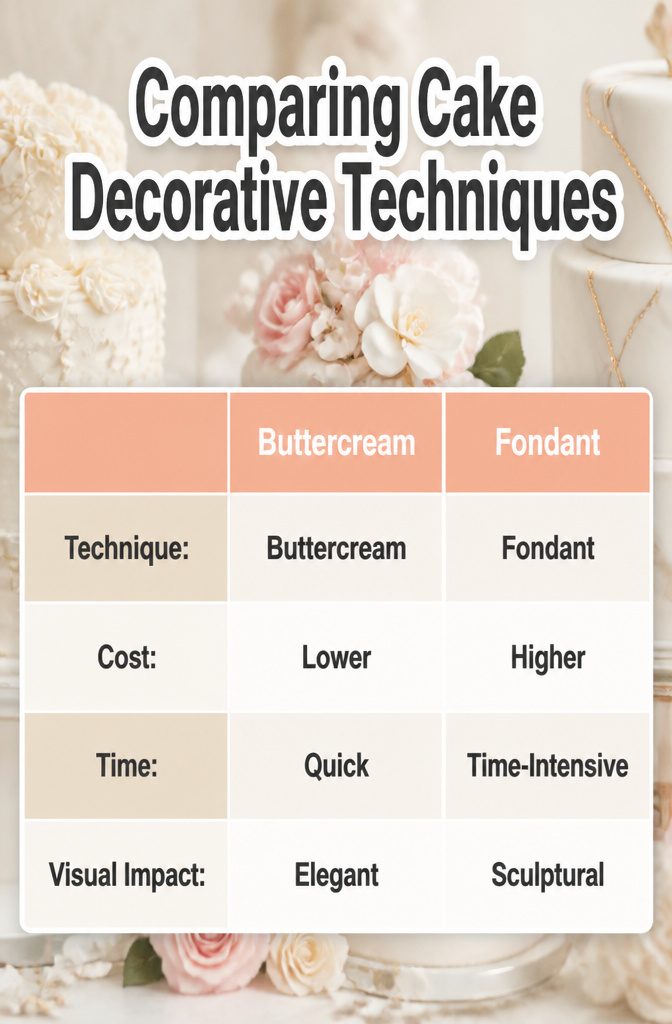
Buttercream piping, sugar flowers, and fondant each offer a different path to visual impact, ranging from intricate to quietly minimal.
Sugar flowers can take days to make, which pushes both the design ceiling and the final cost, but the result shifts a cake from pretty to genuinely extraordinary, whether applied as a single cascading spray or a full crown.
Fondant supports the cleanest, most sculptural looks, paper-thin waves or marbled finishes with metallic veins that buttercream simply cannot hold.
That said, buttercream has made a strong comeback for a reason: a smooth finish with Swiss dots, watercolor washes, or rough textured lines delivers elegance without the same labor overhead.
For most home bakers planning a wedding cake, buttercream piping offers the honest sweet spot, sophisticated enough for the occasion and forgiving enough to execute without a commercial kitchen.
Flavors and Fillings
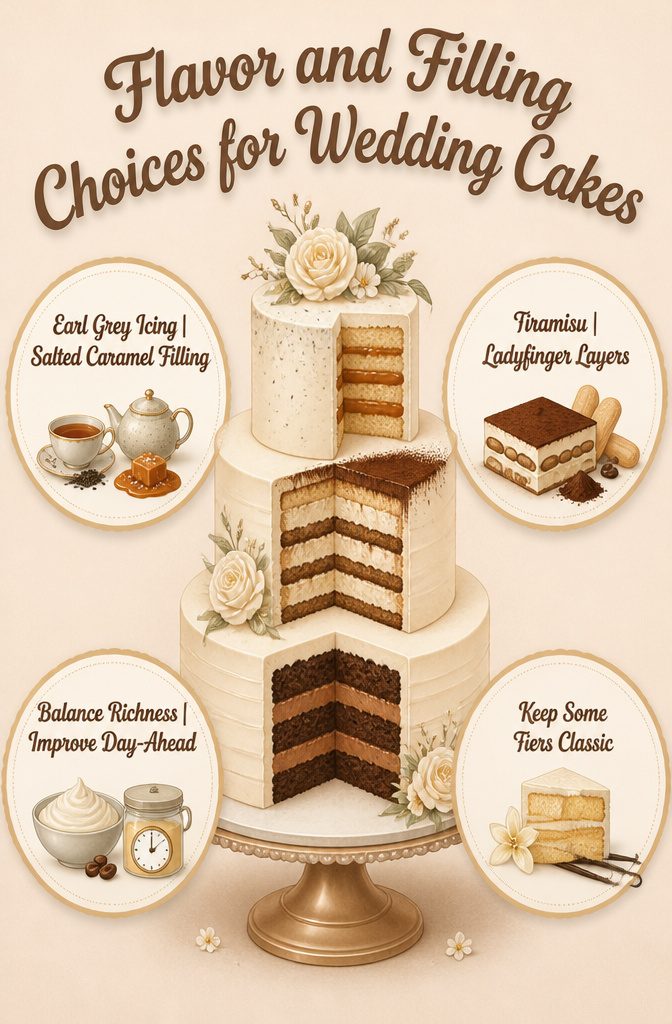
Vanilla and chocolate still anchor most wedding cake menus, and they earn their place. A good baker can make either taste like something you actually want a second slice of, not just something that photographs well under ballroom lights.
The real decision comes when you move past those anchors.
Earl Grey icing with salted caramel filling is the combination Aimee France built for Karen Elson’s wedding cake, and it works because the bergamot cuts through the caramel’s richness instead of letting it sit heavy.
That balance matters at a reception where guests have already eaten a full meal.
Tiramisu operates on the same principle of contrast.
Coffee-soaked ladyfingers against mascarpone, cocoa on top. The practical advantage is that tiramisu improves when made a day ahead; the flavors settle and deepen, which simplifies kitchen logistics for a timed event.
Some bakers pipe the mascarpone into formal wedding-cake shapes, or arrange individual portions into a larger display that keeps the authentic layered structure intact.
Salted caramel on its own, Earl Grey on its own, tiramisu as a full cake: each option gives guests something familiar enough to recognize but specific enough to remember.
The risk with any adventurous flavor is the guest who avoids it. I would keep one tier classic if the others go bold, or serve a separate small cake in a standard flavor for the cautious eaters at the table.
Frequently Asked Questions
What are some unique wedding cake ideas?
Each solves a different problem, from weather stability to guest interaction to flavor development.
How do I choose a wedding cake flavor?
Start with vanilla or chocolate as anchors that please cautious eaters, then add one adventurous tier or filling.
A tasting appointment lets you test how flavors pair with your actual menu and season; bring fabric samples or venue photos so the baker can match the buttercream to your day, not just your Pinterest board.
What is a croquembouche?
A traditional French dessert made of cream puffs bound with spun caramel, served as a tower rather than sliced.
At weddings it replaces the standard cake-cutting ritual with a live moment; guests watch it pulled apart or snipped with kitchen shears.
What are some elegant wedding cake ideas?
Match technique to venue; ornate sugarwork suits historic spaces, while clean rectangular geometries or single-tier heart shapes read as intentional restraint in modern rooms.
What is the most luxurious cake?
For decoration, sugar flowers that take days to craft and full edible silver leaf coverage both push costs and visual impact upward.
Vintage-inspired multi-tiered constructions with brooch work, scrollwork, or architectural details like gold leaf and pearl accents announce hours of craftsmanship that most modern designs skip.
How much should a wedding cake for 100 guests cost?
It does note that sugar flowers and elaborate vintage piping push costs upward because of labor time, and that a consultation reveals which details cost more than they look.
For budgeting, a rectangular long cake yields more clean slices per tier than round designs, and a single-tier heart-shaped cake costs less to decorate than a stacked standard cake of the same diameter since one surface carries the design.
What is the latest trend in wedding cakes?
Pastel palettes with ombré fades and rough textured lines also read as current, while metallic accents against those tones are flagged as risking a dated look.