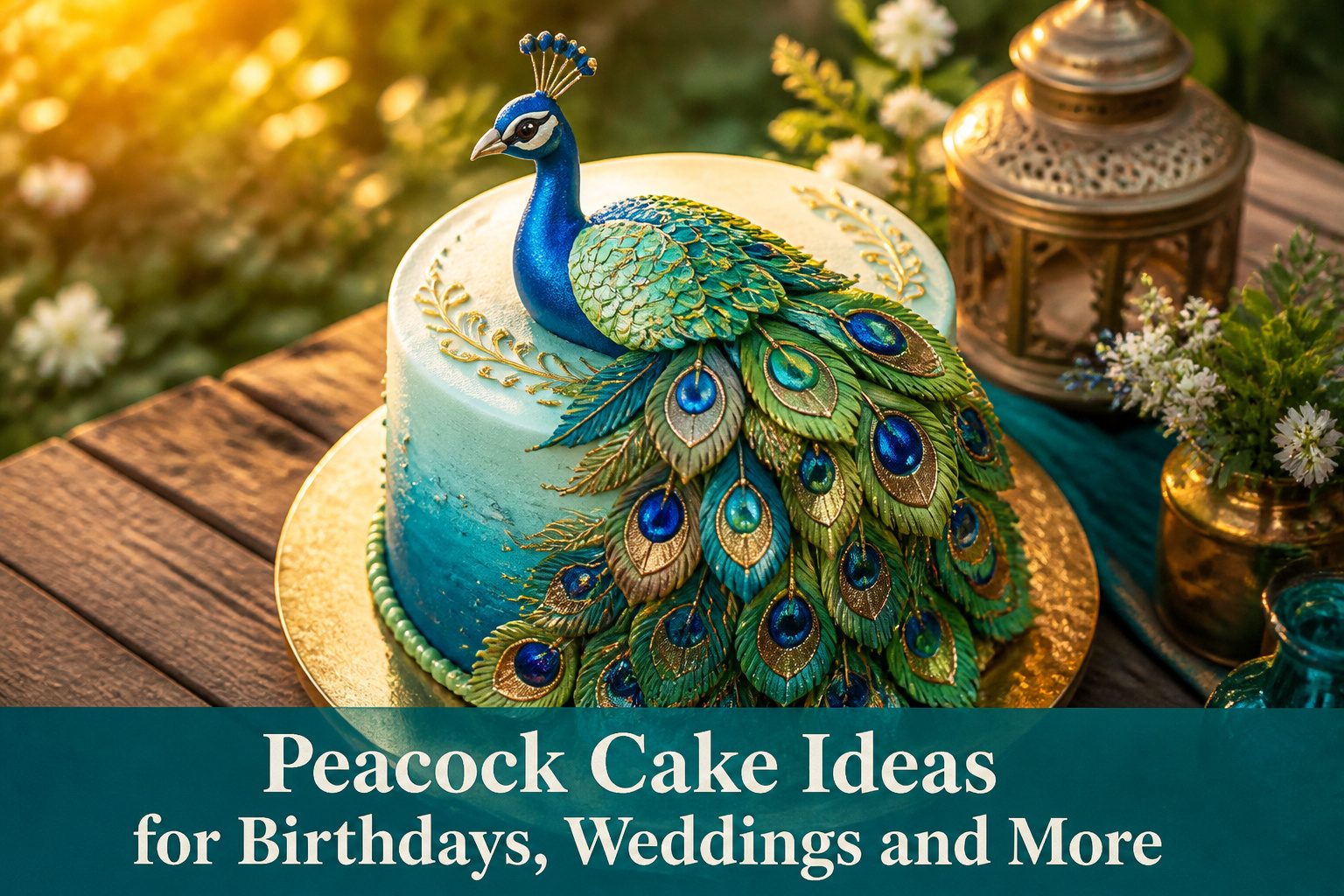
Peacock cakes span from a 25-minute buttercream build to a five-tier gum paste sculpture that needs two days of drying time.
Your decision comes down to how much of the work you are willing to do yourself: piping a petal tip at 45 degrees is one afternoon, but hand-layering 3D sugar feathers in fuchsia and black is a specialty order.
The surprising detail that separates beginners from committed home bakers is the 20-minute chill before you sketch feather outlines; skip it, and the buttercream drags instead of pipes.
1. Pretty Peacock Cake
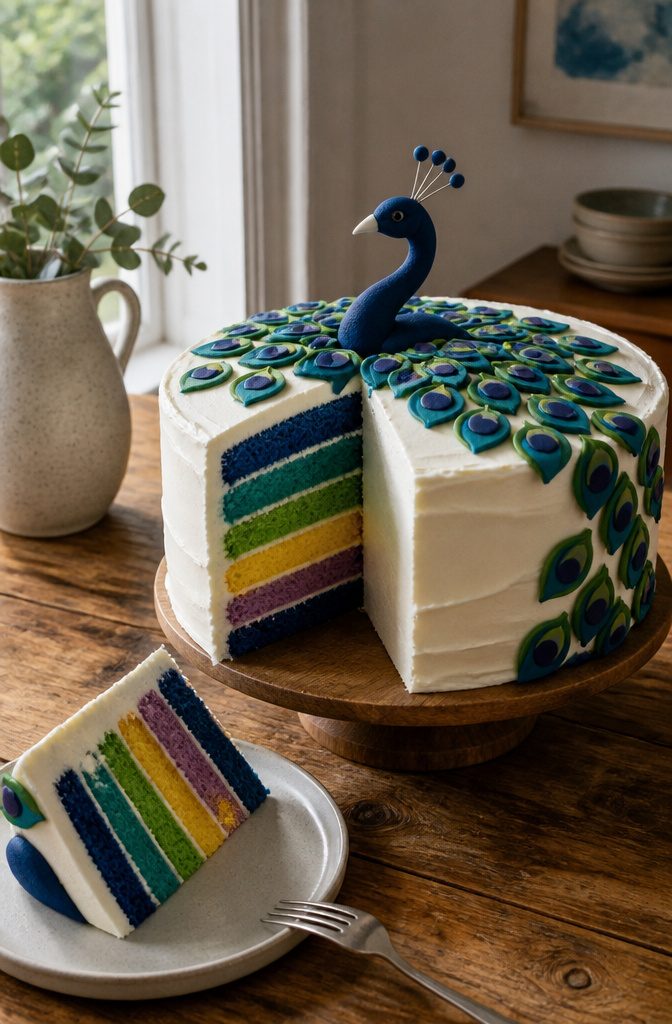
A layered white cake gets its peacock colors from six tinted batters poured in concentric rings: blue, dark teal, light green, yellow, violet, and dark blue.
The dark teal comes from Teal plus Kelly Green icing colors; the dark blue from Royal Blue with a touch of Violet.
The finished slice shows every color at once, which is the whole reason you build it this way rather than frosting the outside and calling it done.
The fondant body sits on top in dark blue, shaped into a cone with a bent neck and a beak made from a half-inch ball of white fondant.
Black sugar pearls form the eye, with yellow fondant head feathers that need an hour to set before you poke them in.
For the feather decoration on the sides, you will want 4.4 oz of Decorator Preferred White Fondant and a 4 lb tub of Creamy White Decorator Icing, with the icing split into six colors using Lemon Yellow, Leaf Green, Kelly Green, Teal, Violet, Royal Blue, and Sky Blue.
Pipe the feather eyes in yellow first, add violet shading, then build the feather lines in dark teal.
The petal outline gets dark blue with a light green inner line, filled with blue. Tear shapes in light green and blue finish the top edge.
Prep runs 10 minutes, baking 15, and the total time clocks 25 minutes at 509 calories per serving. The 20-minute chill before you sketch the feather design with a toothpick is what keeps the buttercream smooth enough to pipe on without dragging.
2. Fuchsia Peacock Beauty
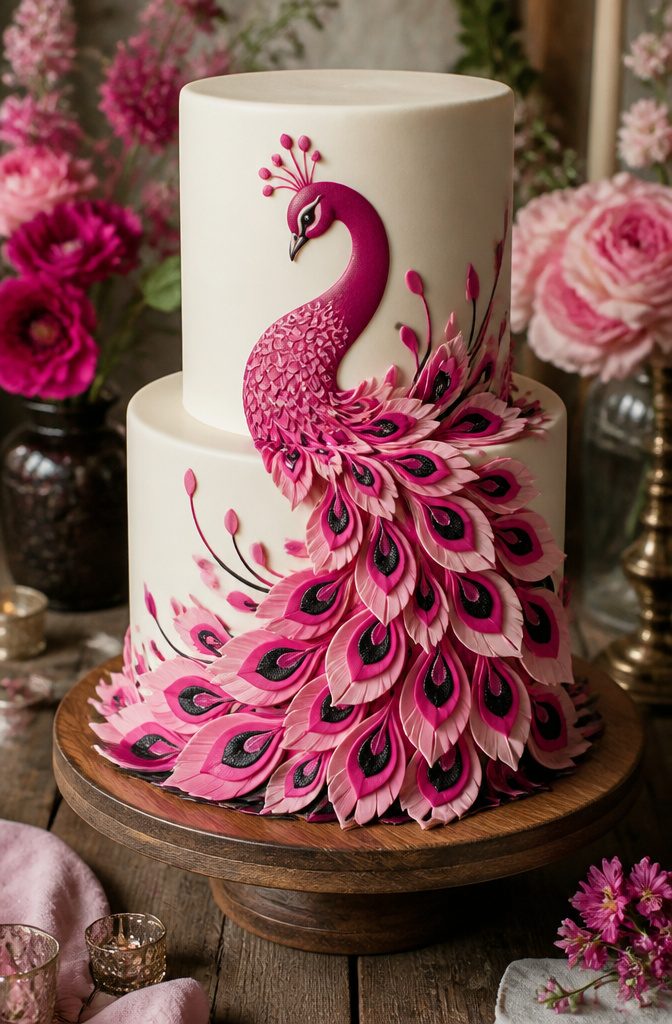
A two-tiered cake draped in cream-colored fondant gives this design its clean stage, but the real shock is the one-foot bright fuchsia peacock climbing across it. That scale turns a pretty accent into the centerpiece the whole room notices first.
The bird’s body is painted directly onto the first tier, neck arched so the head turns back toward its own tail in that classic peacock posture.
The feathers break flat surface entirely. They are built up as 3D sugar work, each one layered from handmade sugar flowers in pale pink, fuchsia, and black with edible ribbons threaded through.
The overlapping petals create actual depth you catch from the side, not just piped illusion.
This color choice is the judgment call that makes or breaks the cake. Peacock designs usually run blue-green-gold; swapping in fuchsia risks garishness but here reads as deliberate drama against the quiet fondant ground.
The sugar flower technique costs time, no question, and the dimensional feathers need careful transport. For a birthday where the cake is meant to stop conversation, the trade-off pays.
3. Golden Peacock and Oriental Elegance
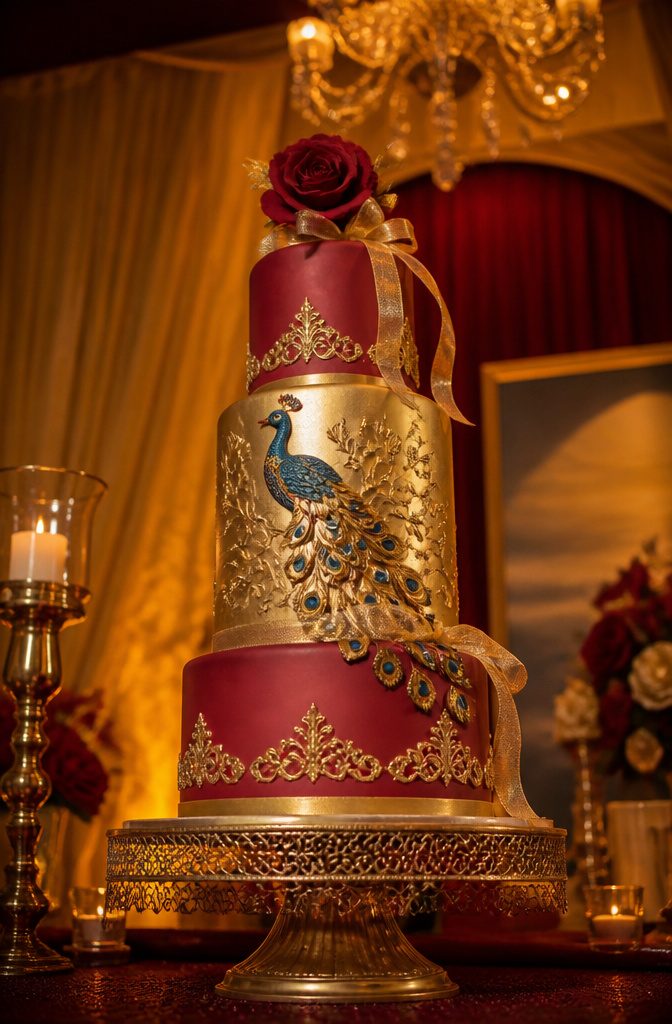
A three-tiered cake in red and gold leans on the center tier to carry its visual weight.
The middle layer is six times the size of the top and bottom layers combined, which sounds extreme until you see how the proportions force every eye to the peacock.
The top and bottom layers stay short and wrapped in regal red fondant. The bottom adds white and gold buttercream, but it reads as a base, not a destination.
The middle tier hosts the peacock itself in a gold foil-like display that needs every inch of that oversized surface to read as elegant rather than crowded.
Gold ribbon and red bow ties bridge the tiers without competing.
A red rose with gold leaves sits on top, continuing the color scheme without introducing a new visual center. The risk with this layout is obvious: a center tier that large can throw off the physics and the logistics.
A cake that looks anchored and ceremonial from across a room is exactly what you want for a wedding or a milestone birthday where the cake will be photographed before it is cut.
4. Classical Peacock
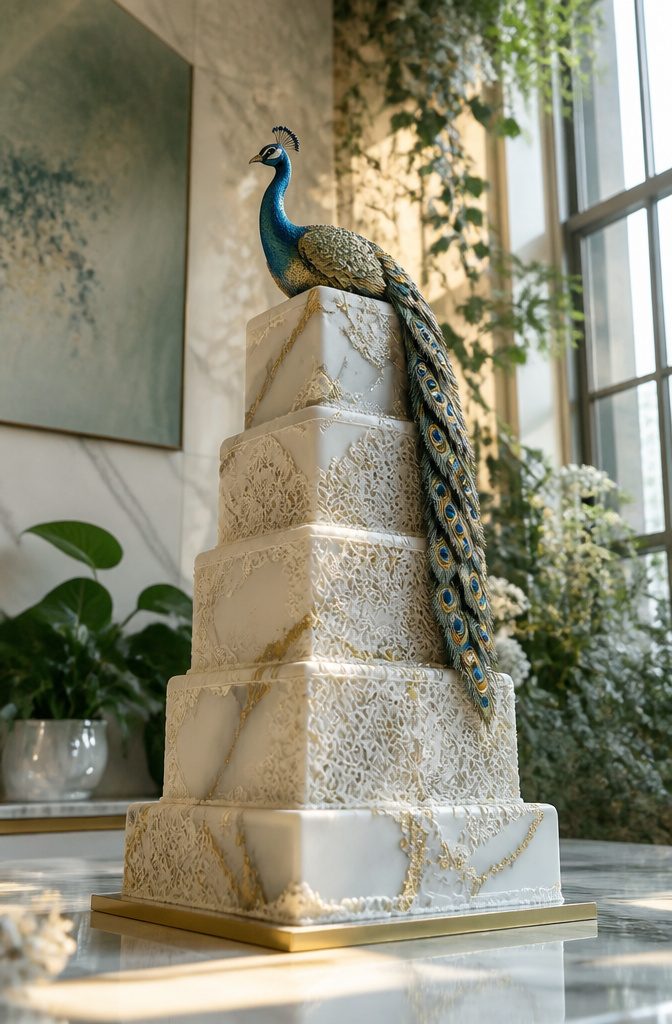
A five-layer square cake with carved marble-look fondant and a realistic peacock topper reads as the most ambitious choice in this list, and it is.
Vicki at Signature Cakes built the structure in white fondant, then carved each tier with lace-like designs that echo classical stonework rather than flat pattern.
The stacking technique matters here: five layers of any height need internal support, typically dowels and cake boards between tiers, or the weight compresses the lower fondant and cracks the marble effect you spent hours tooling.
The peacock itself is sculpted in gum paste, with a modeling knife used for fine carving on the body, eyes, and beak.
Each tail feather is layered olive green and blue paste, finished with golden dust, then arranged to cascade down all five tiers.
The pupils at the feather centers are what sell the realism, and the overall impression, sources note, is of feathers that might actually rustle.
This is not a same-day project.
Gum paste toppers need drying time, and the carved fondant demands patience the stacked height does not forgive. Plan the topper at least two days ahead, or the weight of wet gum paste will sag on the finished cake.
5. Fairy Tale Peacock Cake
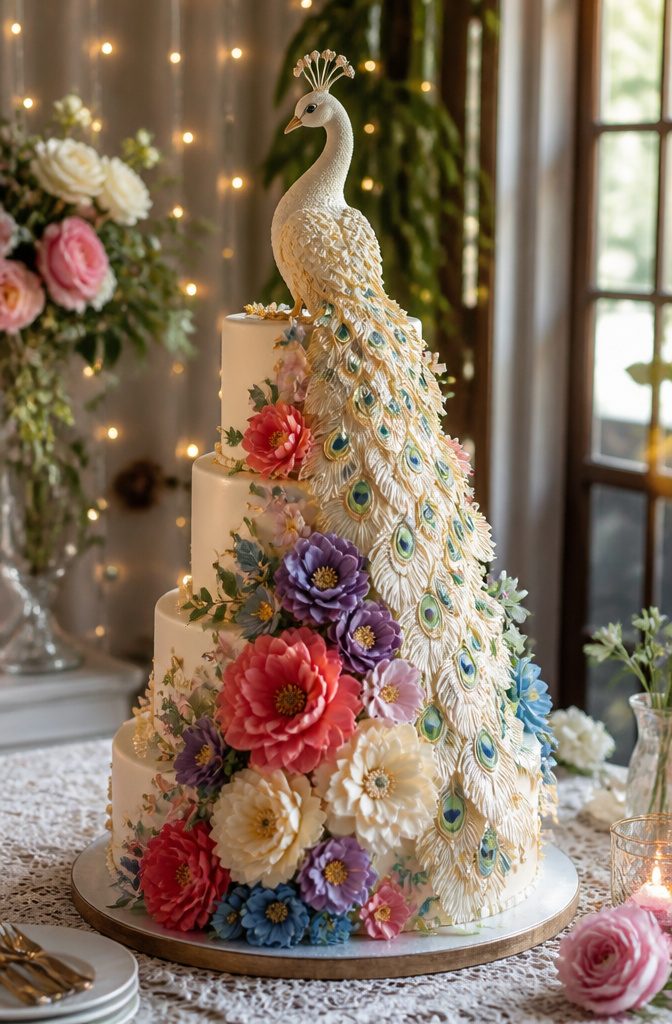
A four-layer cake with a white chocolate peacock and sugar flowers lands in that sweet spot between showpiece and something you can actually pull off at home. The white chocolate modeling technique is the detail that makes it work.
You warm white chocolate with a little corn syrup until it forms a pliable dough, then knead and shape it like clay. It handles more forgivingly than fondant and tastes like actual dessert instead of chewy sugar paste.
The peacock itself gets built in sections: body first, then the fan of tail feathers scored with a knife to suggest the eye patterns.
Let each piece firm up on parchment before you assemble, or the weight will sag. Sugar flowers fill the gaps between feathers and trail down the tiers, which hides any seams and adds depth without demanding perfection.
I like this approach for anyone who wants the drama but not the fondant learning curve. White chocolate modeling clay softens fast in warm kitchens, so schedule the sculpting for a cool morning and keep a fan nearby.
6. Modern Take Peacock Cake
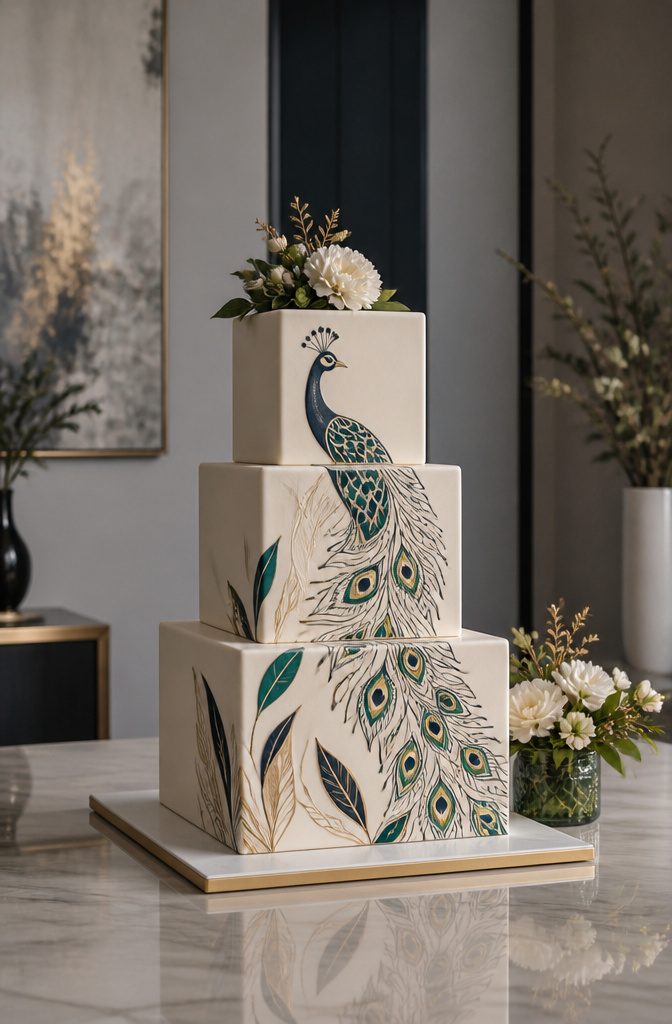
A modern peacock cake works best when restraint reads as confidence rather than compromise. Three square tiers, each smaller than the one below it, give the bird its structure without any literal shaping.
The peacock is drawn across the flat planes in sharp, hand-drawn geometric lines: the head and neck sit on the bottom tier, the body on the middle, and the tail feathers flare across the top where the color concentrates.
The color palette stays tight. Small touches of green mark the peacock against the surrounding linework, with minor accents elsewhere.
That limited range avoids the carnival effect that can overwhelm a reception table. Because each line is painstakingly drawn by hand, the design still feels intricate; the eye keeps moving without the cake shouting.
I would commission this from a decorator comfortable with abstract work, since the geometry has to be precise to land.
The 3D effect comes entirely from the tier sizing and the way the drawn bird wraps the corners. For a wedding where the couple wants the peacock motif but not the full jewel-tone explosion, this is the option that wins.
7. Hay Day Peacock Cake
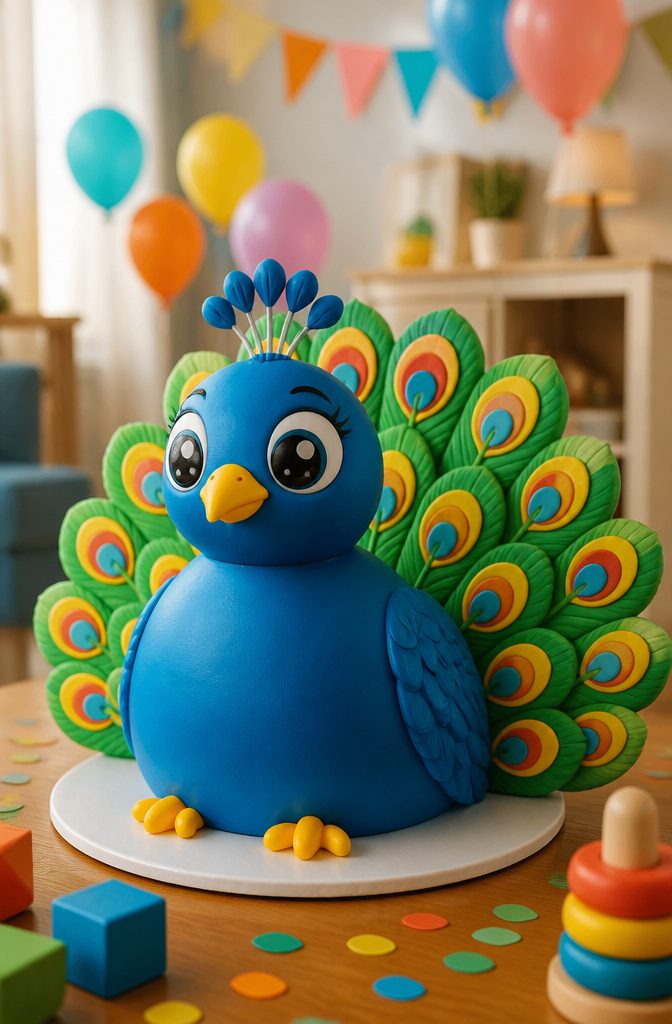
A Hay Day peacock cake works best for a kid’s birthday or any party where younger guests recognize the mobile farm game.
The design translates the game’s cartoonish animals into a giant, rounded peacock with a deliberately playful silhouette rather than realistic proportions.
The build starts with a stacked and carved cake body. Rice crisps mixed with melted marshmallows form the head, which gives you a lightweight shape that sets firm and holds detail without collapsing under its own weight.
Both body and head get covered in blue fondant. For the feathers, you will need molds and edible paint to get the layered, fanning look.
This is a niche choice. The gamer reference lands squarely with children and the younger crowd who know the app, and it does not try to double as an elegant wedding centerpiece or adult celebration cake.
The materials are standard fondant work and molded decorations, so the skill level sits at intermediate: the carving and assembly take patience, but nothing here requires specialty equipment beyond basic molds.
8. Buttercream Peacock Cake
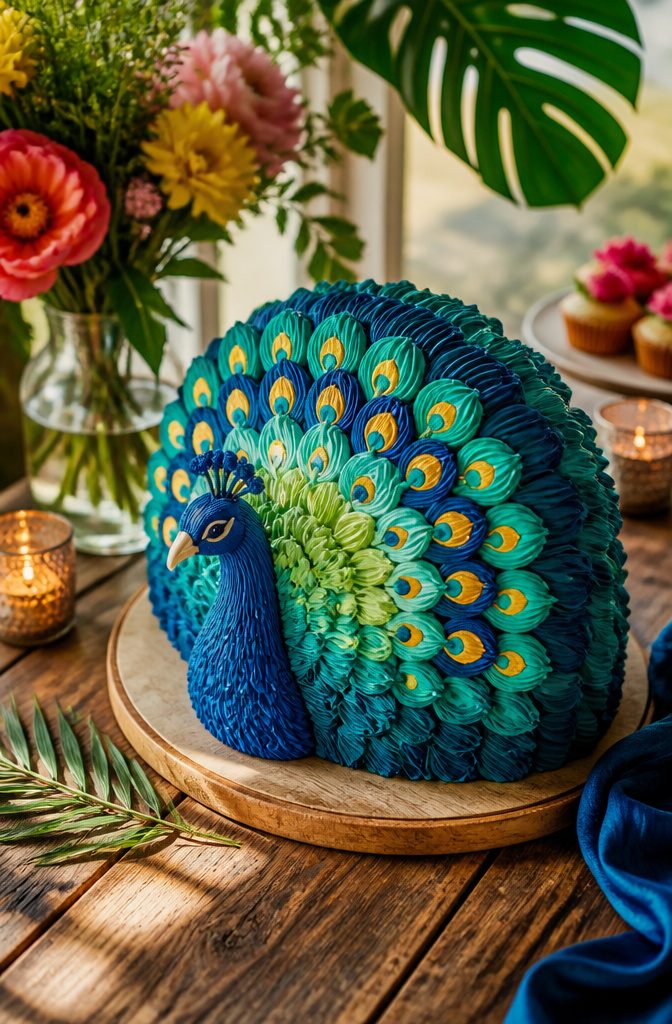
A half-round cake, cut flat on one side and set against a straight back edge, gives you the peacock’s silhouette without carving anything.
The body sits at the narrow top; the fan of tail feathers spreads down the wider face. I like this shape because the surface area is large enough to build real texture, and buttercream handles the whole job.
For the feathers, a petal tip held at 45 degrees pipes overlapping rows that read as plumage without any fondant overlay.
Start at the bottom edge with the darkest blue or green, work upward through teal and gold, and let each row cover the base of the one above it.
The motion is a short wrist flick, not a drag; you want the petal edge to stand slightly off the cake so light catches it.
A 1M round tip or even a zip-top bag with the corner snipped pipes the body and head. Add a thin neck in black or dark brown, then press two white nonpareils in for eyes if you want the detail.
The whole cake stays soft and sliceable, which matters more than it should at a party where half the guests skip fondant anyway. Cleanup is one piping bag and a few bowls.
9. Geometrical Pattern Peacock Cake
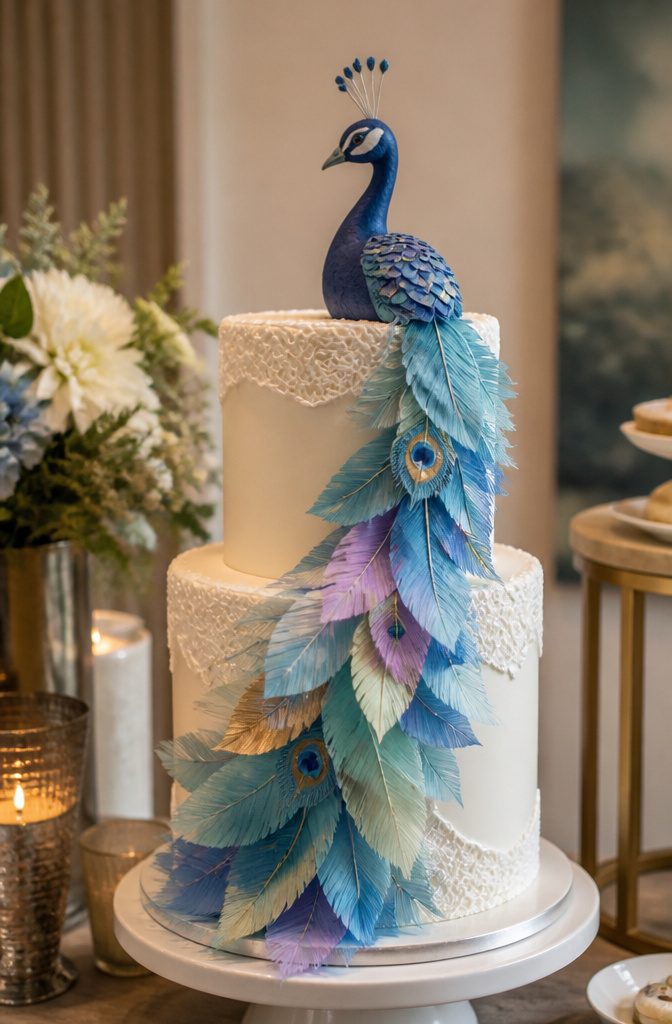
A two-tiered cake with wafer paper feathers and fondant lace hits the peacock theme without the sugar-flower learning curve.
Wafer paper is the same edible paper you find in the baking aisle at most grocery stores, and it behaves more like thin cardstock than fondant.
You cut three colored pieces for each feather, paste them slightly offset so the layers read as barbs, and attach them to the second tier in a sweeping tail pattern.
The lace effect comes from thin blue fondant stripes pressed or piped along the base, which keeps the whole design from feeling too heavy.
I would skip sugar flowers entirely here.
Wafer paper needs no wiring, no drying time, and no gum-paste skills. These feathers can soften if they sit against buttercream too long, so this cake is best assembled the day it is served.
For a wedding or birthday where you want the drama without the week of prep, that feels like a fair exchange.
10. Abstract Buttercream Peacock Cake
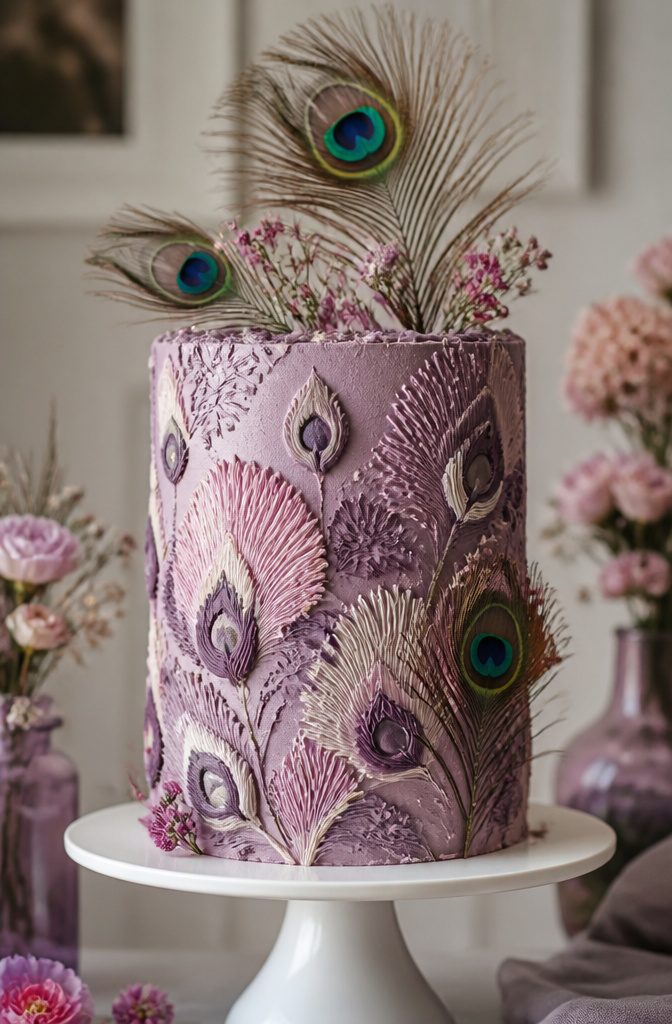
A mauve buttercream base sets this cake apart from the usual jewel-tone peacock designs.
The builder layers the cake, applies a crumb coat, then finishes with that muted purple frosting before pressing a stencil against the side and adding green texture on top.
The two-tone effect reads as abstract plumage without requiring any piping skill.
Real peacock feathers get stuck into the buttercream at the end, on the sides and top. They are decorative only and must be removed before anyone takes a slice.
The feathers add height and movement that buttercream alone cannot match, but they turn a food-safe cake into a display piece that needs a moment of attention at the table.
This one suits weddings or anniversaries where the cake will sit out for photos before serving. The stencil work keeps the technique approachable, and the mauve base photographs softer than a saturated blue or green.
11. Peacock Eggless Cake
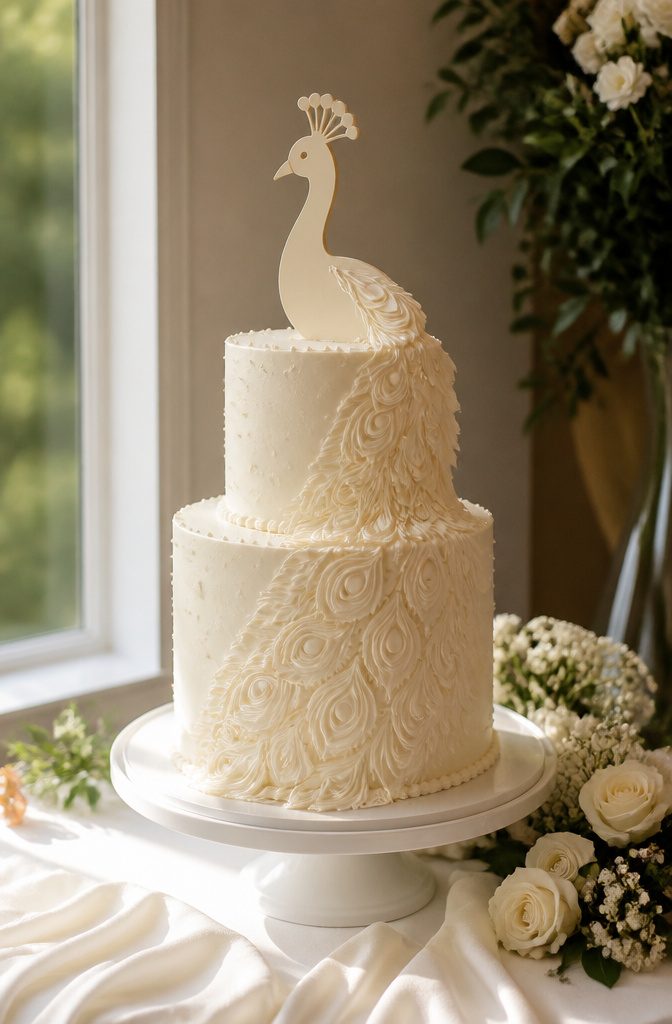
A white peacock rendered in buttercream can carry a wedding cake without eggs in the batter; trust the frosting to do the heavy lifting on detail.
The build starts with a two-tiered cake, frosted smooth, then a cardboard cutout of the peacock’s head traced and set on top.
White buttercream covers the head shape and extends into the tail, piped in fine lines down the cake sides for the feather architecture.
The flower work goes on one side only, which keeps the composition from competing with itself.
Delicate blooms in the same white palette, or a whisper of color if the wedding scheme calls for it, sit against the tail detail without crowding it.
Eggless cakes have a reputation for dryness, but a buttercream-heavy finish solves that on the fork; the fat compensates for the missing emulsifier and gives the peacock its sculptural weight.
For a client with dietary restrictions, this reads as intentional elegance rather than compromise.
The all-white treatment signals wedding formality, and the peacock motif, usually loud, becomes restrained enough for a reception table. The baker’s time goes into the piping, not into sourcing specialty ingredients.
12. Easy Peacock Cake
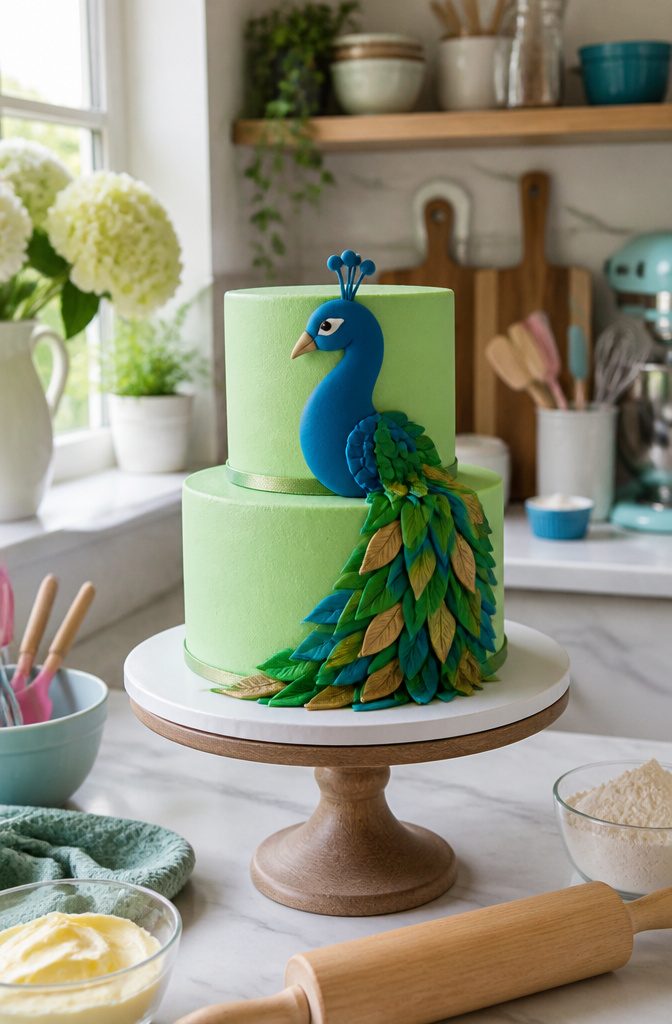
A two-tiered cake with bright green frosting is the simplest place to start if you are new to fondant work.
The peacock’s head and neck sit on top as a single fondant piece, while the tail is built from individual leaves cut with a standard leaf-shaped fondant cutter and assembled feather by feather.
You need only basic fondant tools: a cutter set, a small offset spatula, and a brush of water to seal the seams.
The tail attaches to the back of the cake and fans upward, so the structure does most of the visual work for you.
I would skip any attempt at hand-sculpted feathers at this stage; the cutter gives you clean, repeatable shapes that read as plumage from across the room.
This is the cake I would point a beginner toward first, because the procedure stays straightforward and the result still looks intentional rather than apologetic.
13. Peacock Watercolor Cake
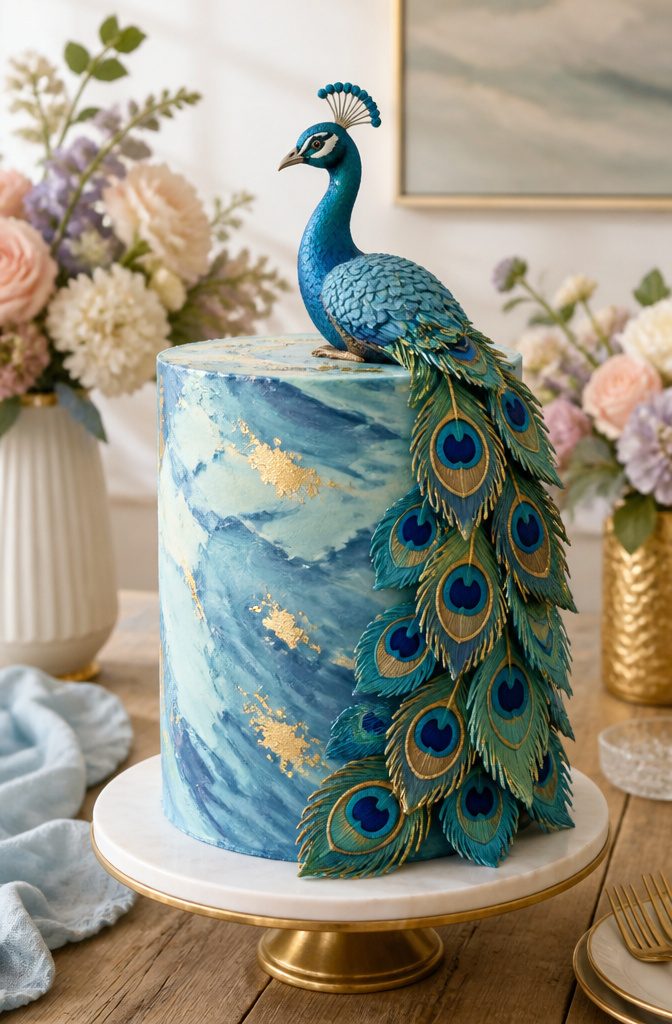
A watercolor buttercream finish gives you the marbled blue base without fondant work.
The technique is straightforward: swipe thin layers of tinted buttercream across a chilled crumb coat, letting the colors overlap at the edges so they blur together like wet paint. Chilling between layers keeps the finish smooth rather than muddy.
Start with a blue base and add a marble effect on top, then use piping tips for details and finish with a dusting of gold.
That piping is where you add texture without overcomplicating the design; a simple shell or rosette border in deep teal or emerald reads as feather detail from a few feet away.
For the peacock itself, a premade topper keeps this buildable in an afternoon. Premade peacock body-shaped toppers work well on similar designs.
Online baking supply shops and craft marketplaces carry these in food-safe resin or printed acrylic; expect to spend roughly $8–$15 for a single topper that sits at the cake edge or angles off the top tier.
The topper does the visual heavy lifting, so the buttercream underneath can stay relatively simple.
14. Shocking Fondant Peacock Cake
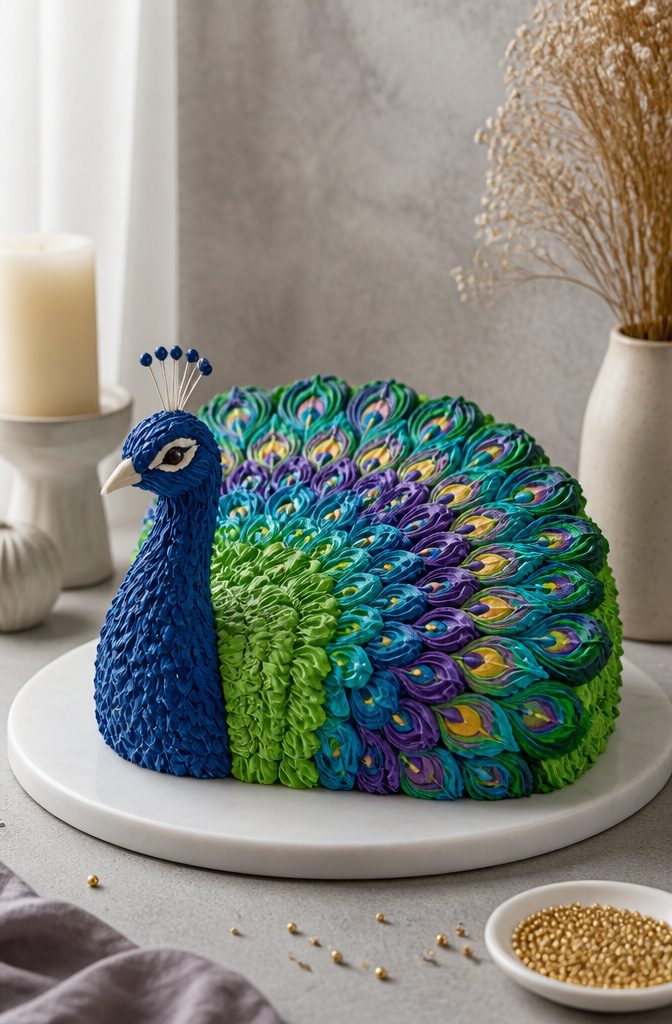
A half-round cake placed on its cut edge forms the body here, with the flat side becoming the canvas for the feathers.
The construction keeps the actual cake work minimal: one layer, one shape, and the drama comes from what you pipe on top.
Two workable approaches to the finish exist. Colorful buttercream piped with a small round tip builds the fan feather by feather, which is the lighter option if you are not confident with fondant.
Alternatively, a white base coat of buttercream can serve as ground for fondant feather details, with a separate piece of blue fondant shaped for the head and placed at the front.
I would choose the all-buttercream route for a home kitchen. It skips the fondant covering step entirely, and the small round tip is a standard piece in any basic piping set.
Buttercream feathers need steady hand pressure to keep each plume uniform; fondant gives you cleaner edges but adds a tool and a cooling step.
Golden beads and dust are optional either way, and in my view they are not worth the extra trip to the supply store unless you already keep luster dust on hand.
15. Peacock Cake Design
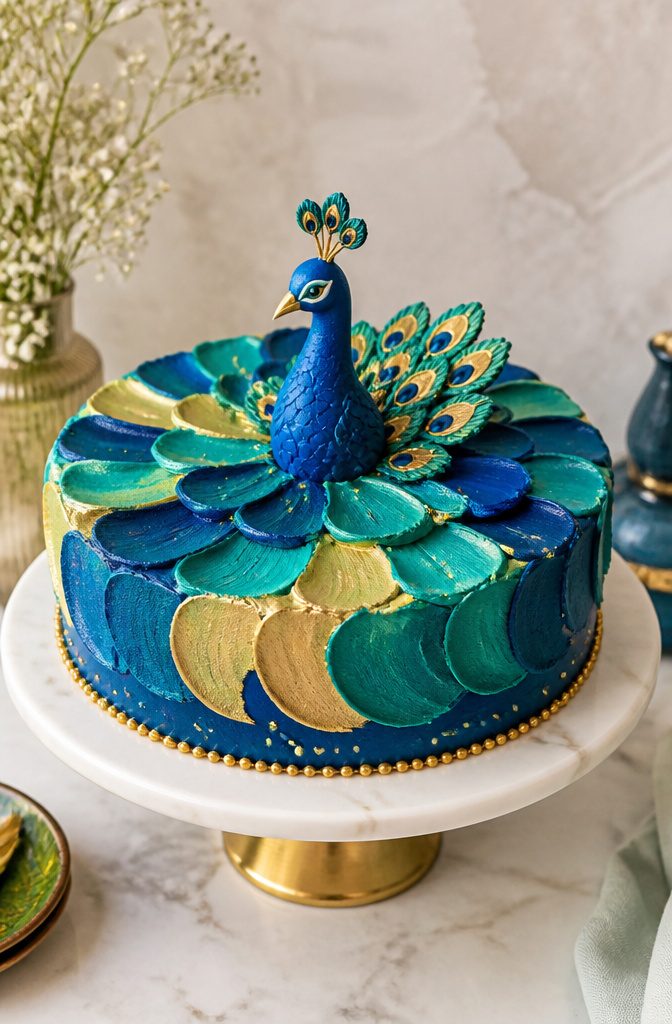
A round cake with swirling buttercream in peacock colors gives you the impact of an elaborate design without the sculpting work.
The base coat goes down first in your chosen background shade, then piping tips 1M or 2D create the signature swirl that reads instantly as peacock feather texture when you alternate deep teal, emerald, sapphire, and touches of gold.
The premade peacock body topper does the heavy lifting here. It sits at the center or cascades down one side, and the swirling buttercream around it does the rest of the storytelling.
You are not modeling fondant feathers or hand-painting iridescence; the piping carries the theme while the topper supplies the recognizable silhouette.
This approach cuts decoration time sharply. Base coat, twelve to sixteen swirls in a ring, place the topper, add a few gold accent dots, and the cake is finished.
For a weeknight celebration or a last-minute order, this is the peacock cake idea that actually fits real schedules.
16. Perfect White Peacock Cake
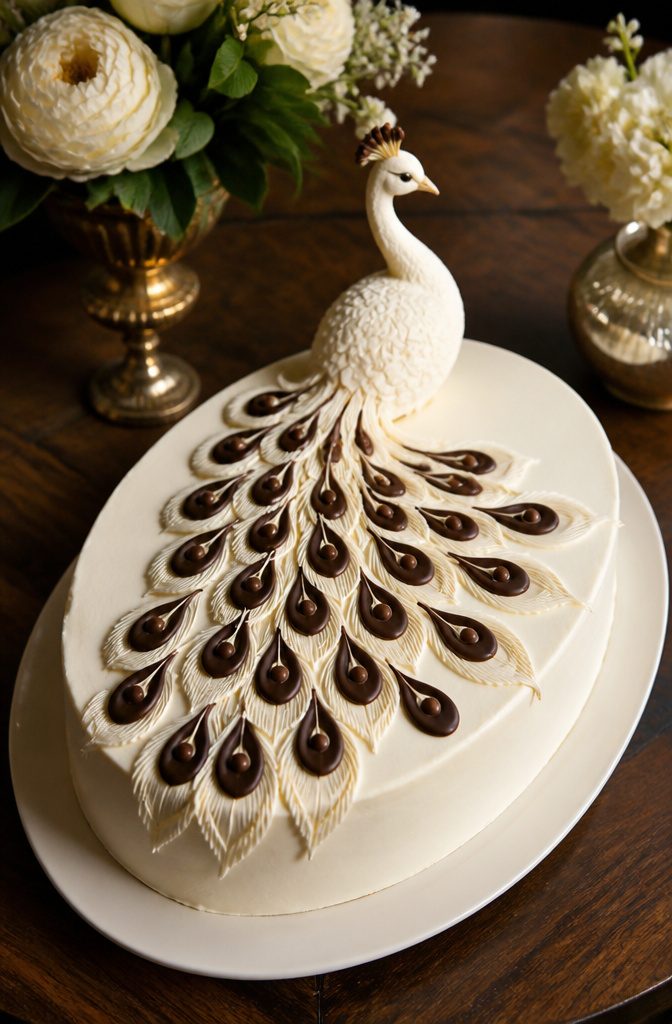
A white peacock cake reads as elegant rather than loud, which makes it the choice for weddings and formal celebrations where the bird’s shape matters more than its usual color.
The build starts with an oval cake, stacked and carved before a smooth coat of white buttercream covers every surface.
What gives this design its impact are the feathers, and they come from chocolate that you temper yourself or melt from candy coating.
Tempered chocolate sets hard and glossy, snaps cleanly, and holds fine detail if you pipe the feather shapes onto parchment and let them set.
Candy melts skip the temperature precision; they melt in the microwave, pipe the same way, and stay stable without the fuss of seeding and tabling. You get a softer bite and a slightly duller surface.
For a cake that sits out during a long reception, tempered chocolate wins on durability. For a home birthday with a quicker timeline, candy melts get you the same visual result with one less variable to manage.
The head is chocolate too, piped or molded and placed last so it does not soften against the buttercream.
Assembly happens in stages: cake first, then feathers pressed into the buttercream at angles that fan across the back and sides, the head set at the narrow end to finish the silhouette.
Decorated with lovely buttercream feathers, this cake is all a flutter!
— Wilton
Wilton’s version uses tinted batter inside for a surprise color when sliced, but the white exterior with chocolate accents is the detail that carries this design.
You get the peacock form without committing to a full palette of fondant or airbrushing, which keeps both the grocery list and the cleanup reasonable.
Color Schemes That Read as Peacock
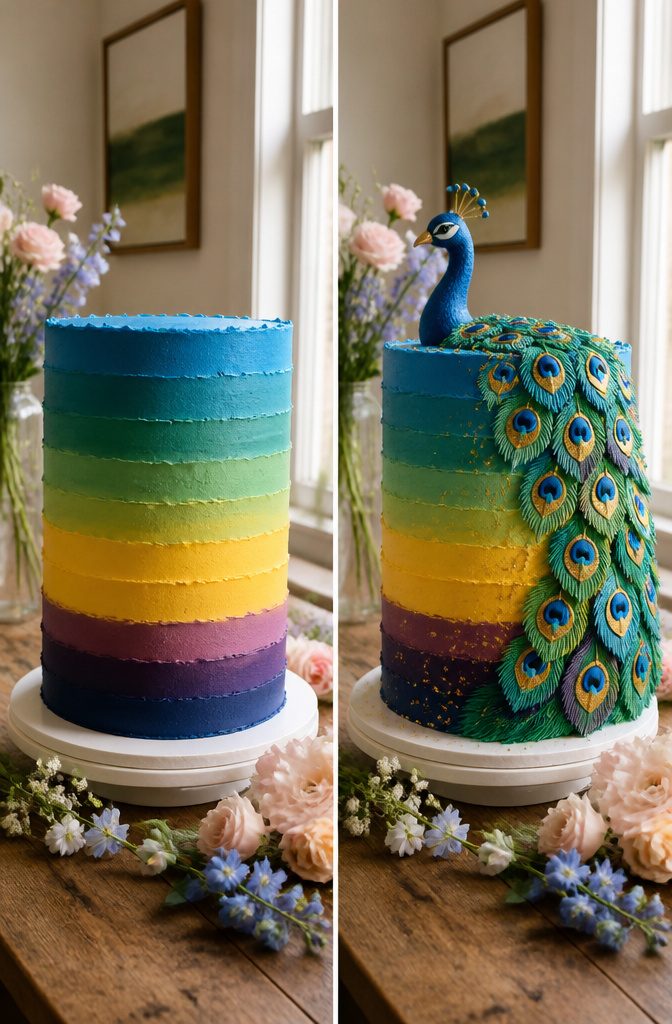
The teal, blue, green, and gold palette is what makes a peacock cake read as peacock rather than generic bird.
Wilton’s approach layers six colors in a specific order: blue, dark teal, light green, yellow, violet, and dark blue, with the dark teal made from Teal plus Kelly Green, the light green from Leaf Green plus Lemon Yellow, and the dark blue from Royal Blue with a touch of Violet.
For occasions, the full six-color spectrum suits weddings and milestone birthdays where the drama justifies the grocery-store hunt for multiple icing colors.
A child’s party or casual gathering calls for a stripped-down version: stick to teal, green, and gold, which most supermarkets stock in standard gel sets.
If violet proves hard to find, a deeper blue mixed from Royal Blue and a smaller touch of whatever purple is available reads close enough from a distance, and the gold accents do the heavy lifting anyway.
Precision fights accessibility here; I would rather see a three-color cake that gets finished than a six-color plan abandoned at the baking aisle.
Fondant or Buttercream
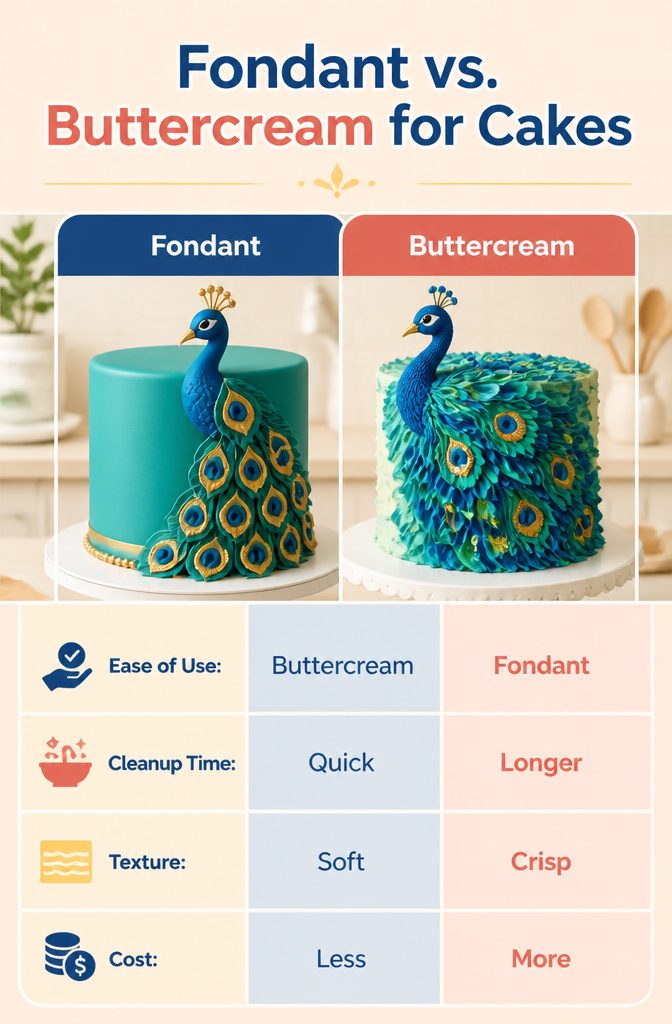
Buttercream is the better starting point if you have never covered a cake before. It forgives fingerprints, smudges, and temperature wobbles; when the peacock feather goes sideways, you scrape it off and pipe again in about thirty seconds.
Fondant asks for a steady hand, a smooth coat underneath, and a cooler kitchen than most home ovens leave behind.
Fondant gives crisp edges and colors that buttercream simply cannot hit, especially the saturated teals and metallic golds that make a peacock cake read as peacock rather than bluebird.
I reach for fondant only when the design needs flat geometric panels or standing tail feathers that hold their shape, but buttercream wins for every freehand eye-spot and ruffled plumage effect.
Cleanup differs more than prep: buttercream bowls rinse warm, fondant scrapings harden like clay and go straight to the trash.
Plan an extra five minutes of wiping if you choose fondant, plus the cost of the fondant itself, which runs roughly double a batch of Swiss meringue buttercream.
Beginners should start with buttercream, move to fondant for one statement piece per cake, and never believe anyone who says you must pick a side for the whole project.
Weddings Birthdays and What Changes
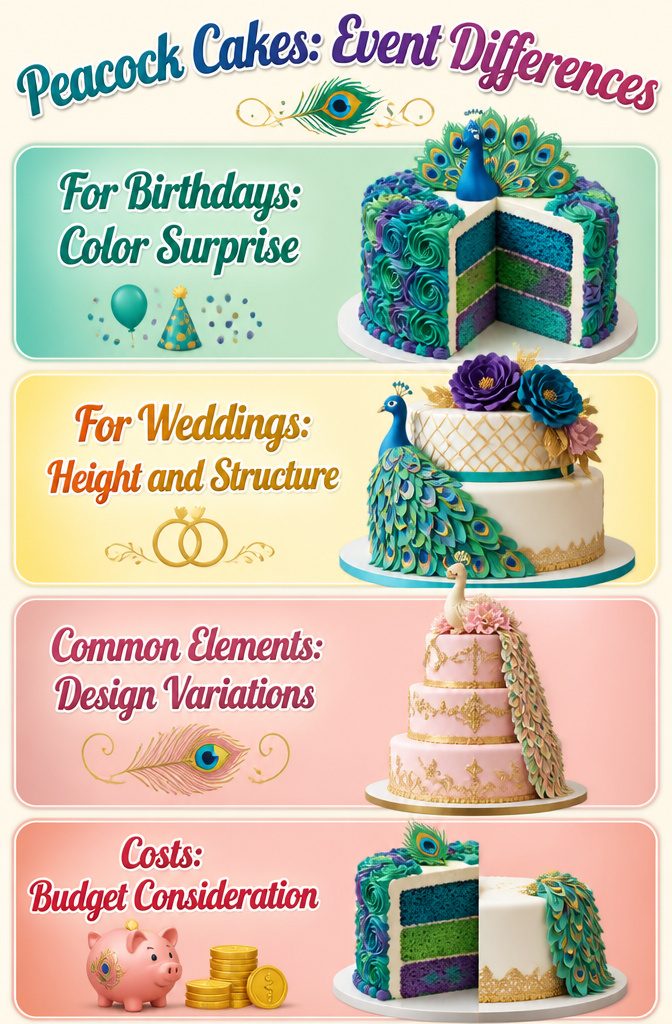
A peacock cake reads differently depending on whether the doorbell is ringing for a five-year-old’s birthday or a wedding reception.
Birthday cakes lean on color surprise: Wilton’s Pretty in Peacock approach tints the batter itself so the cut slice carries the theme inside, not just on the surface.
That move lands with kids and casual parties where the reveal matters more than architectural polish.
Weddings and spring celebrations pull the design toward structure and height.
The geometrical pattern cake builds two tiers with wafer paper flowers and layered feather pieces, finishing with fondant lace stripes. That level of detail suits a seated dinner where guests study the cake before the slice.
The fairy tale peacock cake from Highland Bakery splits the difference at four tiers, wrapping the lower three in pale-pink fondant with hand-painted gold classical designs and cascading a single tail feather down the full height.
The peacock itself is white chocolate, perched in sugar flowers on top.
That cake works for either occasion, but the carved-stone look and gold leaf read formal. I would steer the buttercream-and-tinted-batter route for a child’s party and save the fondant lace and tiered construction for the wedding table.
Sugar Flowers and Edible Decorations
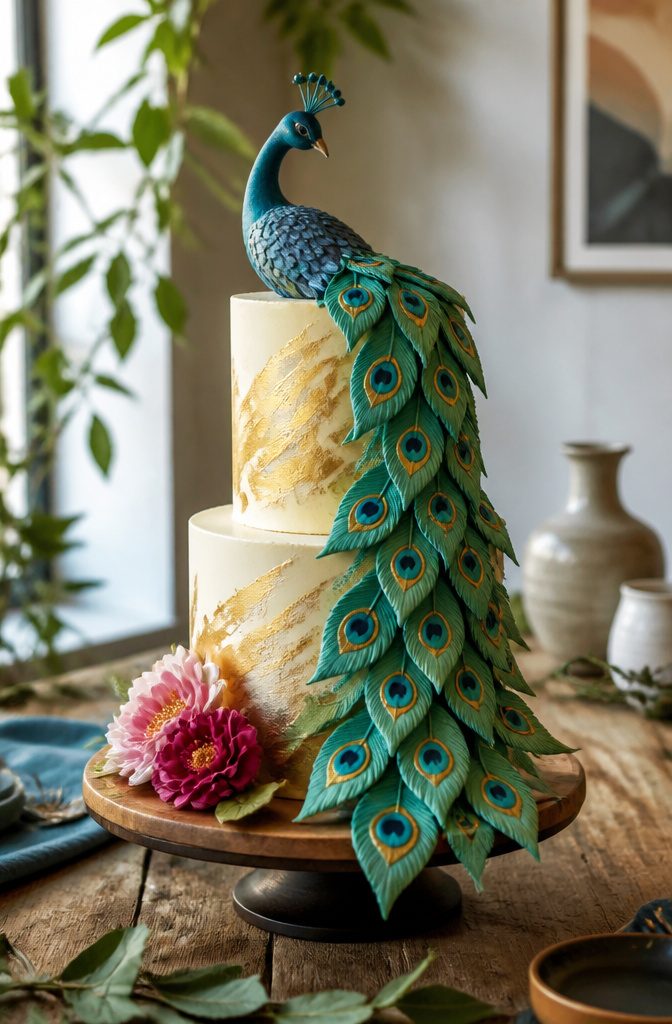
Chocolate feathers, wafer paper, and sugar flowers each solve a different problem on a peacock cake, and the choice depends on which part of the bird you are building.
Wafer paper feathers stay crisp and light for days, which matters when the tail has to stand off the cake or curve down multiple tiers.
The Highland Bakery cake used white chocolate for the peacock itself, a good move for a three-dimensional body that needs heft and a smooth surface for painted gold details.
Sugar flowers demand the most skill but give the most realistic result. The fuchsia cake layered pale-pink, fuchsia, and black petals into flowers that read as feathers from a distance and as botanically correct blooms up close.
That overlap is the point: a peacock’s train is already flower-like, so handmade sugar flowers do double duty as ornament and plumage.
Buttercream flowers, by contrast, soften and lose definition after a few hours, which is why the wedding cakes that have to sit out lean on sugar paste or gum paste instead.
For a home baker, chocolate is the most forgiving entry point.
It molds, it sets, it takes luster dust. Wafer paper sits in the middle: buy it pre-printed or paint it yourself, but know that humidity is its enemy.
Sugar flowers are not a weeknight project. Start them days ahead, or buy them from a supplier and arrange them as you would fresh flowers.
Frequently Asked Questions
What are some ideas for peacock cakes?
Designs range from simple buttercream cakes dyed in peacock colors to elaborate sculpted cakes with 3D sugar feathers.
Specific options include a six-color layered Pretty Peacock Cake, a fuchsia two-tiered design with dimensional sugar flowers, a three-tiered red-and-gold wedding cake with an oversized center tier, a five-layer classical marble-look cake with gum paste topper, a white chocolate modeling version for home bakers, and a modern geometric three-tier design with hand-drawn lines.
Beginners can start with leaf-cutter fondant feathers or swirled buttercream with a premade topper.
What occasions are peacock cakes suitable for?
Peacock cakes fit weddings, milestone birthdays, and any formal celebration where the cake needs to stand out.
The full six-color spectrum suits weddings and major birthdays where the drama justifies the effort. White peacock designs work especially well for weddings, while simpler three-color versions in teal, green, and gold match children’s parties or casual gatherings.
A Hay Day peacock cake targets kids’ birthdays specifically, and the modern geometric design appeals to couples wanting the motif without jewel-tone intensity.