Whimsical wedding cakes run from a single-tier watercolor painting to a five-tier topsy-turvy engineering project, and the deciding factor is rarely budget; it is how much structure you are willing to trust.
The watercolor style demands a baker with a steady hand and hours of brushwork, while the topsy turvy needs angled dowels and frozen cake layers carved to seat against tilted boards.
One couple held their reception at the American Museum of Natural History and let a dinosaur figurine placement against purple sugar flowers justify the whole joke.
1. Watercolor Wedding Cake
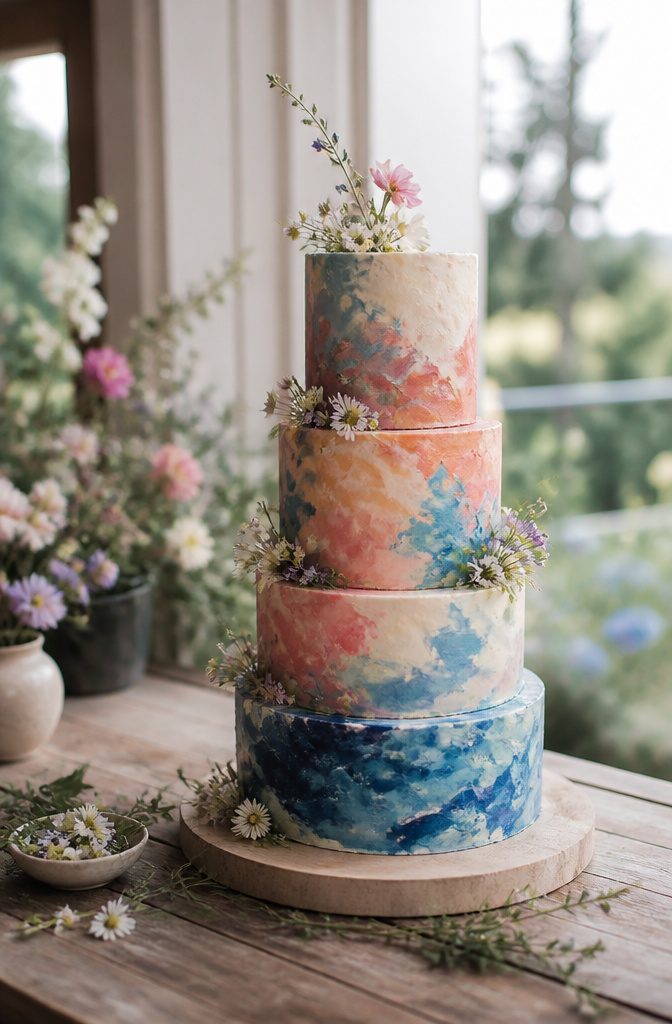
A watercolor wedding cake looks like someone set a palette of wet pigment against clean white tiers and let the colors bloom. The technique works on buttercream or fondant, though each base behaves differently.
Fondant gives you a smooth, almost paper-like surface that takes fine brushwork cleanly; buttercream stays softer and can blur edges in a way that reads more casual, more hand-finished.
Either way, the colors that hold up best are the ones with some saturation to them. Pale washes tend to look like mistakes or water damage; deeper blues, corals, or moody plums read as intentional art.
What makes this whimsical rather than formal is the looseness. The brushstrokes are visible, the edges feather and bleed, and no two tiers ever match exactly.
It is the opposite of the piped precision that says ballroom wedding. This is a hand-painted technique, and that matters for your planning.
A steady hand or a skilled baker is non-negotiable. Stencils and printed edible sheets exist, but they flatten the effect into something closer to wallpaper.
If you want the real watercolor look, you are commissioning a small painting, not ordering a finish. Budget and timeline need to account for that.
2. Gold Wedding Cake
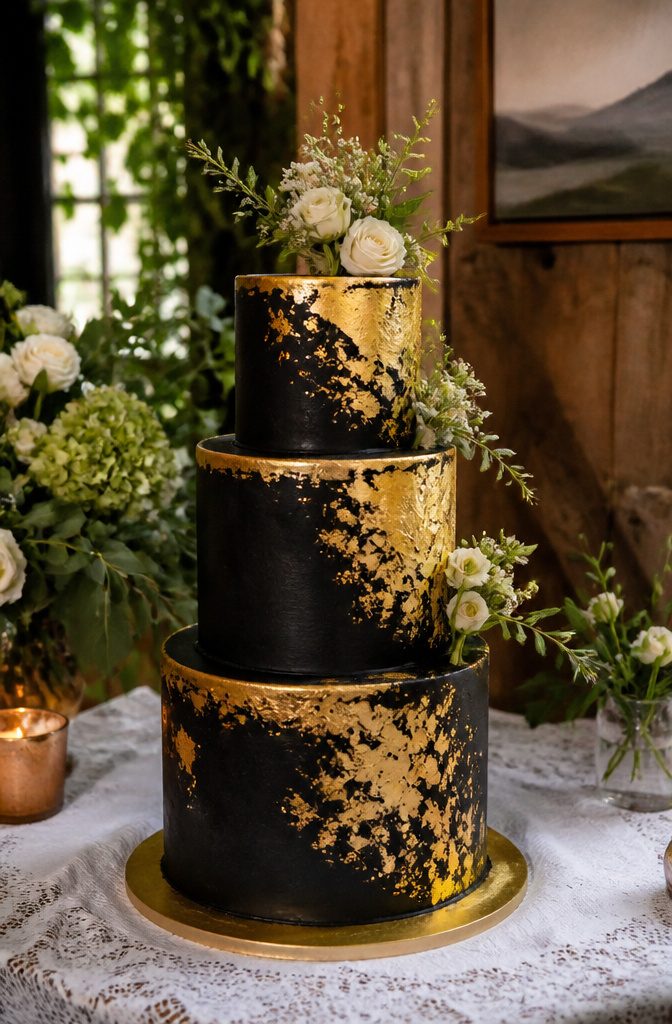
Gold leaf on a wedding cake sits closer to luxe than whimsical, though the line blurs when the application is loose and hand-painted rather than precise.
Edible gold leaf and luster dust are not interchangeable: leaf is actual gold hammered thin enough to eat, fragile and best applied in sheets or torn fragments for solid coverage; luster dust is a powder mixed with alcohol or lemon extract and painted on, the tool used for those vine details where the baker wants a brushstroke, not a mirror.
The dust reads softer, more organic, and that organic quality is what nudges it back toward whimsical territory.
A white cake with gilt designs can honor a cultural tradition, as one couple did for their Hindu and Western ceremony, or it can simply add warmth against ivory buttercream without claiming any heritage.
Black tiers with gold leaf go the other direction, dramatic and photographic, the kind of choice that dominates a reception room rather than whispering.
For a woodland theme, light green tiers with gold-painted vines and gumpaste leaves bridge both worlds: the metallic catches candlelight, the botanical shape keeps it from feeling like a display piece.
The practical limit is your baker’s steadiness. Leaf demands a still hand and dry air; luster dust forgives a small tremor and can be touched up minutes before delivery.
3. Fresh Flower Wedding Cake
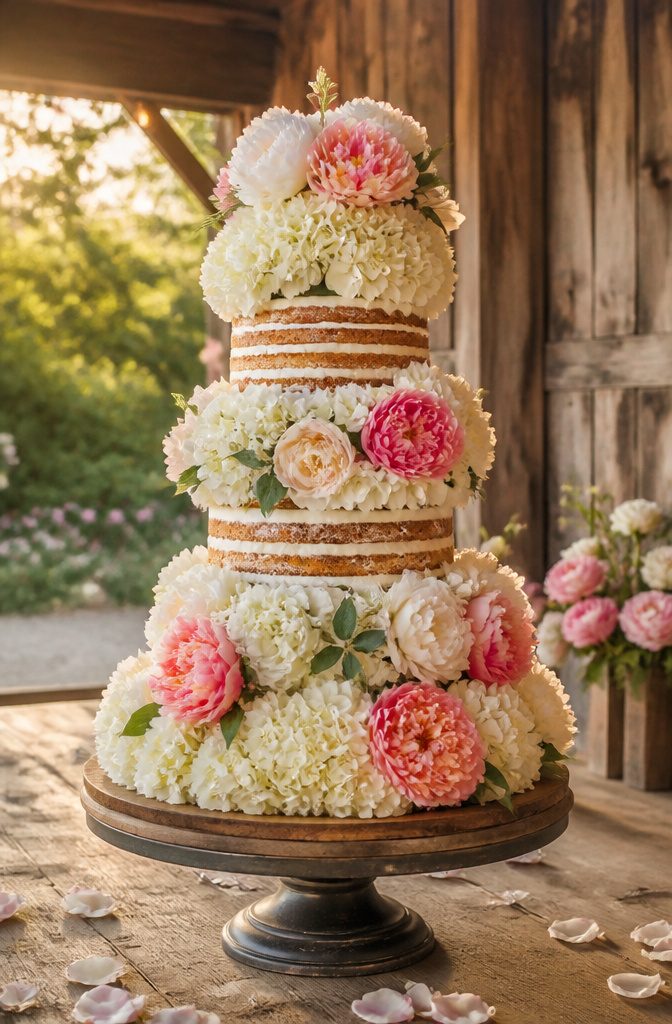
Fresh flowers on a wedding cake look effortless, but the execution is where the cake survives the day or doesn’t.
I like alternating floral tiers, ivory peonies and green hydrangea on one layer, clean fondant on the next, because the rhythm keeps the eye moving without cluttering the structure.
Roses, ranunculus, and seasonal blooms work the same way, though peonies hold their shape longest in my experience.
The safety part is non-negotiable. Only edible or food-safe flowers belong on a cake at all, and even then they never touch the frosting directly.
Florists insert them through drinking straws or flower picks pushed into the cake, then pipe a buttercream seal around the entry point.
Hydrangea and lily of the valley are toxic; so are tulips and daffodils. If your florist isn’t certain, you are eating around that section or skipping it.
Fresh flowers give you a living, imperfect beauty that sugar cannot fake, but you give up the control of knowing exactly what each petal will look like.
Organic texture wins against sugar paste every time for photographs and that just-picked mood. But a summer tent reception in San Diego heat, the kind that real wedding faced, wilts peonies in under three hours.
I would plan the cake cutting early, or accept that the last tier served may look different from the first.
4. Butterfly Wedding Cake
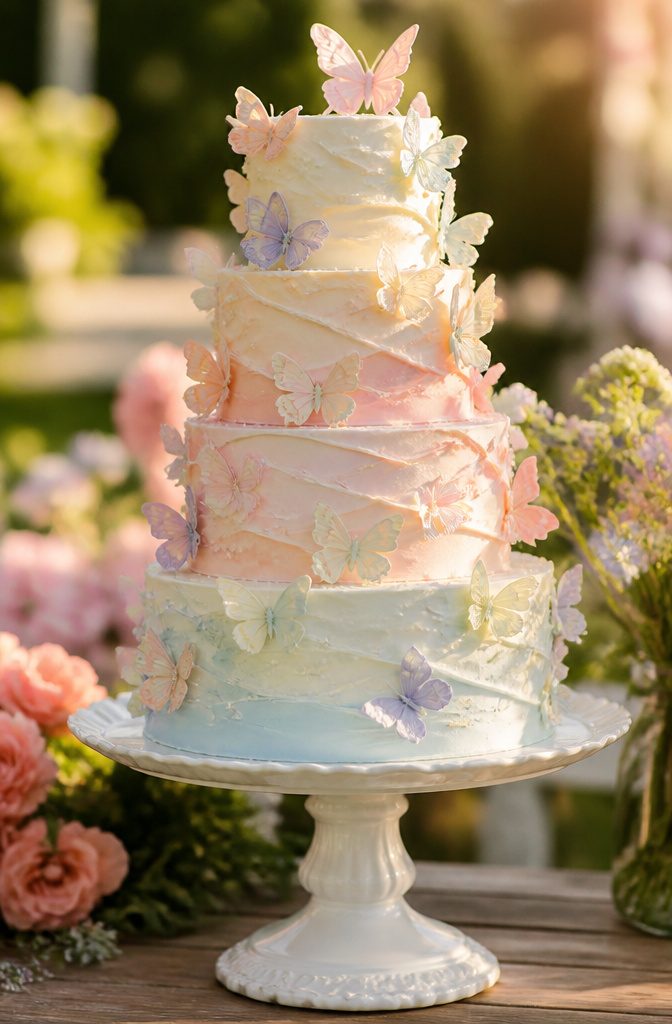
Wafer paper and rice paper both give you that slightly translucent wing you see on a real monarch, but gum paste holds a 3D curl if you want the butterfly to lift off the fondant like it just landed.
I attach them with a dot of royal icing or edible glue, nothing more, and I place them while the icing is tacky so they grip without sliding down the tier.
The 3D effect works when one or two butterflies per tier sit on a wire or a bent gum-paste body so the wings actually cast a shadow.
Flat appliqué, dozens of them marching in a line, reads more craft-store than whimsical, and past a certain density you are looking at a children’s birthday cake.
Three to five butterflies with space around them keeps the mood light and adult. I would skip any plastic picks or non-edible supports; this detail is about delicacy, and a metal stem poking through ruins it.
5. Dinosaur Wedding Cake
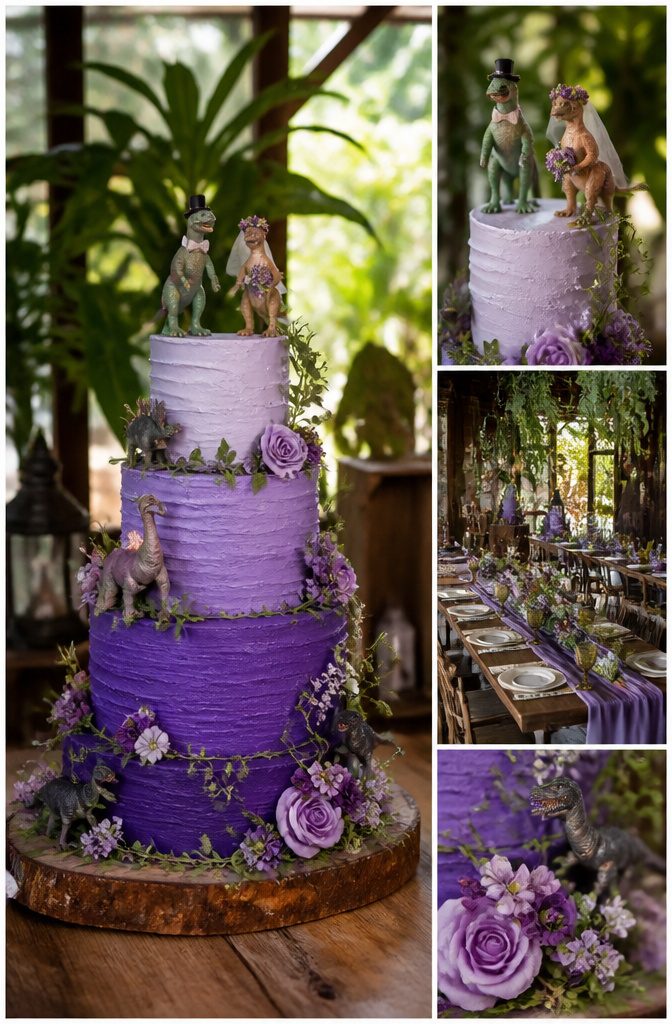
A dinosaur wedding cake lands somewhere between gallery piece and inside joke, which is exactly the appeal for couples who share a playful streak or a childhood fascination they never outgrew.
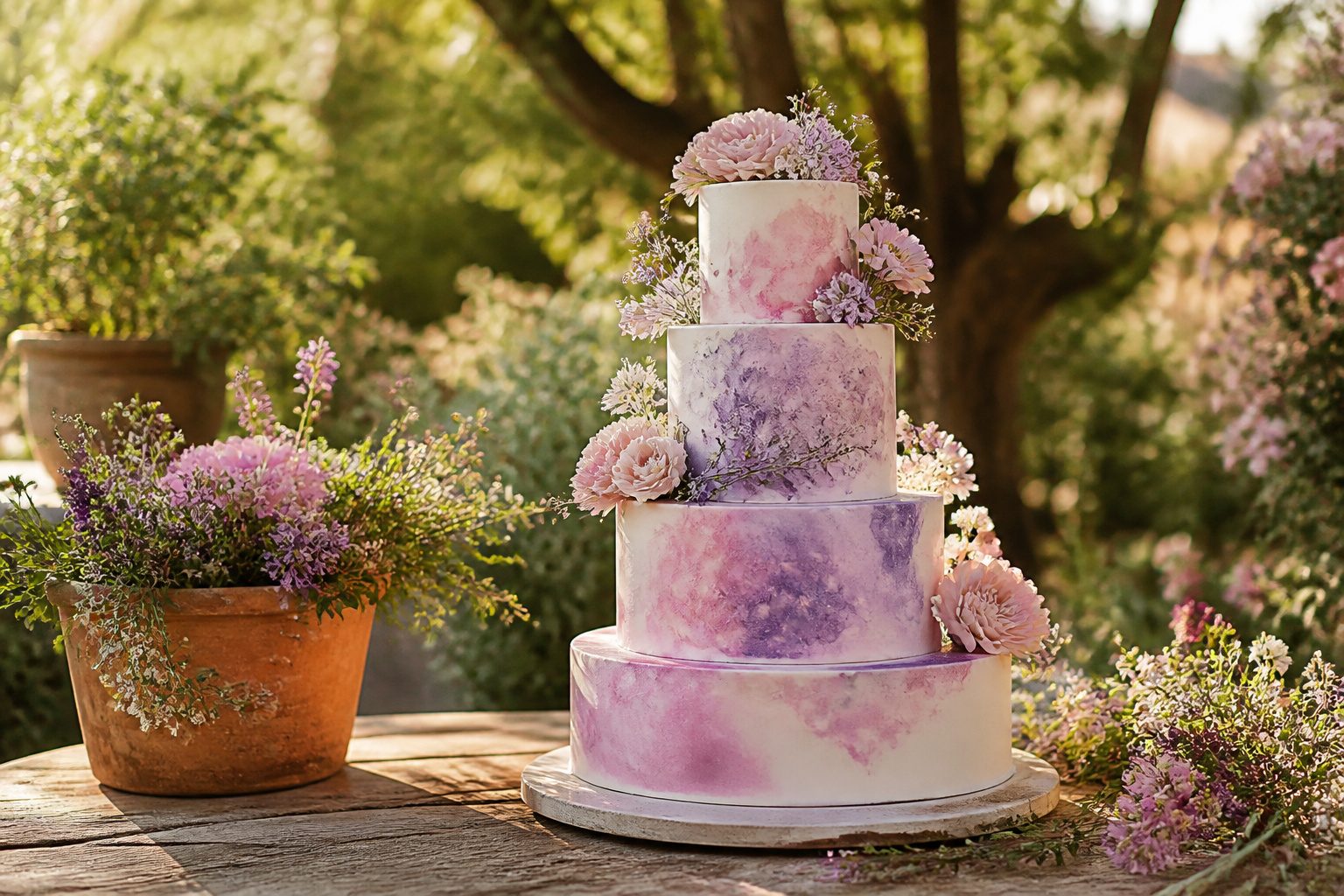
The version that works starts with tiers in shades of purple sugar flower, then sets small dinosaur figurines at the base rather than crowding every layer.
That placement matters: it keeps the eye moving upward through the floral work instead of trapping it at toy level.
The risk is birthday-party energy, and the fix is material contrast. Sugar flowers read as deliberate craft; plastic or resin dinosaurs read as found objects.
The balance wins when the figurines look like they were chosen, not scavenged — matte finish over glossy, scale that suits the tier height, colors that echo the floral palette rather than clash with it.
One couple held their reception at the American Museum of Natural History and let the setting justify the whimsy; the cake felt like a continuation of the room rather than a novelty wheeled in for laughs.
Skip numbered candles, skip primary-color frosting, skip anything that turns the cake into a backdrop for singing. The dinosaurs should look like guests who wandered in and stayed for the party.
6. Fairytale Castle Wedding Cake
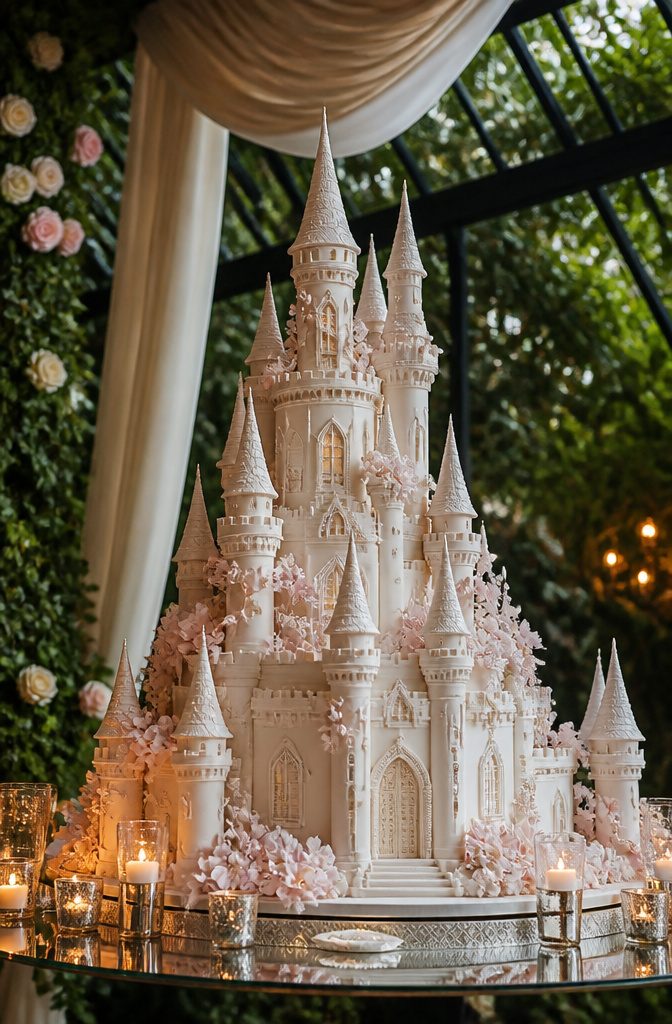
A castle cake built up from stacked tiers loses its magic if the turrets sag before the first dance.
Rice cereal treats under rolled fondant give towers their lightest possible weight, which matters because this is a cake you walk guests past rather than wheel out for slicing.
Molded sugar details hold sharper edges and catch light like real limestone, but they need dry air and a steady hand; I have watched a humidity-warped balcony crack clean off a spire by mid-afternoon.
The newer 3D-printed internal supports solve the engineering problem neatly.
Food-safe plastic armatures run through fondant shells, letting you build higher with less internal cake. Most bakers who use them wrap the supports in matching fondant so no white strut shows at a seam.
What none of these methods fix is serving. The cake inside the walls earns its keep structurally, not gastronomically; dense pound cake or even dummy tiers carry the load better than anything you would want a fork through.
If you are set on eating your castle, plan a separate sheet cake in the kitchen and let this one sit on the table as architecture.
7. Topsy Turvy Cake
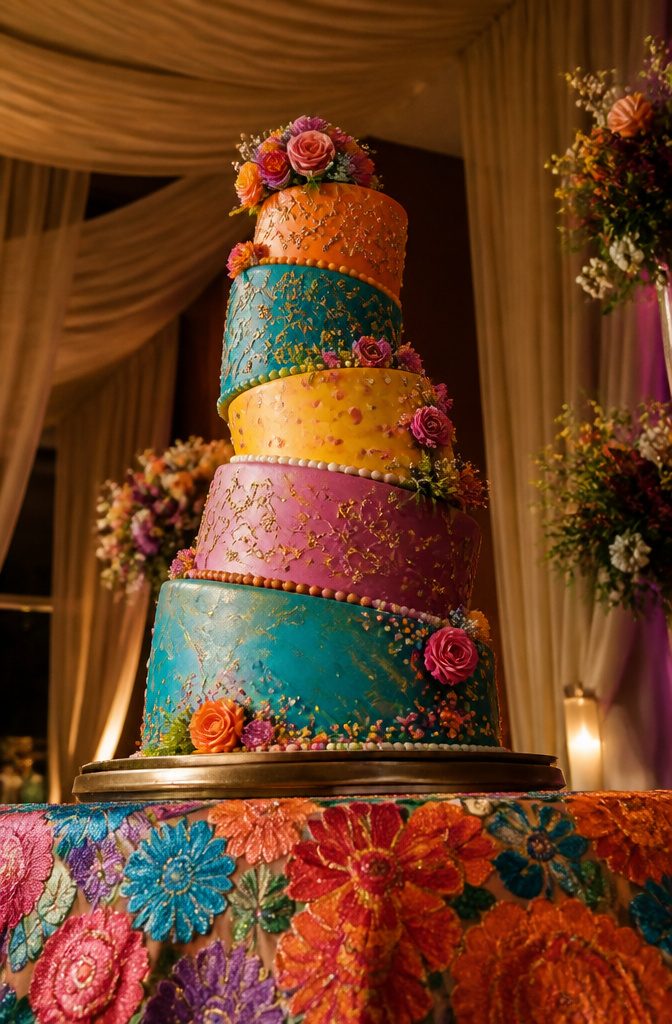
A topsy turvy cake tilts each tier deliberately off-center, so the whole stack looks like it might topple even when it is perfectly secure.
That illusion is what makes it one of the most structurally demanding whimsical styles you can attempt, even for a small cake.
The internal build starts with graduated cake boards, each one smaller than the tier it supports so the upper tier has room to cantilever.
You angle the dowels to match the tilt of the tier above, not straight down, which means every joint has to be measured against the angle of the one below it rather than a simple vertical line.
Carving the cake itself comes after the structure is set; you trim the bottom of each tier at an angle so it seats flat against the tilted board beneath it.
I would not attempt this without a solid cake base and a full set of sharpened dowels, because the offset weight multiplies stress at every joint.
The smaller the cake, the less forgiving the angles become; a two-inch error reads as charming on a tall five-tier stack and as a mistake on a single-tier mini.
For a home baker, this is the whimsical style where the decoration is almost an afterthought next to the engineering.
8. Naked Wedding Cake
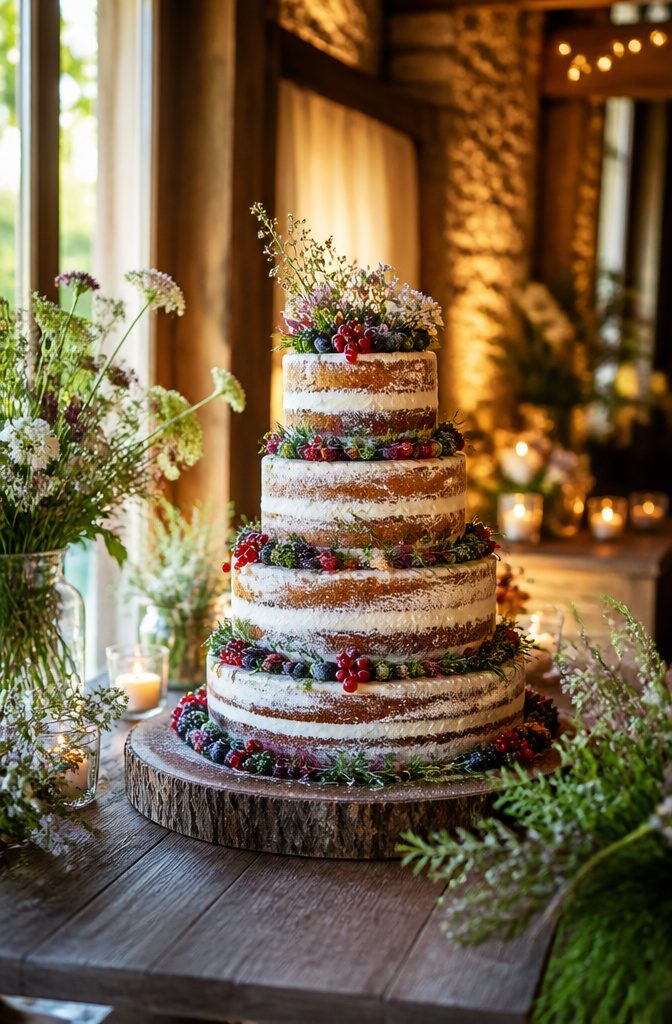
A naked wedding cake leaves the layers almost entirely exposed, with just a whisper of frosting between them.
Semi-naked takes the same idea but adds a thin veil of buttercream scraped almost to transparency, giving you that balance between rustic texture and a polished silhouette.
Both styles lean on a moist crumb recipe, since there is no thick coat of frosting to seal in moisture; bakers typically use oil-based sponges or brush layers with simple syrup to keep the cake tender through the reception.
The whimsy here lives in what you stack on top. Fresh rosemary, sage, berries, and figs turn a semi-naked cake into something that feels gathered rather than arranged, perfect for a fall wedding with deep wine tones.
Flowers give the same cake a lighter, garden-party air. Either way, this style reads as relaxed and organic, especially outdoors.
A naked cake is honest about what it is, with nowhere to hide a dry crumb or uneven layer.
Every uneven layer, every dome or crack from the oven, shows. A fully frosted cake forgives; a naked one demands a level bake and precise stacking.
If your kitchen runs warm or your timeline is tight, semi-naked forgives slightly more, that scrape of buttercream softening the edges where a truly naked cake would show every seam.
9. Rustic Wedding Cake
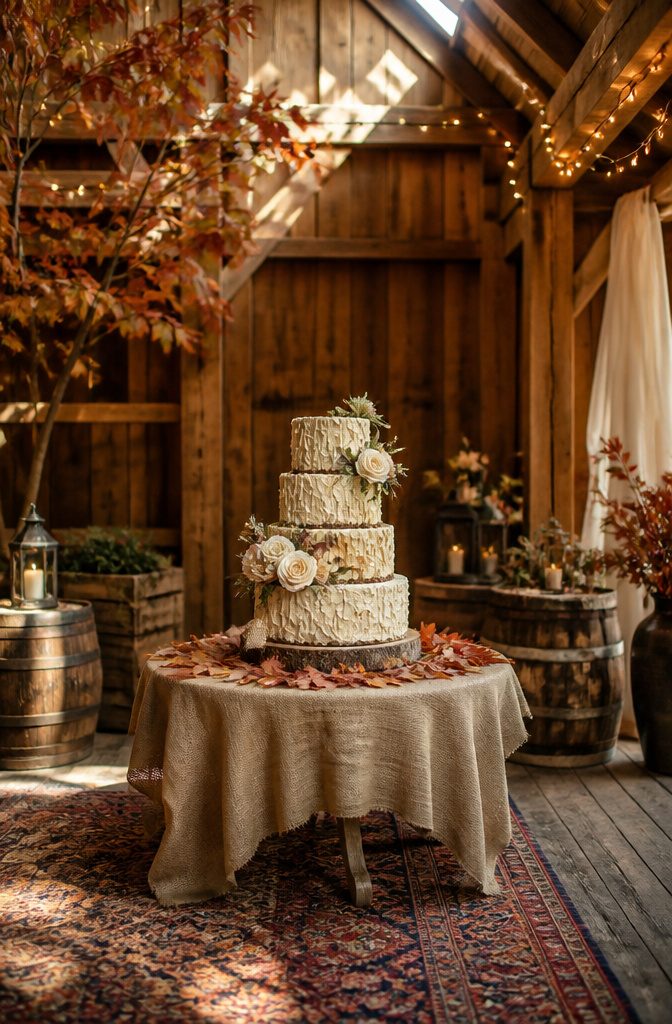
A rustic wedding cake starts with the finish you deliberately do not smooth.
Textured buttercream, raked with an offset spatula or comb, gives the surface the uneven look of plaster or tree bark. The naked or semi-naked base leaves the cake layers partially exposed, which reads as relaxed and organic rather than unfinished.
A semi-naked cake keeps just enough frosting between the layers to look polished without losing that imperfect charm, and it photographs especially well for fall weddings paired with fresh rosemary, sage, berries, or figs.
The color palette stays earthy: ivory, taupe, sage, dusty rose, the muted tones of a barn-venue afternoon.
This overlap with farmhouse aesthetics is not accidental; both share the same rejection of fondant gloss in favor of materials that look touched by hand. The imperfect finish is the point, not a flaw to hide.
For a baker at home, textured buttercream forgives more than satin-smooth fondant ever could.
A slip of the spatula adds character rather than ruins the coat. Exposed layers dry faster, so plan to assemble closer to serving than you would with a fully frosted cake.
10. Cottagecore Wedding Cake
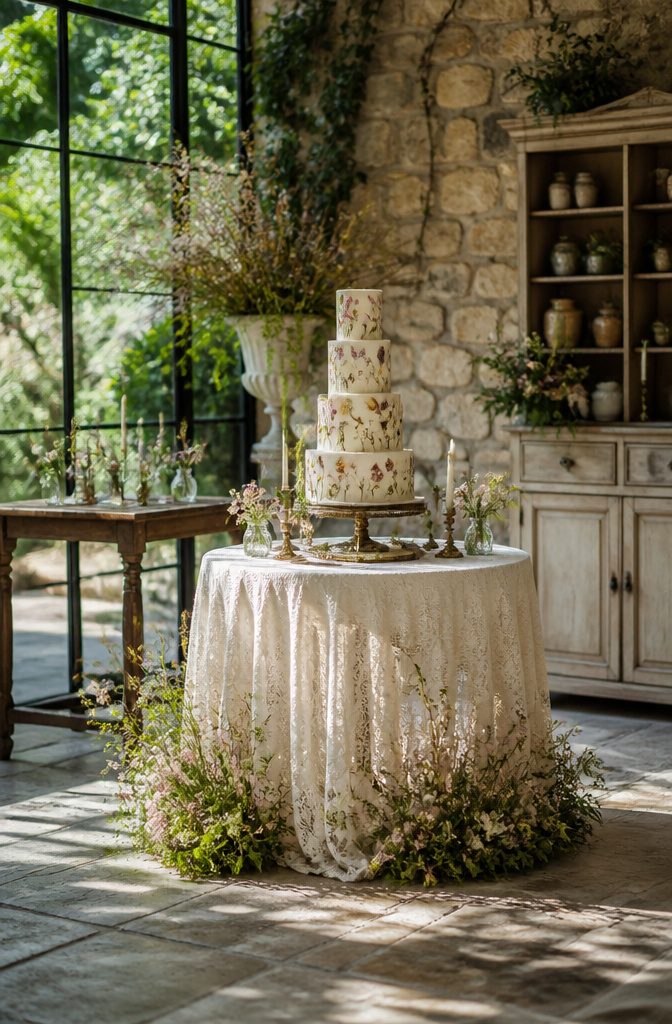
A cottagecore wedding cake leans into pressed flowers, hand-piped vines, and buttercream soft enough to look touched by hand rather than machine.
The palette stays muted, think sage, dusty rose, and cream, and the finish is matte, never glossy. Vintage cake stands, the kind you might inherit or find at a flea market, complete the look.
This style sits deliberately between two neighbors. Rustic wedding cakes let the cake show its rough edges; cottagecore polishes the same countryside references into something prettier, more intentional.
Fairytale wedding cakes go grand with spires and gold leaf; cottagecore stays modest, one or two tiers, maybe three, never reaching for spectacle.
Fresh berries and greenery work here, though buttercream and wildflowers alone carry the theme without extra produce. One couple on a budget used upside-down flowerpots as cake stands, decorating each to match their garden setting, then planted them afterward.
Another baker I noticed sources from her own garden and local farms, making her own butter and almond flour, finishing with simple buttercream and wildflowers.
The handcrafted aesthetic asks for time, either yours or your baker’s.
Hand-piped vines take longer than a smooth coat or fondant drape. That labor shows, and for this style, that is exactly what you want.
11. Celestial Wedding Cake
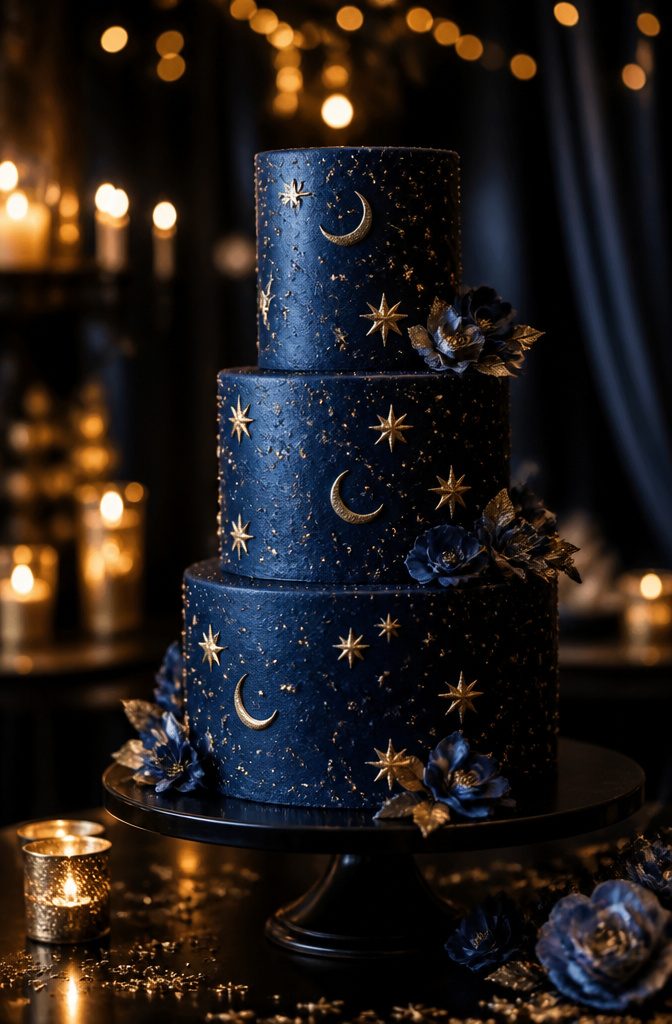
A celestial wedding cake lives or dies on its background.
Navy, black, or ivory buttercream sets the stage for gold moons and scattered stars, and the contrast is what makes the whole thing read as night sky rather than just dark cake.
Metallic hand-painting with edible luster dust catches candlelight; edible glitter adds depth without the flat shine of fondant alone. Constellation piping, done with a fine round tip and steady pressure, lets you map real star patterns or invent your own.
The color gradient matters more than most couples expect. A straight jump from navy to black looks muddy under reception fluorescents, but a slow fade through midnight blue keeps the dimension.
Buttercream handles this better than fondant; the texture catches light like oil paint, and you can build the gradient with a spatula rather than airbrushing.
Lighting at the venue is the trade-off no one mentions.
This style needs dimmer switches or uplighting to show off the metallics. Harsh overhead lighting flattens the glitter into gray, and outdoor afternoon sun washes the whole effect out.
If your reception is bright, scale the metallic details up so they survive the glare, or accept that the cake photographs best after dark.
12. Garden Wedding Cake
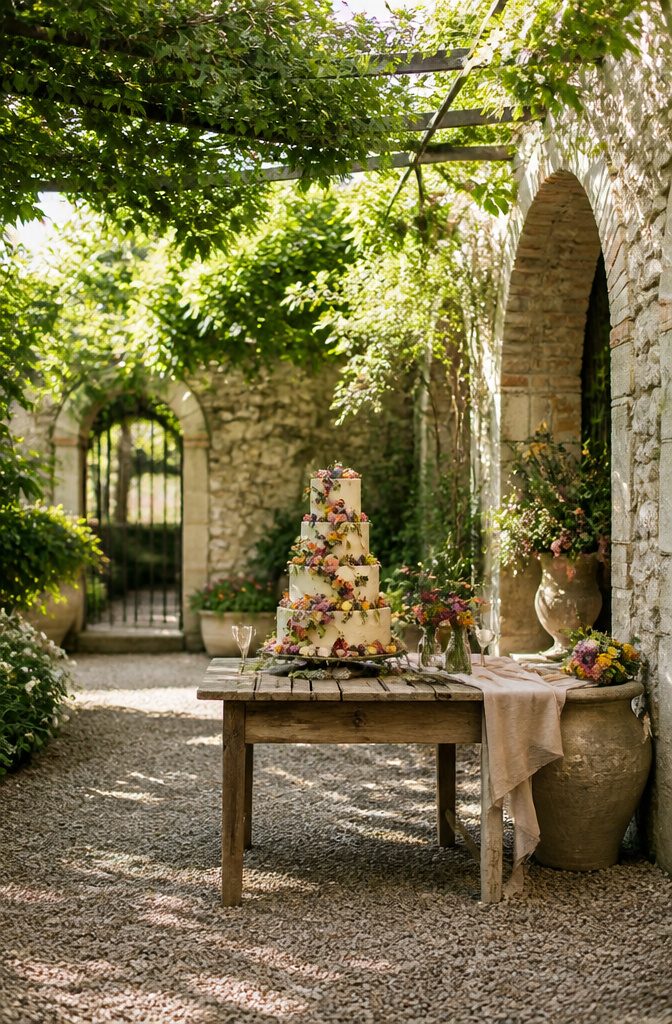
A garden wedding cake lives in the space between a fresh flower cake and something wilder.
Where a standard fresh flower arrangement might place three perfect roses at neat intervals, the garden style piles on abundance: trailing vines, unstructured placement, and enough variety that no two tiers read the same. Think meadow-gathered, not florist-delivered.
The look depends on seasonal availability, which is both the charm and the constraint.
Spring brings ranunculus and sweet peas with those ruffled, unusual petal shapes that suit the aesthetic perfectly; late summer offers dahlias and zinnias in bolder territory than blush and ivory.
Winter brides wanting this effect in December are asking for a different cake, or they need a sugar artist who can replicate the wild English garden look without the fresh stems.
Either way, you need a florist who works with food.
Not every florist understands which blooms are safe near buttercream, or how to insert stems without dragging pesticide residue through the frosting. Ask specifically about their experience with cake work; general wedding floristry does not automatically cover it.
The cake itself should be soft buttercream rather than fondant, since the slight irregularity of the finish reads as more organic against all that greenery.
13. Art Deco Wedding Cake
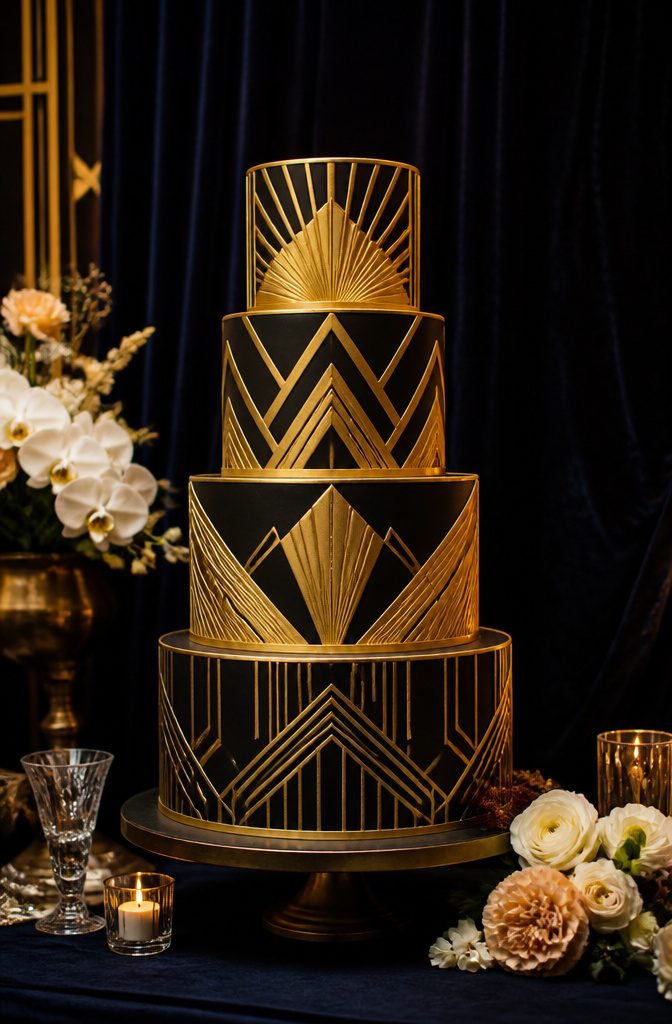
Sharp geometry carries whimsy as well as any flowing line, and an Art Deco cake proves it.
Repeating chevrons, sunbursts, and stepped tiers build a visual rhythm that feels playful precisely because every angle is calculated. The symmetry invites the eye to travel the pattern, catching something new on each pass.
The palette steers clear of soft pastels. Black and gold tiers deliver dramatic glamour through gold leaf and metallic accents that photograph sharply against dim reception lighting.
Emerald green paired with gold reads bold and luxurious, especially with minimal floral work that lets the color do the statement-making. Blush softens the look without drifting into confectionery sweetness.
What I like about this direction is its restraint as the source of surprise.
A 1920s-era fan motif in fondant, a single tier wrapped in edible mirror finish, a cascade of identical gilded triangles: each choice relies on duplication rather than variety.
The effect is confident, slightly theatrical, and genuinely unexpected at a wedding where guests have learned to expect organic swirls and watercolor washes. Art Deco geometry demands precision; there is no forgiving a wavering line or mismatched angle.
A hand-piped chevron that wobbles halfway down the tier ruins the illusion instantly, so this style demands either steady piping skills or a stencil and patience.
14. Colorful Carved Tiers
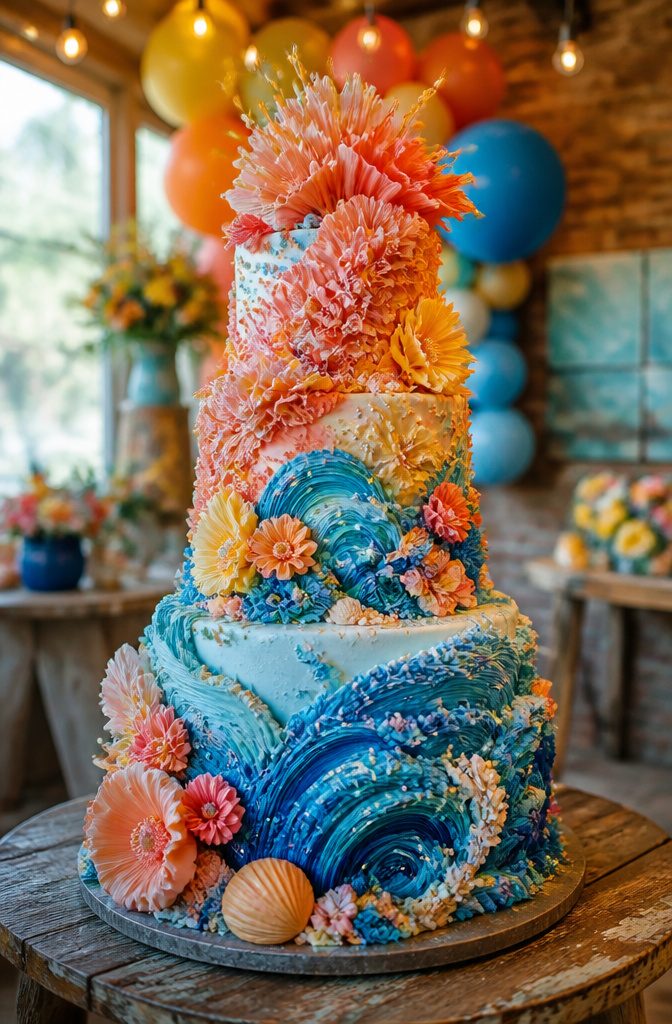
Carved tiers ask more of the baker than any smooth-stack design, and what you get is a shape that reads as sculpture first, cake second.
You start with a fully frozen layer, firm enough to survive a serrated knife without crumbling, and work from a paper template pinned to the surface.
The waste runs high: carving a sphere or teardrop from a standard cylinder can cost you a third of the cake by volume, so you bake extra or plan to serve sheet cake in the kitchen.
Color is where this style breaks from tradition entirely. Most wedding cakes whisper in ivory and blush; a carved cake in saturated coral, cobalt, or saffron announces that the palette is the point.
The fondant or buttercream has to be rolled thick enough to hide the knife marks underneath, and that extra coat adds weight the structure has to carry.
I think the look justifies the engineering, but only if the couple commits all the way. A half-measure, pastel carving, reads as a mistake rather than a choice.
15. Themed Cakes
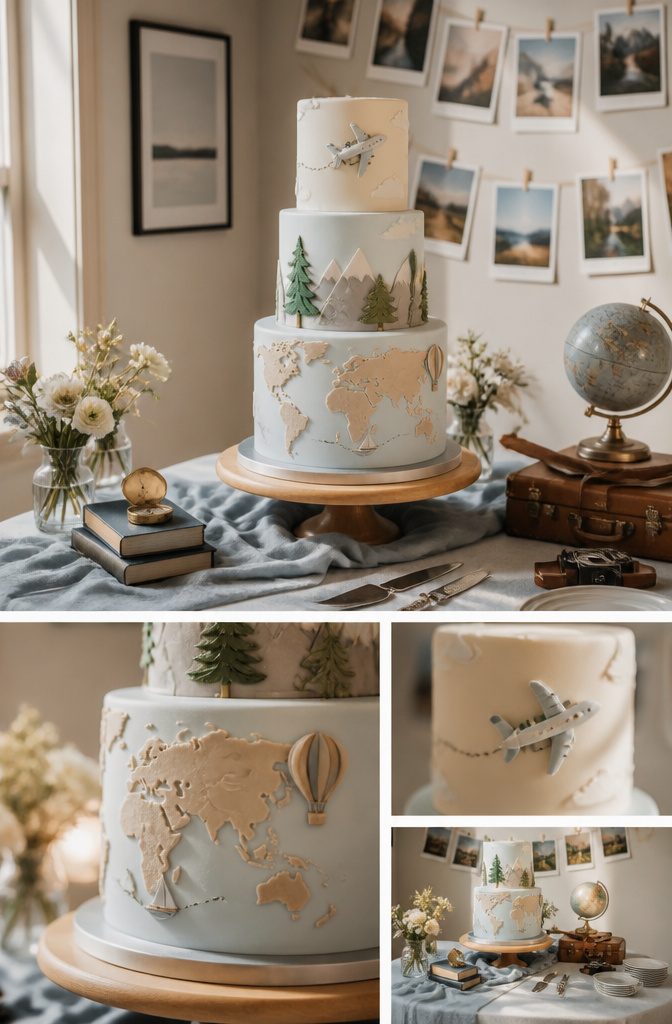
A themed cake is where the couple’s story becomes impossible to miss.
Hawaiian, theater, literature, travel, shared hobbies: the risk is always the same. Cram every reference onto three tiers and the result reads as craft project, not wedding cake.
The better move is one or two motifs, repeated with discipline.
A Hawaiian cake I studied carried just a tiki figure in modeled chocolate, a single gumpaste lei, and 3D palm fronds wired into a chocolate clay trunk. Nothing else.
No surfboards, no ukuleles, no sunset airbrush. The restraint let each element land.
The same principle held on a Chinese-themed tiered cake: dragons and painted fondant motifs, nothing more. Food coloring applied the detail; the couple’s specific request shaped the choice, but the decorator stopped before the tier became a parade.
This is where personalization becomes most explicit, and most dangerous. Two motifs give a guest something to discover.
Seven make them work for the reference. I would rather a guest ask "why the theater masks?" and hear the story than scan twenty props and absorb none of them.
What Makes a Cake Whimsical
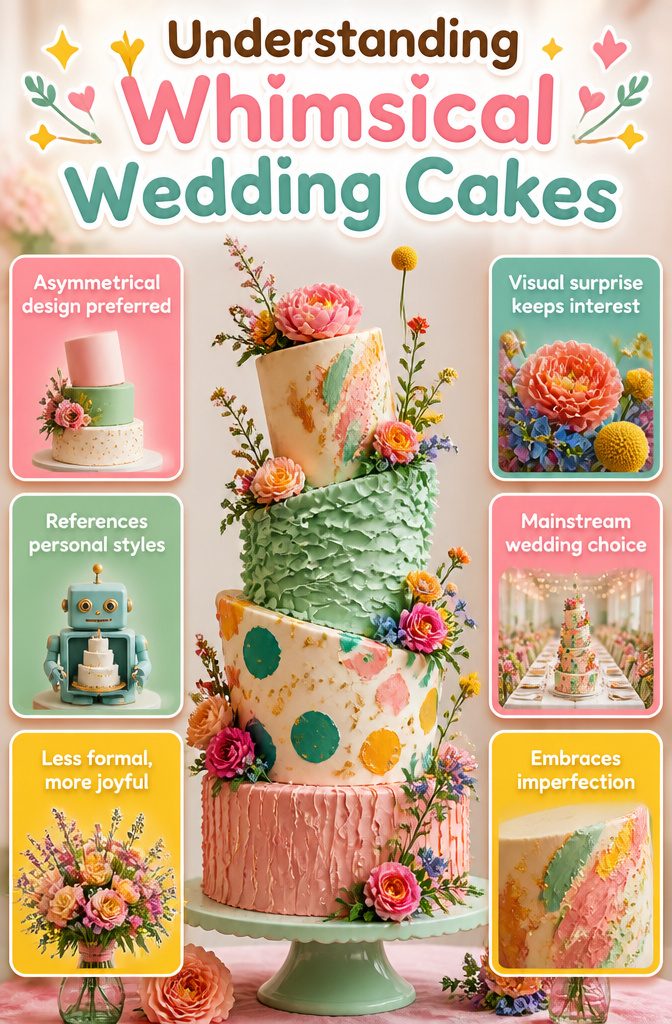
A whimsical wedding cake starts with one deliberate break from white-on-white formality. That might mean asymmetrical tiers, an unexpected color, or a shape that tilts slightly off-center.
The looseness reads as joyful rather than sloppy because every element still works together: the colors cohere, the textures balance, and the overall design holds intention.
The personal reference matters just as much. One couple, both programmers who met on Twitter, commissioned a robot cake that held a miniature white tier inside it.
The detail was specific to them, but the principle applies broadly. A whimsical cake references something the couple actually cares about, not a generic theme.
Visual surprise completes the effect.
Wild, dramatic stems, ruffled petals, or bold color shifts keep the eye moving. These cakes embrace imperfection and asymmetry, the opposite of the rigid, controlled designs that dominated weddings for decades.
That shift in wedding culture is now mainstream rather than alternative.
Even with minimalist trends persisting and Pantone selecting a shade of white as color of the year, couples still want something that feels alive and personal. The whimsical approach answers that directly: less neutral showroom, more overflowing garden.
Flowers: Fresh, Sugar, or Something Else
Flowers on whimsical wedding cakes fall into three camps, and the choice shapes both the look and the logistics of the day. Fresh blooms bring real fragrance and that slightly imperfect, just-picked quality that reads as wild rather than manufactured.
Sugar flowers trade that spontaneity for permanence: they will not wilt in August heat, and they hold detail like the paper-thin crinkled petals and dark centers of a poppy far better than anything living.
Wafer paper and gum paste sit in between, lighter than sugar and delicate enough for oversized blooms that seem almost impossibly realistic, though they lack the depth of well-made sugar work.
Cost and food safety pull the decision in different directions. Fresh flowers require a florist who knows which stems are food-safe and which have been treated with chemicals unfit for a cake; even then, they are a same-day commitment.
Sugar flowers take hours of handwork and cost accordingly, but they keep indefinitely. Wafer paper flowers cost less than sugar and travel well, though they can feel more fragile to the touch.
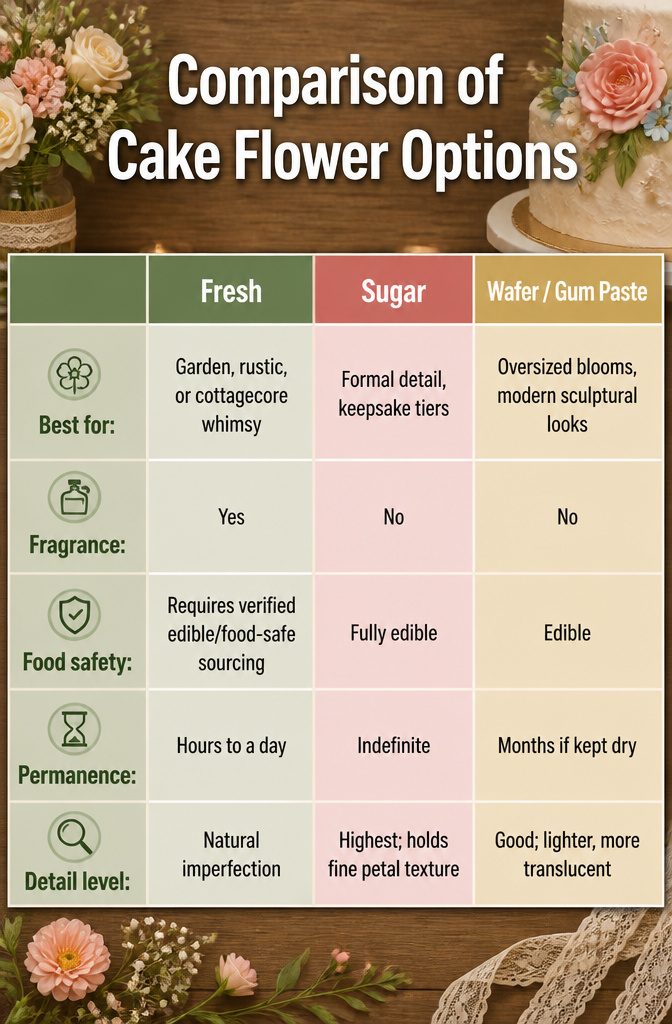
| Fresh | Sugar | Wafer / Gum Paste | |
|---|---|---|---|
| Best for | Garden, rustic, or cottagecore whimsy | Formal detail, keepsake tiers | Oversized blooms, modern sculptural looks |
| Fragrance | Yes | No | No |
| Food safety | Requires verified edible/food-safe sourcing | Fully edible | Edible |
| Permanence | Hours to a day | Indefinite | Months if kept dry |
| Detail level | Natural imperfection | Highest; holds fine petal texture | Good; lighter, more translucent |
For a whimsical cake, I lean fresh when the whole event is outdoors and the vibe is meant to feel gathered rather than arranged.
Fresh flowers mean giving up control and adding a task to the day-of timeline. Sugar wins if you want the cake to become a keepsake, or if the design depends on a specific bloom out of season.
Wafer paper is the practical middle ground, especially for the bold, oversized florals that suit a more modern whimsical style, but it reads as slightly less lush up close.
Techniques Worth Knowing
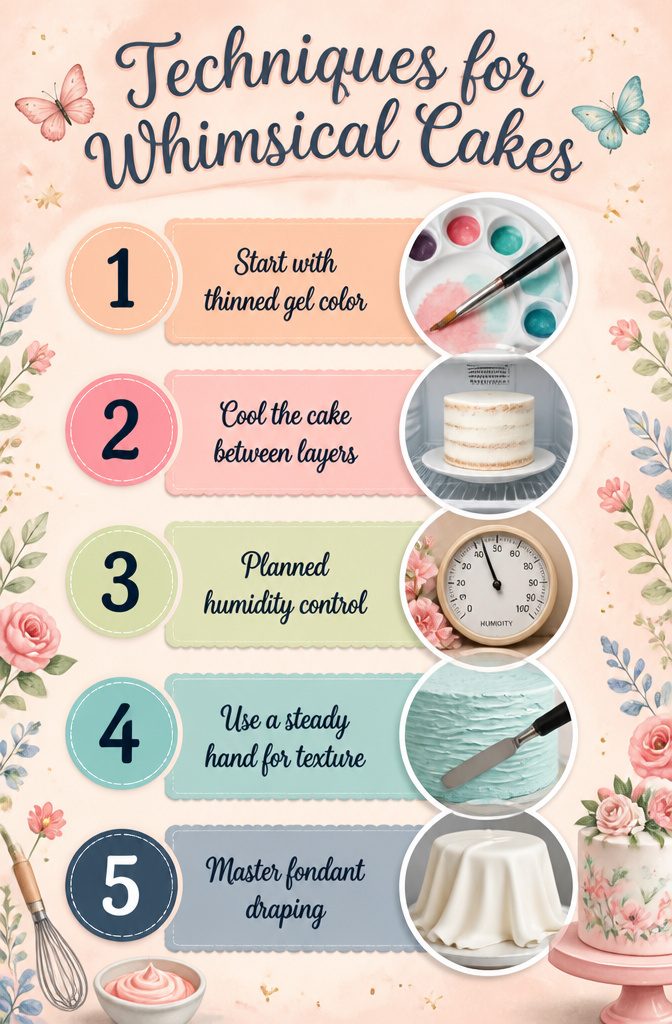
Watercolor painting on buttercream or fondant starts with gel color thinned to the consistency of, well, water. The technique migrated from cake competitions to wedding tables after decorators proved it could hold on chilled surfaces without bleeding.
A home baker can manage this with a clean brush and patience, though the cake needs to sit cold between layers so colors do not muddy.
Sugar sculpting, by contrast, demands a controlled environment.
Humidity above 50 percent turns gumpaste scabiosa or any pincushion-centered flower into a wilted mess, and the tools for pulling petals thin enough to read as real run past what most of us keep in a junk drawer.
The same competitive circuit that popularized watercolor also pioneered these botanicals, but the skill ceiling is real.
Buttercream texturing sits in the middle.
A palette knife and a steady hand create the ridges and soft movement that read as handcrafted without reading as sloppy. No specialty equipment, no climate control, just the willingness to stop before you overwork the surface.
Fondant draping and carved tiers fall to the pro side. Draping requires fondant rolled to an evenness that a pin and mat rarely achieve at home; carving needs internal supports most home kitchens do not stock.
I would attempt watercolor or textured buttercream for a small wedding. For sugar scabiosa or a gravity-defying shape, I would call the person whose living room is not also their prep space.
Building Your Own Theme
The biggest mistake I see with whimsical wedding cakes is collecting too many references.
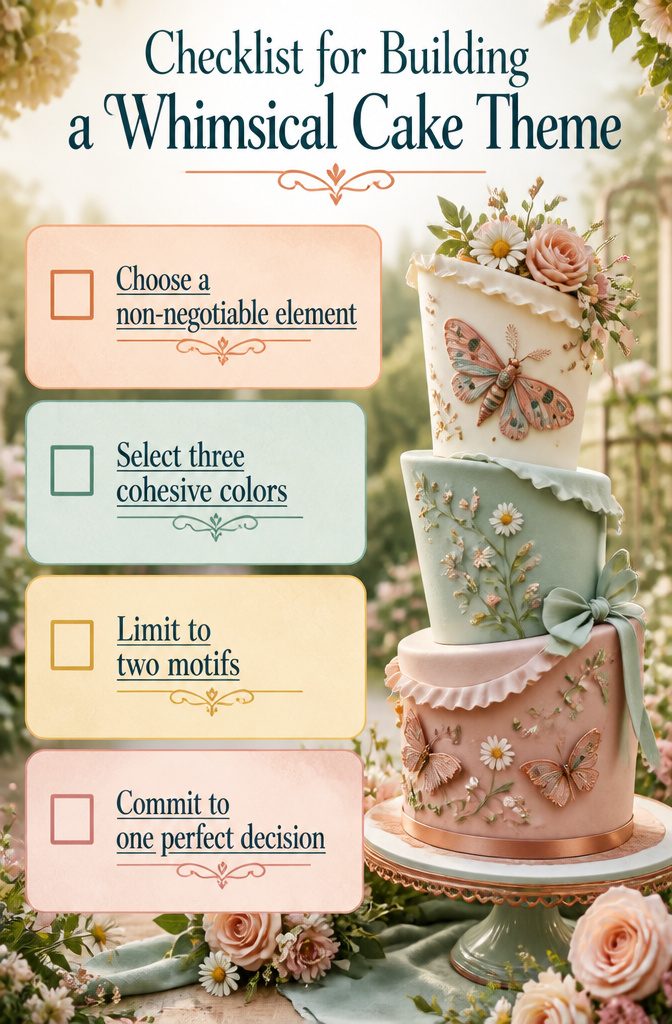
A Pinterest board with fifty pins looks like research, but it is usually just indecision wearing a costume. Pick one non-negotiable element first.
Maybe it is a hand-painted moth, a cascade of sugar daisies, or a tier that tilts like a topsy-turvy stack. That single choice becomes the anchor everything else answers to.
From there, lock in three colors and no more.
Two of them should be the workhorses, appearing in the fondant, the ribbon, the base details. The third color arrives only in small, deliberate flashes, maybe the moth’s wing spots or the daisy centers.
Two motifs is the ceiling. A third motif dilutes the first two and turns "whimsical" into "cluttered."
I would rather see a cake with one strange, perfect decision than a cake that tried to include every pretty thing the baker saw that month.
The couple who commits to sugar butterflies and nothing else, carried out in dusty rose, cream, and a single thread of copper, ends up with something coherent.
The couple who also wants watercolor, also wants gold leaf, also wants fresh figs, gets a cake that reads as anxious.
One strong move reads as confidence. That is the whole difference.
Frequently Asked Questions
What are some unique wedding cake ideas?
Watercolor designs, topsy-turvy tiers, dinosaur figurines paired with sugar flowers, celestial night-sky effects, and carved sculptural shapes in bold colors all make for distinctive choices.
Each breaks from the standard white-on-white formality through one deliberate visual surprise, whether that is asymmetry, unexpected color, or a personal reference like a shared hobby.
How can I personalize my wedding cake?
Pick one or two motifs that actually matter to you, then repeat them with discipline rather than crowding every reference onto the tiers.
A couple who met on Twitter commissioned a robot cake holding a miniature white tier inside; a pair who married at the American Museum of Natural History used small dinosaur figurines that felt like part of the room rather than a novelty prop.
The specificity is what makes it yours.
What materials are used for whimsical wedding cakes?
Buttercream and fondant serve as the two main finishes, with fondant giving a smoother surface for fine brushwork and buttercream reading more casual and hand-finished.
Edible gold leaf, luster dust, wafer paper, rice paper, gum paste, royal icing, and fresh or sugar flowers all appear as decorative elements.
Internal supports like angled dowels, graduated boards, or food-safe plastic armatures handle structural demands for tilted or tall designs.
What is the new trend in wedding cakes?
Whimsical garden aesthetics with wild, romantic, and unexpected flowers are dominating 2026 wedding planning.
Brides are asking for texture, movement, and depth in cascading arrangements rather than neat, symmetrical placement. The look pairs with soft buttercream, muted palettes like sage and dusty rose, and vintage or handmade stands.
What does a whimsical wedding mean?
A whimsical wedding prioritizes personality and imagination over rigid tradition, letting the couple’s actual tastes shape the event.
For the cake specifically, that means one deliberate break from formality, an element of visual surprise, and a handcrafted feel that reads as joyful rather than sloppy.
Slightly off-balance layers, rich colors, and imaginative shapes all fit, provided the colors cohere and the design holds intention.
What does “whimsical cake” mean?
A whimsical cake embraces imperfection and asymmetry while still maintaining coherence across color, texture, and overall design.
It references something the couple cares about, includes at least one unexpected element, and keeps the eye moving through wild stems, ruffled petals, or bold shifts. The effect is alive and personal rather than neutral and showroom-perfect.
What are the trends for wedding cakes in 2026?
Garden-inspired whimsy leads, with brides requesting flowers that feel gathered rather than arranged: butterfly ranunculus, cascading sugar blooms, and seasonal varieties with unusual petal shapes.
Cottagecore and enchanted forest details like moss textures, mushrooms, and natural woodland elements run alongside this. The overall direction favors soft buttercream, matte finishes, and handmade or vintage presentation over glossy fondant and rigid geometry.