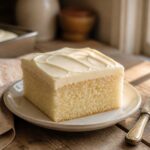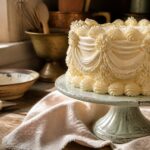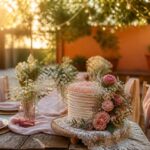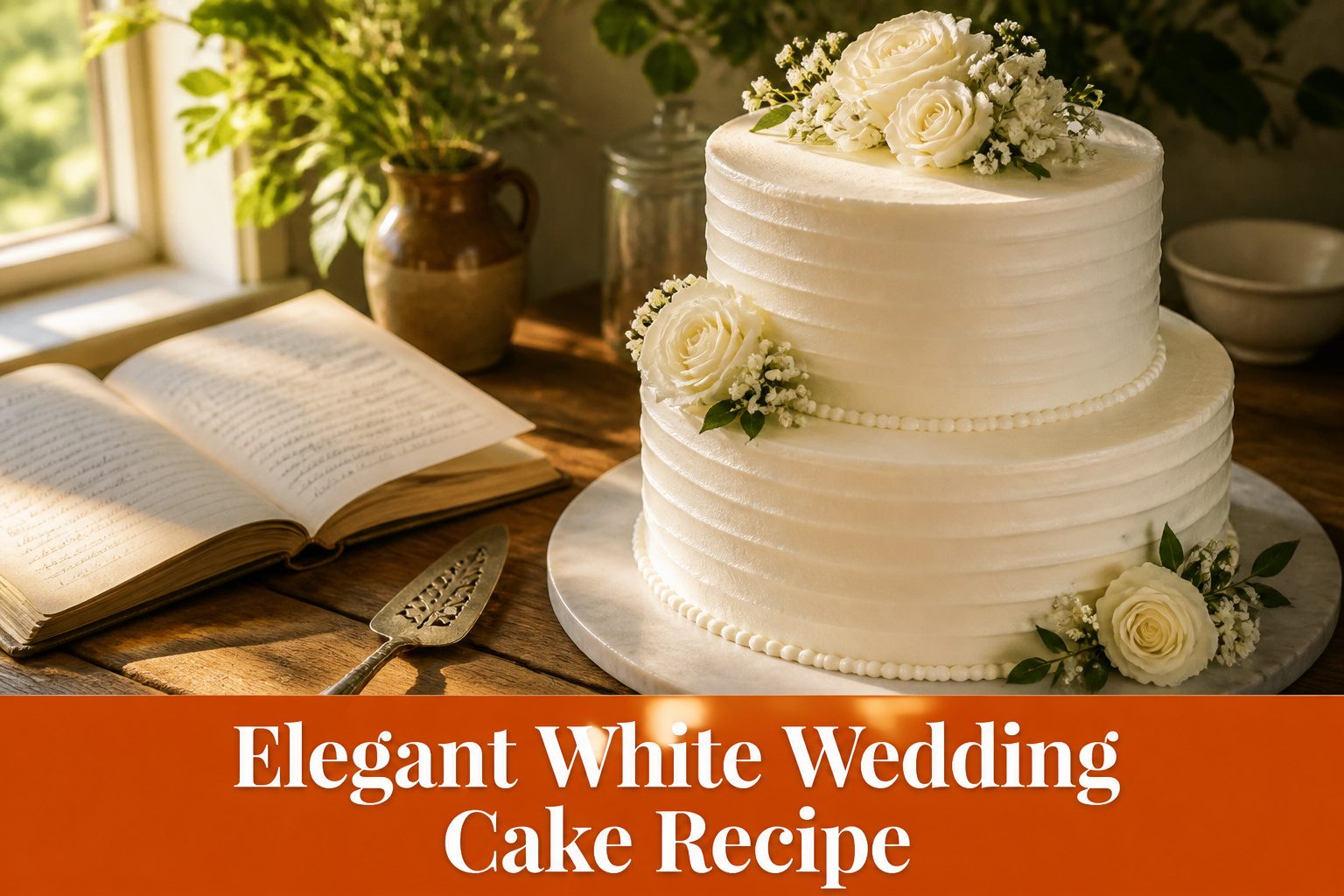
This white wedding cake tastes like vanilla and butter with a tight, moist crumb that holds up under tiers.
The difference is a doctored box mix: 15.25 ounces exactly, plus flour, sour cream, and egg whites to build density without weighing you down. Total time runs about four hours, not counting cooling.
Scaling is the hard part.
One batch yields 6½ to 7 cups, enough for a single tier; you will need to triple it for a standard 6-8-10 inch stack and make half again more buttercream than the base recipe gives, or the finish goes thin at the crumb coat.
Ingredients
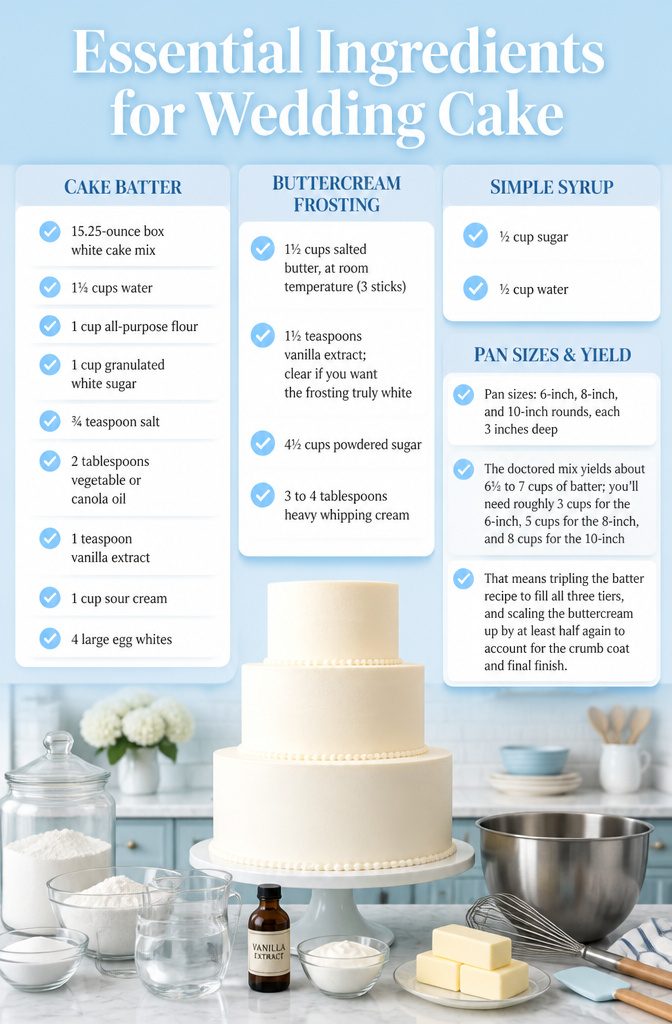
A doctored white cake mix gives this tiered build the density and crumb it needs without the fuss of measuring flour and leavening from scratch. The box size matters: 15.25 ounces, not the newer downsized versions some brands have moved to.
For the cake batter:
- One 15.25-ounce box white cake mix
- 1⅓ cups water
- 1 cup all-purpose flour
- 1 cup granulated white sugar
- ¾ teaspoon salt
- 2 tablespoons vegetable or canola oil
- 1 teaspoon vanilla extract
- 1 cup sour cream
- 4 large egg whites
For the buttercream:
- 1½ cups salted butter, at room temperature (3 sticks)
- 1½ teaspoons vanilla extract; clear if you want the frosting truly white
- 4½ cups powdered sugar
- 3 to 4 tablespoons heavy whipping cream
For the simple syrup:
- ½ cup sugar
- ½ cup water
Pan sizes: 6-inch, 8-inch, and 10-inch rounds, each 3 inches deep. The doctored mix yields about 6½ to 7 cups of batter; you’ll need roughly 3 cups for the 6-inch, 5 cups for the 8-inch, and 8 cups for the 10-inch.
That means tripling the batter recipe to fill all three tiers, and scaling the buttercream up by at least half again to account for the crumb coat and final finish.
Method
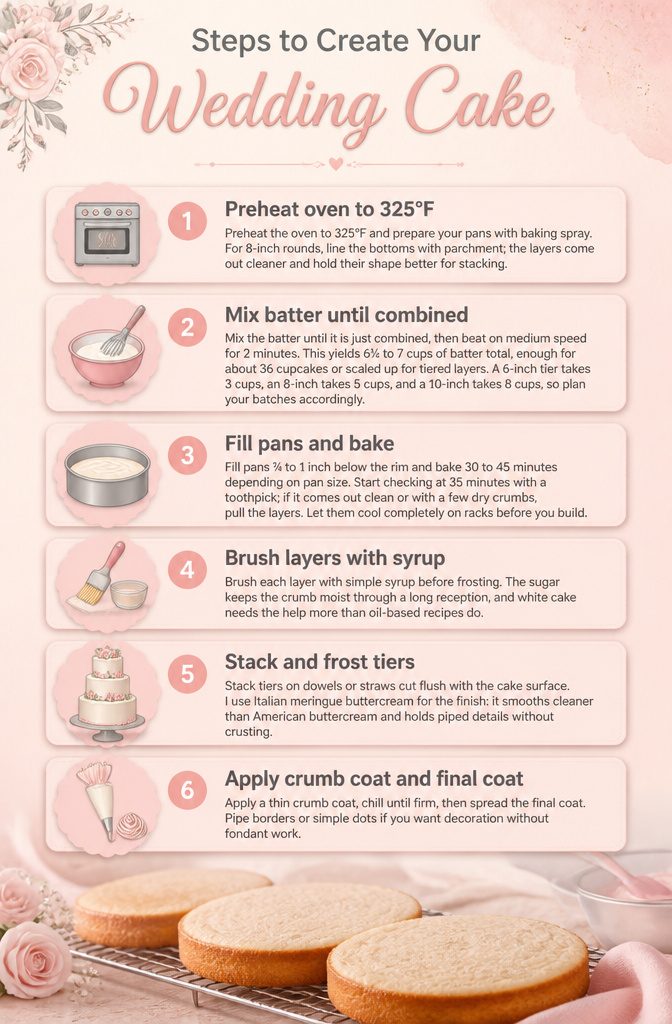
- Preheat the oven to 325°F and prepare your pans with baking spray. For 8-inch rounds, line the bottoms with parchment; the layers come out cleaner and hold their shape better for stacking.
- Mix the batter until it is just combined, then beat on medium speed for 2 minutes. This yields 6½ to 7 cups of batter total, enough for about 36 cupcakes or scaled up for tiered layers. A 6-inch tier takes 3 cups, an 8-inch takes 5 cups, and a 10-inch takes 8 cups, so plan your batches accordingly.
- Fill pans ¾ to 1 inch below the rim and bake 30 to 45 minutes depending on pan size. Start checking at 35 minutes with a toothpick; if it comes out clean or with a few dry crumbs, pull the layers. Let them cool completely on racks before you build.
- Brush each layer with simple syrup before frosting. The sugar keeps the crumb moist through a long reception, and white cake needs the help more than oil-based recipes do.
- Stack tiers on dowels or straws cut flush with the cake surface. I use Italian meringue buttercream for the finish: it smooths cleaner than American buttercream and holds piped details without crusting.
- Apply a thin crumb coat, chill until firm, then spread the final coat. Pipe borders or simple dots if you want decoration without fondant work.
Flower Meadow
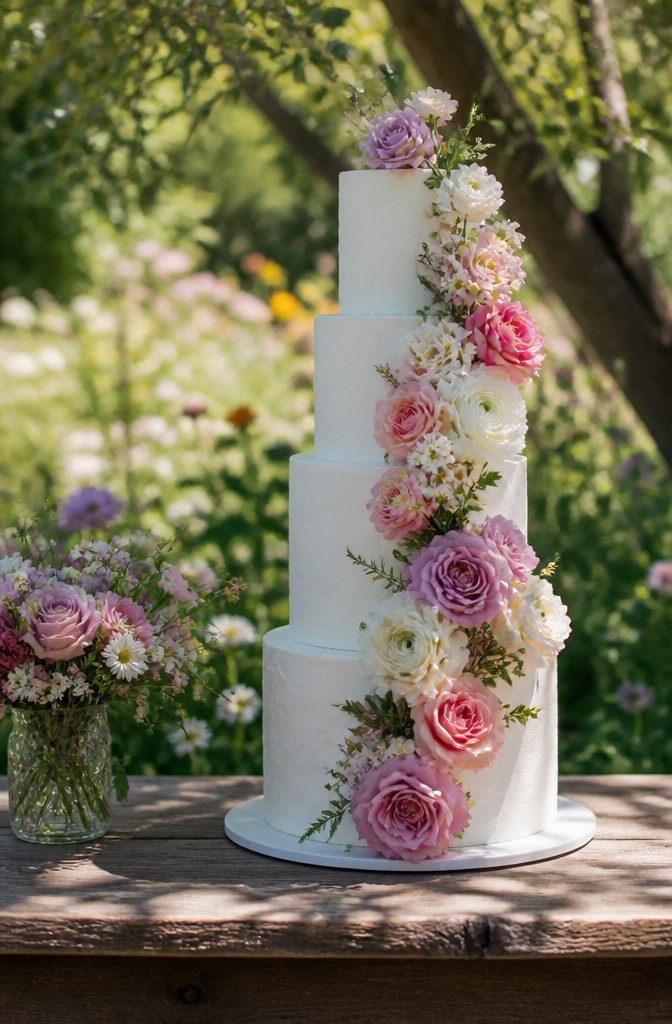
A meadow-style arrangement turns an elegant white wedding cake into something that looks gathered rather than constructed.
White buttercream with an organic, hand-finished texture on the bottom tier gives the flowers something to root against, and the scattered placement keeps the whole thing from reading too formal.
Fresh flowers are the faster path. Sugar flowers cost more and take longer, but they survive a summer tent or a venue without refrigeration.
Realism is the hard part: even exquisitely lifelike sugar work reads as craft up close, while fresh petals wilt and bruise by the last dance.
For a winter wedding, I’d push toward sugar or skip flowers entirely for sparkle and texture. The meadow idea needs that garden context to make sense; in December it can look like something that blew in and froze there.
Keep the cake itself simple.
The design works because the surface stays quiet and the flowers do the talking. Too much piping or too many tiers and you have a centerpiece competing with itself.
Modern Chic
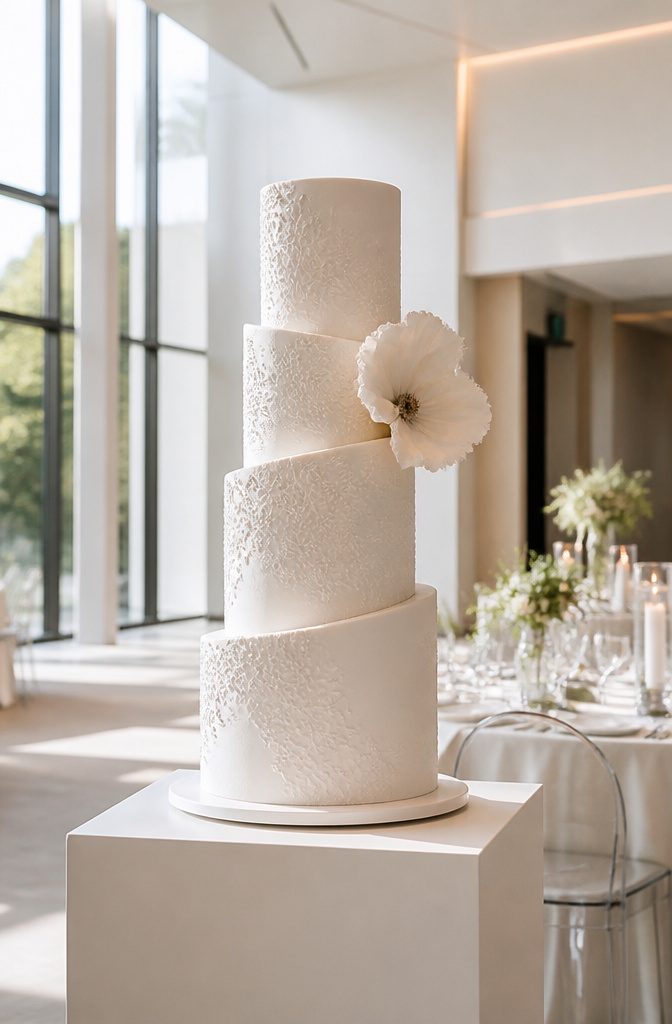
Clean lines and minimal ornamentation separate a modern white wedding cake from its busier cousins. The surface matters most here: smooth fondant or buttercream finished to a satin sheen, with every seam hidden and every edge crisp.
I prefer this approach for venues with strong architecture, lots of glass or white walls, where the cake reads as sculpture rather than centerpiece.
Uneven tier heights add visual interest without extra decoration. One source pairs this with a flowy stenciled design that draws the eye upward, then balances the geometry with a single whimsical sugar flower arrangement.
The restraint is the point. Couture textures, ruffles and oversized floral details can work in this style, but they succeed only when treated as fashion elements: one statement detail, not many competing ones.
Cascading Florals
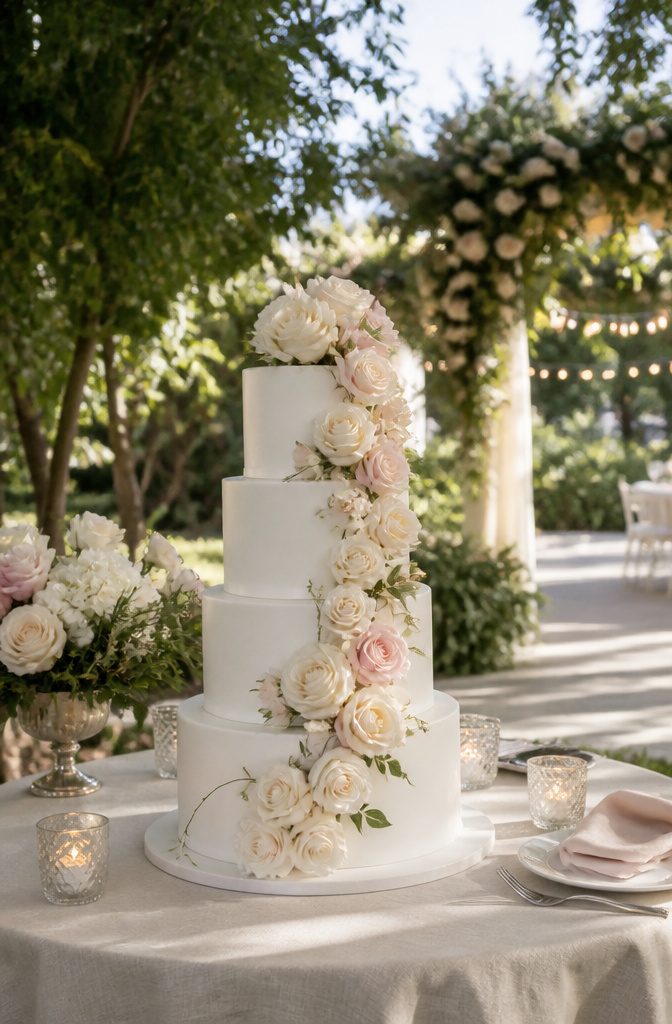
Cascading florals draw the eye downward in a way that feels inevitable, not arranged.
Sugar roses wired in graduated sizes start tight at the top tier’s edge and spill toward the middle tier, each stem bent at a slightly different angle so no two petals line up.
The white fondant underneath is not just background; it is the reason the pale pinks or soft ivories read as color rather than clutter.
For a home baker, the practical limit is three wired flowers per cascade, with the rest filled in by piped buttercream buds or fresh blossoms tucked into floral picks.
More than that and the weight tilts the tier, or you are ordering an internal structure from a cake supply shop, which most of us will not do for a single weekend.
I have seen cascades fail when the baker wired every bloom directly into the cake; the cake sags by hour three of the reception.
Floral picks with a dab of royal icing at the base solve this, and they lift out clean for slicing.
Fresh flowers work if you treat them as garnish, not architecture. A cascade of ranunculus or spray roses needs to be assembled on site, the last thing before the cake table opens.
They will drink from the picks for four to six hours, which is enough for most receptions but not for a cake that sits in a warm kitchen all morning.
Sugar flowers, set the night before, hold their shape and free you to worry about the seating chart instead.
Cable Knit Textures
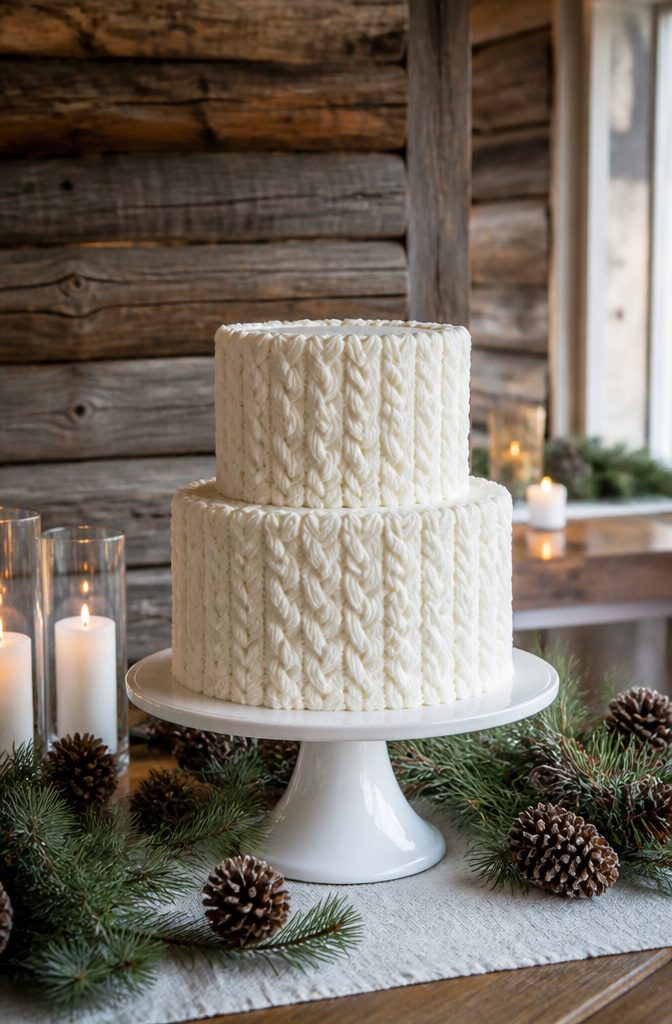
A cable-knit buttercream pattern turns a smooth white cake into something that looks almost touchable, like a folded winter sweater.
The effect comes from a basketweave piping tip and a steady hand moving in overlapping S-curves, first left to right, then right to left, building rows that interlock the way yarn does.
The tip size matters more than the design complexity.
Too small and the lines blur together; too large and the weave looks clumsy against a delicate cake. I find a medium basketweave tip, around 16 to 20, hits the right scale for tiers 8 inches or wider.
The buttercream needs to hold a sharp edge, so a Swiss meringue or stiff American buttercream works better here than anything with soft peaks.
Color stays pure white or shifts barely off-white, ivory, or the palest blush, since the texture itself carries the visual weight.
For a winter wedding, this reads as intentional coziness rather than rustic casual; the precision of the piping keeps it elegant.
Time is the cost. Each tier takes roughly three to four times longer to finish than a smooth coat, and the pattern shows every hesitation in your wrist.
Skip this for a cake that will sit in a warm room longer than two hours; the raised lines are the first place buttercream weeps.
Breath Taking Baby’s Breath
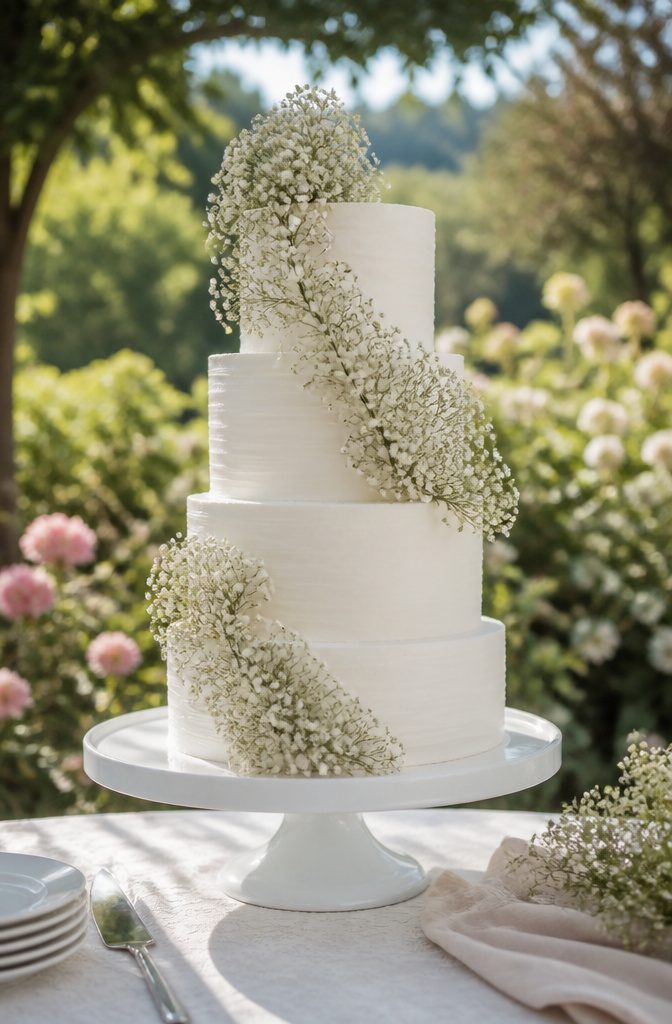
Baby’s breath earns its spot on an elegant white wedding cake through restraint. A handful of delicate, cloud-like sprays tucked between tiers reads romantic without crowding the white fondant or buttercream base.
The stems feed cleanly into narrow drinking straws or floral picks inserted at the last minute, so neither water nor sap touches the cake itself.
I like to cluster the sprays asymmetrically, maybe three soft points on a four-tier cake, rather than ringing every layer.
The negative space matters as much as the flowers here. It keeps the eye moving upward and lets the white surface stay the main event, which is the whole reason someone chose an all-white cake in the first place.
One limitation: baby’s breath browns fast in summer heat. If the reception runs outdoors or the cake sits out for hours, consider sugar paste versions or move the display into air conditioning until the photographer finishes.
The real stems look ethereal for those first shots, though, and they cost a fraction of what roses or peonies would run for the same coverage.
Sheer Elegance
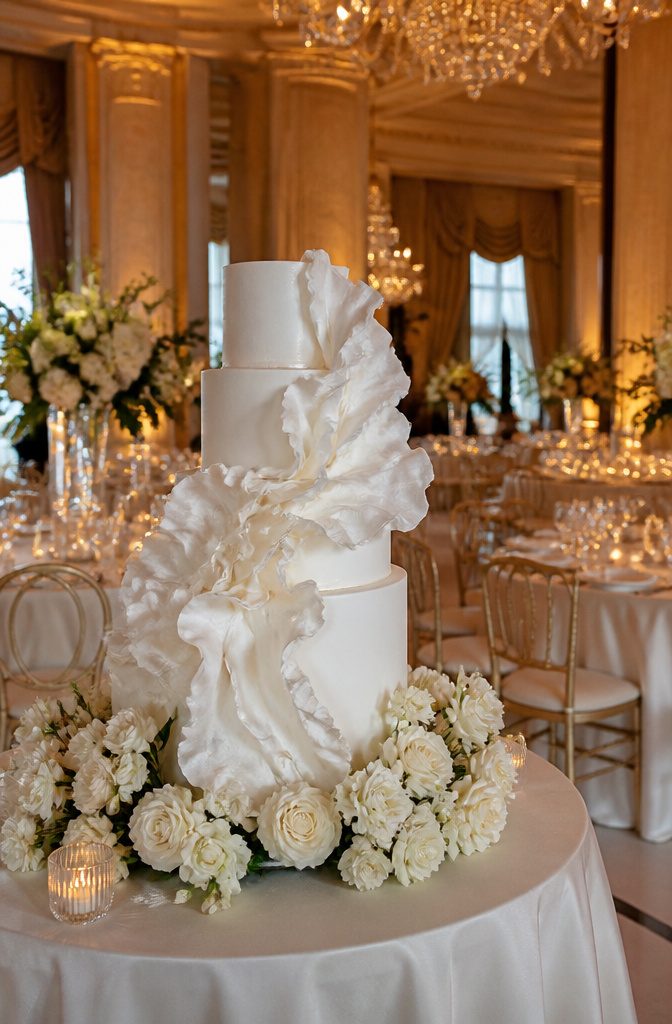
Wafer paper ruffles catch light the way couture fabric does, turning a plain white cake into something that reads as fashion rather than frosting.
The effect depends on keeping the paper thin enough to stay translucent; once it crosses into opacity, the dress-like quality collapses into craft-project territory.
A barely-there shimmer works on the same principle. Pearlescent or silvery edible sparkle, applied top to toe, risks cheap flash in the wrong hands.
The balance that saves it is restraint in coverage and choice of finish: a soft pearl over a hard glitter keeps the look luxurious rather than disco.
Full, blousy florals in the same white tone give the eye somewhere to rest so the shimmer reads as texture, not decoration.
Fragility is the risk.
Wafer paper softens in humidity, and shimmer shows every fingerprint from handling. These finishes suit a controlled venue more than an outdoor summer reception, and they demand delivery timing that leaves no margin for last-minute fixes.
Whimsical Lights
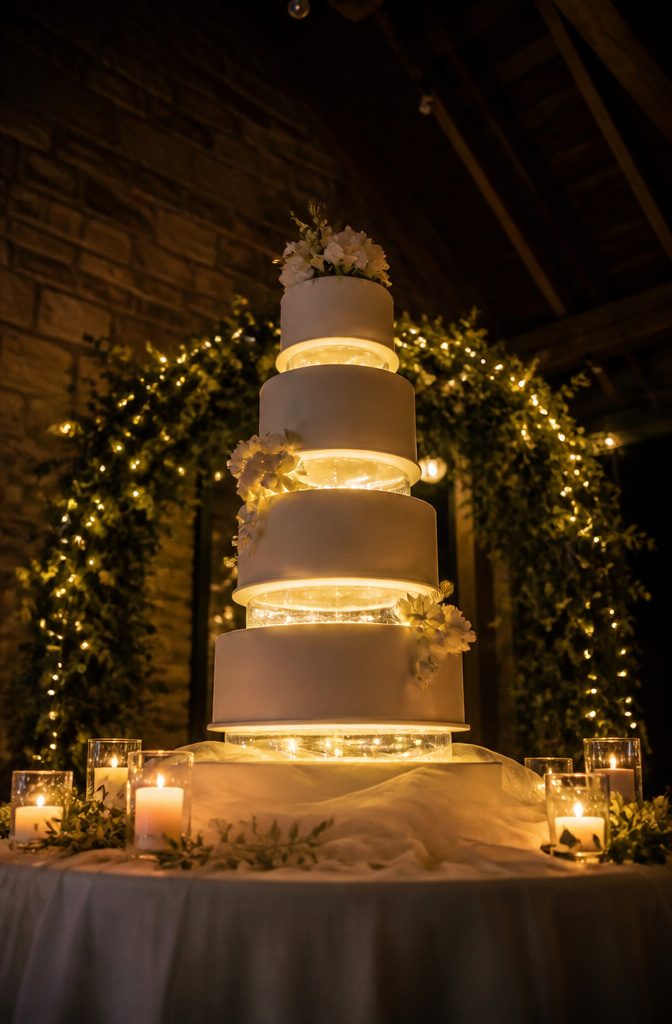
Small LED strands tucked between tiers or beneath sheer separators give an elegant white wedding cake its after-dark presence.
The acrylic separators I see used most often are the workhorse here: they hold the lights in a clean channel while keeping the wiring invisible from every angle the guests will see.
A three-tier setup with lights between each level reads as floating rather than stacked, which is the effect most couples want when they ask for "whimsical."
The stenciled texture and sugar flowers that usually sit on the top and bottom tiers catch that light differently than smooth fondant would.
Texture scatters; smooth reflects. For a white cake specifically, the glow needs something to break it up or the whole thing flattens into a lantern.
Battery-powered strands win over plug-in for this application every time.
No cord trailing to a wall outlet, no tripping hazard near the cake table, and the battery pack hides inside the separator column or tapes to the underside of a tier board.
Plan for eight to twelve hours of runtime on fresh cells; ceremony through last dance, with margin.
Weight is the problem. Acrylic separators with built-in light channels add ounces a standard pillar does not, and a tall three-tier already pushes the limits of what a standard cake stand balances well.
Keep the overall height under eighteen inches if you are not using a custom base, or the glow becomes a wobble waiting to happen.
Summer Vibes
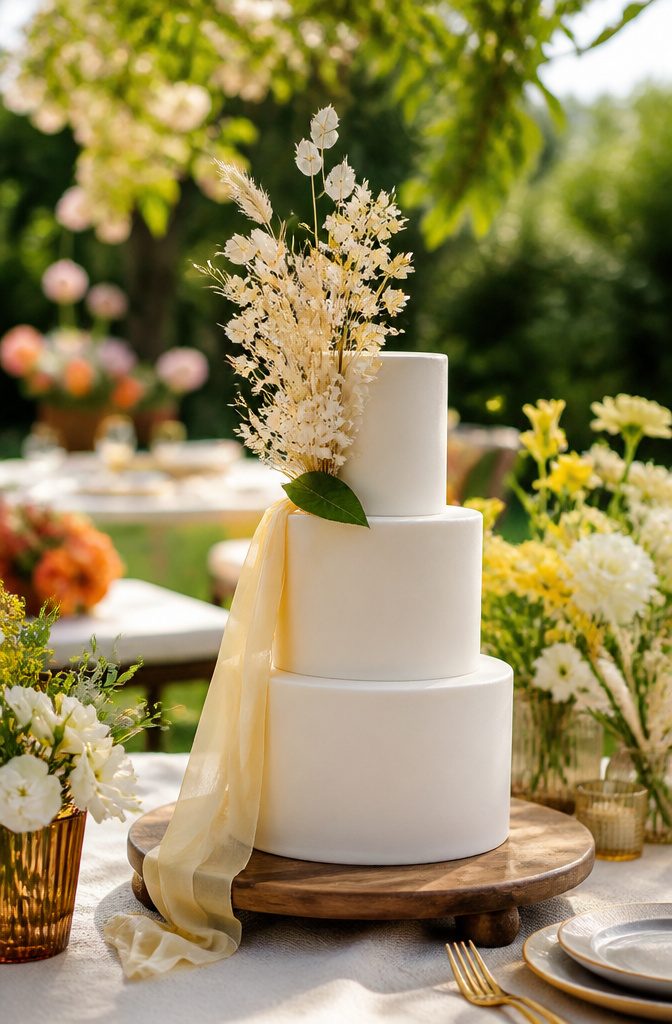
Bright summer heat calls for restraint on a white canvas.
I like sun-bleached botanicals, dried grasses, or a single citrus leaf tucked at an angle where buttercream meets the stand. The pale yellow of a lemon verbena or a soft yolk-colored ribbon reads as warmth without shouting.
A white cake in July benefits from one accent color, never two. Pale yellow works because it sits back; tangerine or coral fights the icing for attention and usually loses.
The same rule holds for foliage. Citrus leaves give you that waxy green without the heaviness of eucalyptus, and they hold their shape out of water longer than most people expect.
I would skip anything that needs refrigeration until the last possible hour.
Fresh flowers sweat against cold buttercream, and the gap between kitchen and garden table is where summer cakes go wrong. Dried elements or botanicals that have already cured sidestep that risk entirely.
Towering in White and Roses
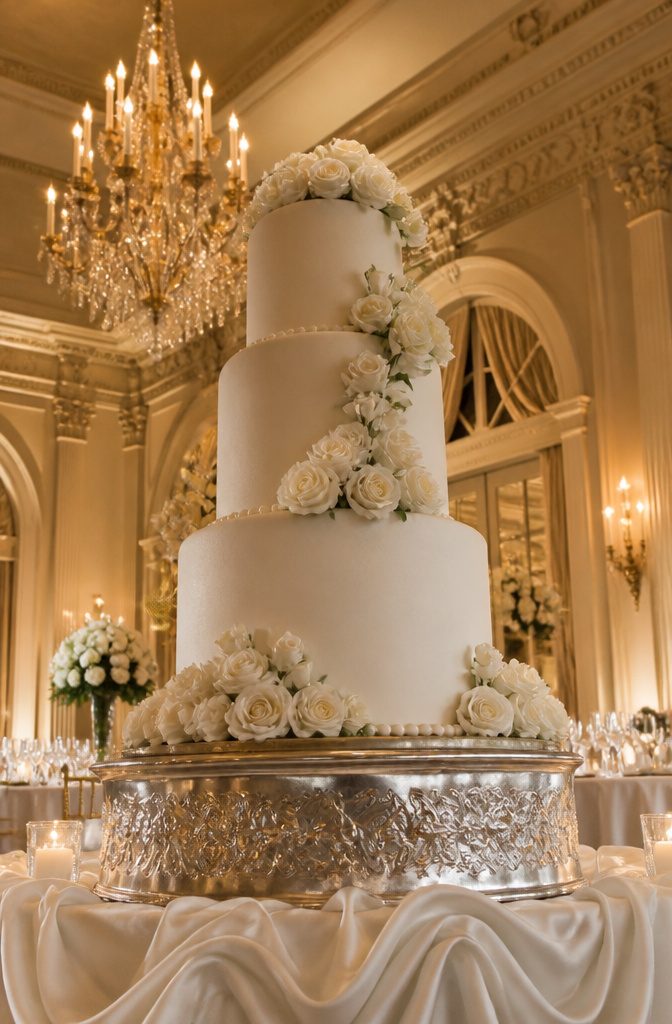
A three-tier white cake stacked tall is the classic that still reads as the most formal choice for a traditional wedding.
The height itself does the work; elaborate colors or modern shapes are not required to signal importance. White roses placed at the base of each tier and where the layers meet draw the eye upward and reinforce that vertical line.
Three tiers is the minimum that achieves this effect; anything shorter starts to look like a generous birthday cake rather than a ceremonial centerpiece.
The roses should be fresh, not sugar, if you want the slight variation in cream and ivory that keeps an all-white palette from flattening into one blank surface.
That subtle shift in tone is what separates an elegant white wedding cake from a catering-hall standard. Fresh roses also mean arranging them the morning of, which is a constraint worth weighing against how good they look.
Sugar roses can be set days ahead, but they tend toward a uniform brightness that photographs flatter and real light reveals as slightly artificial.
For a reception lit by candles and late-afternoon windows, fresh wins. For a ballroom with flash photography, the difference narrows.
Flowers Abundance
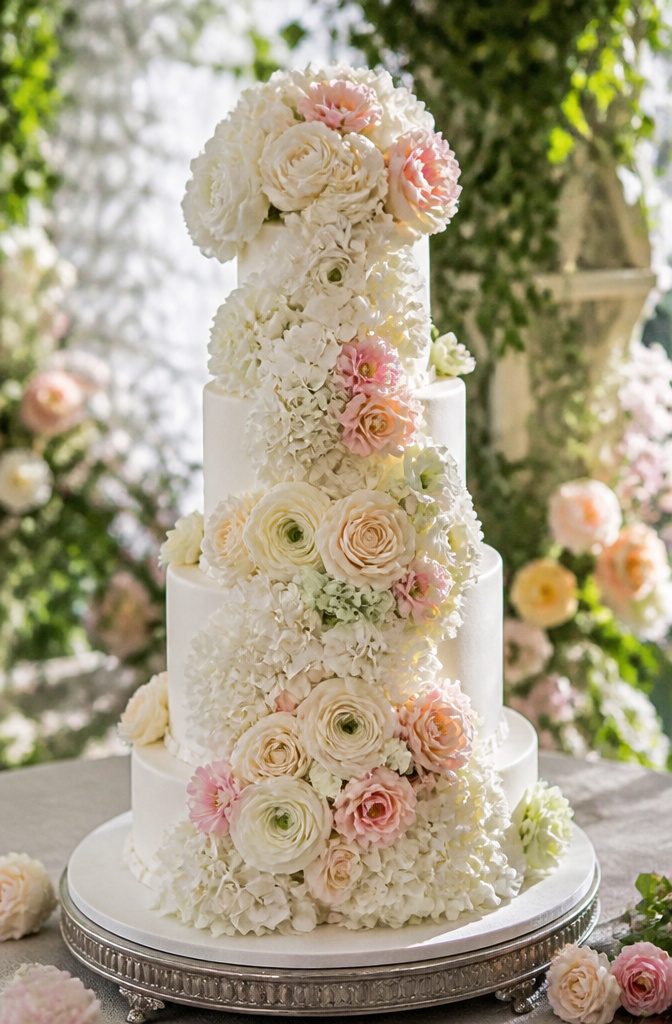
A full floral covering turns the cake into something closer to a garden sculpture than a dessert.
Buttercream roses, ranunculus, and hydrangea clusters pressed close together hide nearly every inch of fondant or frosting beneath, so the white base reads only in the gaps between petals.
The density matters more than the individual flower; a sparse arrangement looks like an accident, but wall-to-wall blooms signal intention and labor.
Icing flowers work, but fresh blooms carry more impact if you treat them food-safe.
Wrap stems in floral tape, insert straws cut to the exact depth of the tier, and never let sap or pollen touch the cut surface guests will eat.
The cost climbs fast: a four-tier cake can take sixty to eighty individual flowers, and a florist’s bridal markup applies even when the bouquet is anchored in sponge cake.
The real trade-off is weight. Fresh flowers drink water, and buttercream softens under pressure.
A cake fully clothed in blooms needs internal doweling more rigid than standard, and the display table must be level; even a slight lean compresses one side and gaps open between petals. Transport becomes the hardest part of the day.
Spring Vibes
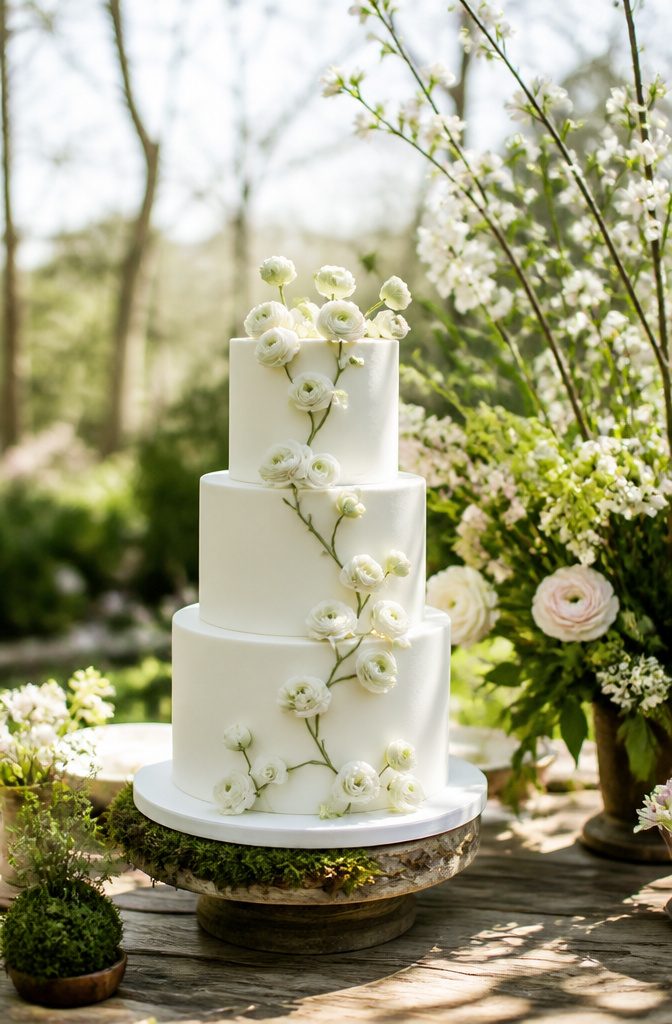
Soft green stems and pale buds read as new growth rather than full bloom, which is exactly the restraint that keeps a white cake from looking like a grocery-store sheet cake.
I like pale green fondant stems that climb from the base in asymmetrical sweeps; they give the eye a path without cluttering the surface.
Early-season blossoms, white or barely blush, work best when they are small and clustered, not the open roses that dominate summer designs.
Sugar ranunculus buds, closed tight with a hint of color at the center, sit naturally against the stems and read as something just about to happen.
The white ground matters here: any ivory or cream shifts the whole thing toward antique, which is its own mood but not this one. For a home baker, the limit is time.
These details are simple individually, but twelve stems and forty buds add up, so I would plan this for a single-tier display cake or a small cutting cake where the decoration stays manageable.
The result is a cake that feels like late March, not mid-July.
Classic Textures
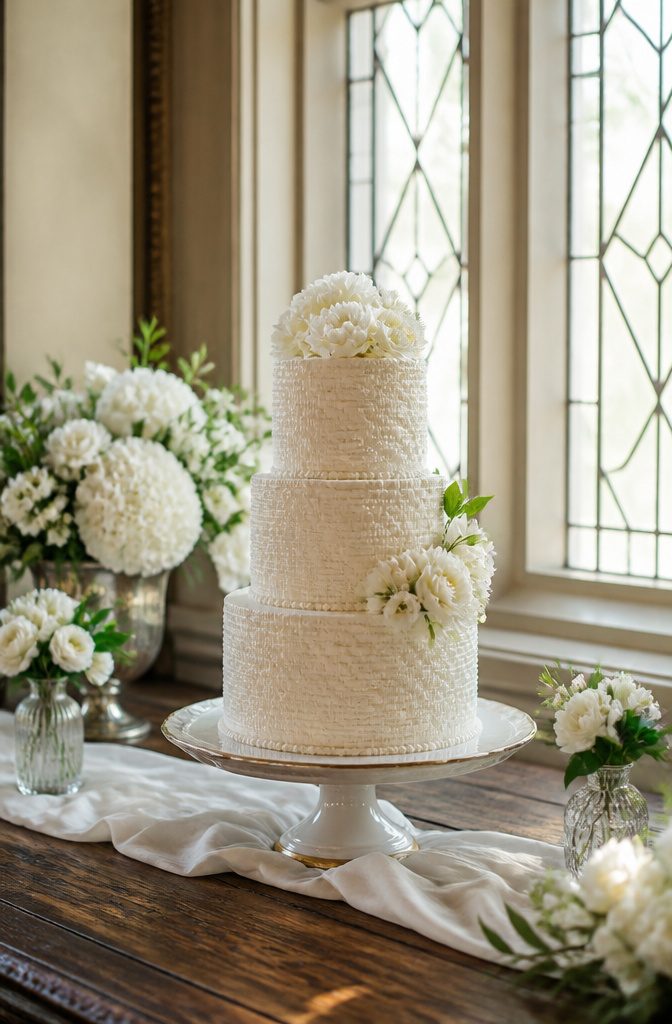
A basketweave finish reads as fabric wrapped around the tiers, and it forgives a buttercream that is not perfectly smooth underneath.
The technique uses a small square tip to lay vertical lines, then short horizontal strokes woven over and under in alternating rows.
Cornelli lace looks like freehand scribbles that never touch, traced across the surface with a round tip in one continuous motion. It covers a cake fast and needs no marked pattern, though the spacing takes practice to keep even.
Scrollwork sits between the two in formality: loops and curls piped with a star or round tip, often clustered at the base or top edge of each tier.
White-on-white piping keeps the effect quiet, so the texture itself becomes the decoration rather than competing with flowers or ribbon.
Of the three, I would choose basketweave for a home baker working without a rotating stand; the straight lines are easier to control at a fixed angle, and the woven pattern hides small inconsistencies that scrollwork would broadcast.
Cornelli lace is faster once the hand learns the rhythm, but a single crossed line ruins the open effect and requires scraping back to start again.
All three demand buttercream at the same consistency, stiff enough to hold a peak but soft enough that the pressure from the bag stays even through a full minute of piping.
Let the buttercream crust for ten minutes before you begin, so a slipped tip leaves a mark you can lift away with a toothpick rather than a smear.
Mixed Textures
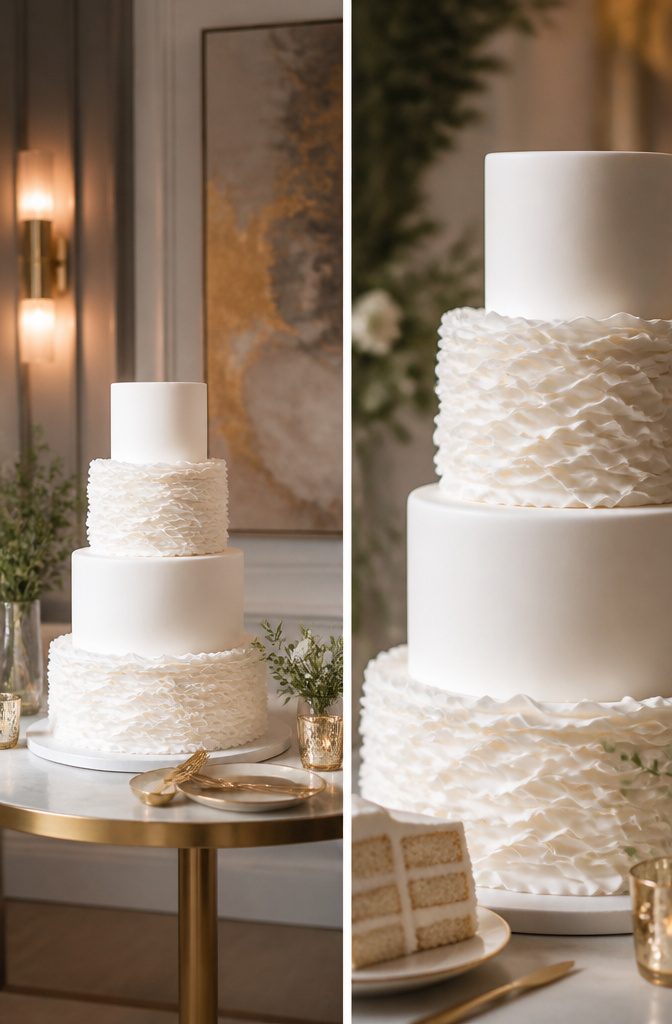
A smooth fondant base against piped ruffles gives an elegant white wedding cake the depth that flat color alone cannot manage. The eye reads the contrast before it registers the detail: one surface holds still, the other moves.
Matte against satin works the same way. A matte tier set between two with sheen catches light differently at every angle, so the cake changes as guests move around the room.
Fashion textures translated into icing and wafer paper work well, where ruffles and oversized florals create what reads as dress-like quality.
The risk is busyness. Two textures succeed; four compete.
I would keep the palette strictly white and let the finish do the variation. Piped details need breathing room, which means either a generous band of smooth fondant between ruffled sections or a single statement tier against simpler neighbors.
Wafer paper offers another path. It carries texture without the weight of buttercream buildup, and it takes ruffling with a delicacy that reads contemporary rather than fussy.
Fragility is the issue: humidity softens the crisp edges that make the effect work, so this suits controlled indoor settings better than garden receptions in peak summer.
Vintage Lambeth Piping
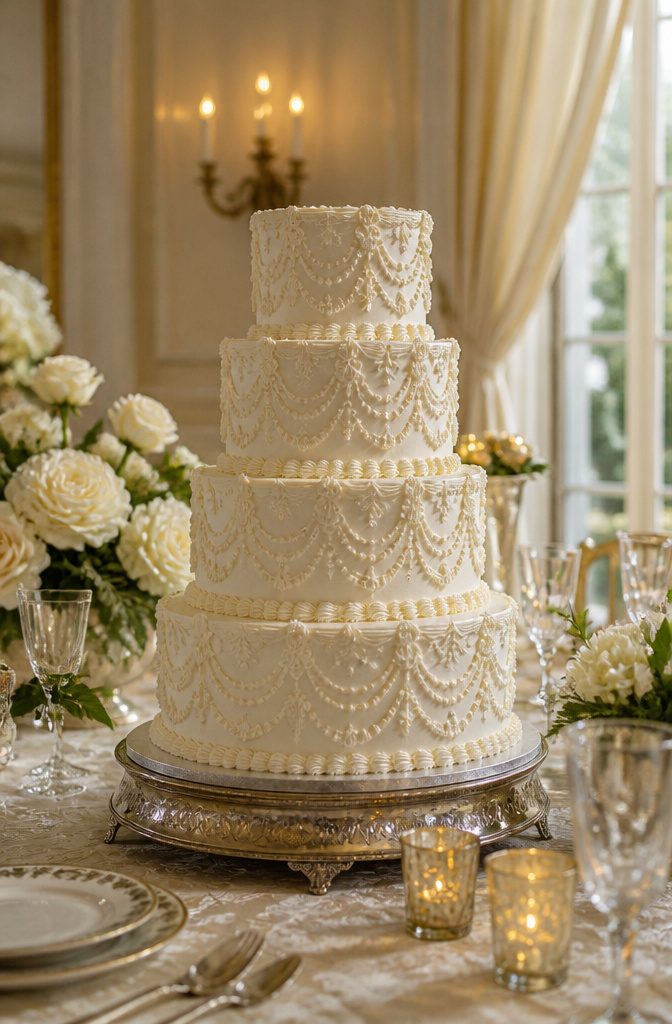
Vintage Lambeth piping builds its effect through stacked layers of royal icing, each one piped over the last to create ridges and scrollwork that cast tiny shadows under reception lighting.
The technique looks impossibly intricate in photographs, but the method is repetitive rather than difficult: a base line goes down, a slightly smaller line pipes directly on top, and a third line finishes the crest.
What separates a convincing Lambeth cake from a busy one is spacing the base lines far enough apart that each ridge reads as a distinct architectural element, not a single blob.
Deep relief needs room to breathe. Royal icing hardens to a matte porcelain finish that photographs brilliantly against white fondant or buttercream, though the same dryness makes it brittle if the cake will travel far.
For a home kitchen without a turntable, piping on a sheet of parchment first and transferring the dried pieces with a small offset spatula keeps the work portable and the pressure consistent.
The time investment is real: a three-tier cake with full Lambeth coverage can take six to eight hours of active piping, and the icing must crust between layers.
I would not attempt this for an outdoor summer wedding, where humidity softens the structure, but for a climate-controlled venue the result still carries the gravity of a 1930s hotel ballroom.
Elegant Bohemian
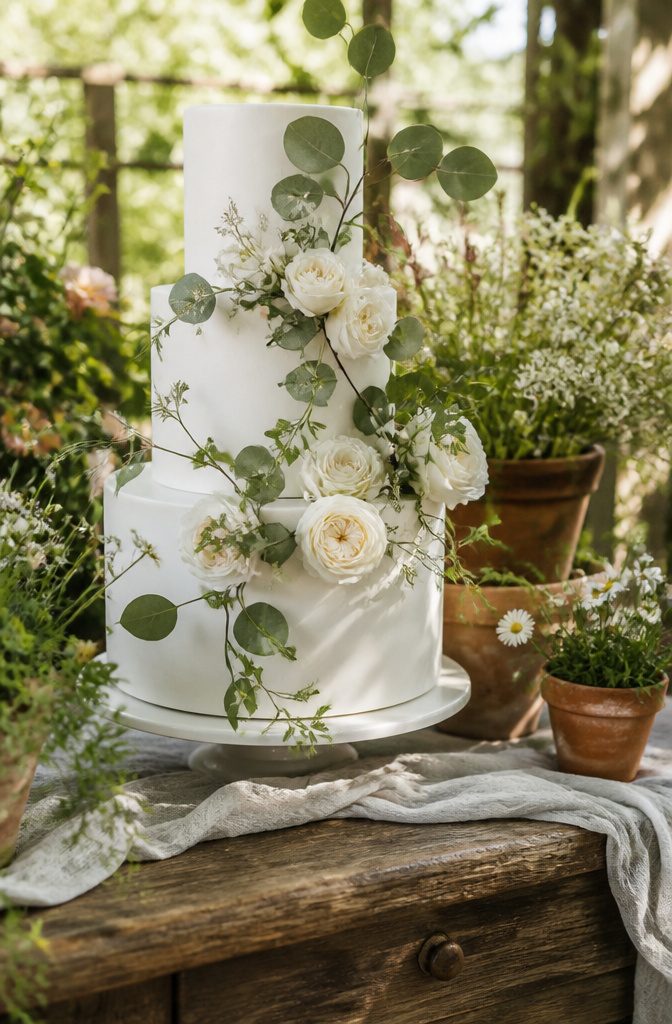
Loose greenery and foraged-looking florals turn a white cake into something that feels discovered rather than constructed. The stems should trail at odd angles, not stand at attention.
I start with a base of eucalyptus or ruscus draped from the top tier downward, letting the ends curl where they fall, then tuck in garden roses, ranunculus, or whatever looks fresh at the market that morning.
Nothing symmetrical, nothing wired into a perfect sphere.
The frosting needs to be smooth enough to read as intentional, since the flowers provide all the visual noise. Swiss meringue buttercream works better here than fondant; the slight sheen catches light the way dew would on real petals.
For a three-tier cake, I plan roughly twice the greenery I think I need. The gaps between stems matter as much as the stems themselves.
This style forgives a slightly tilted tier or a thumbprint in the buttercream.
That is the point. The cake looks like someone carried it in from a meadow minutes before the ceremony, which is exactly the mood a bohemian wedding wants.
Modern Boho Style
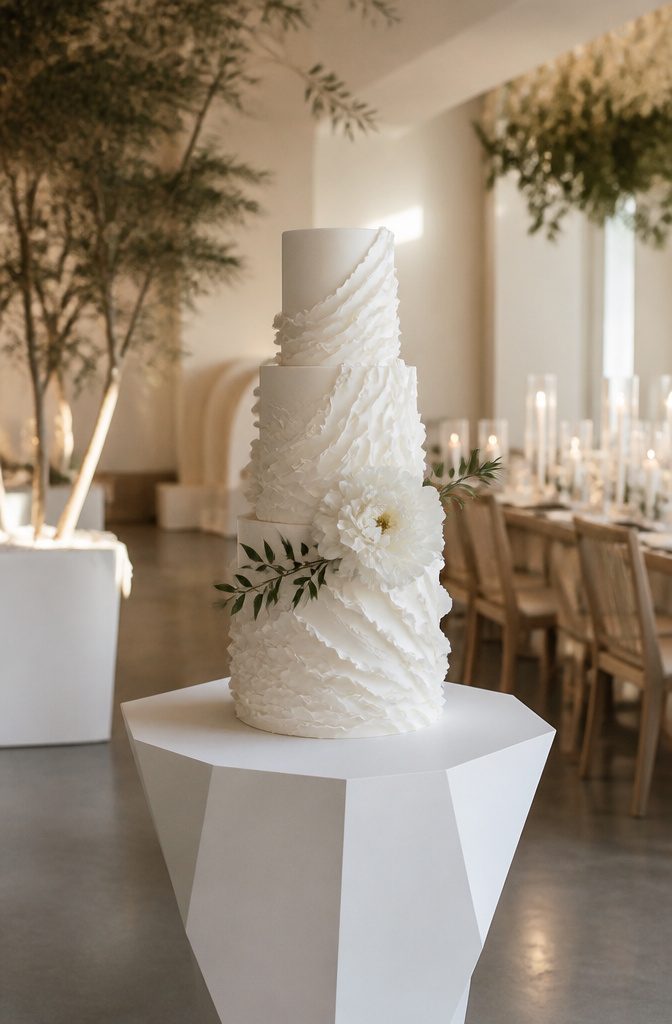
A modern boho white wedding cake keeps the free-spirited mood but strips away the clutter.
I would start with white-on-white texture over color: think ruffles in icing or wafer paper that catch light without adding a second hue. Couture textures add artistic interest and depth, and that logic applies here too.
Restrained botanicals work better than wild abundance for this look.
One large statement bloom with some white foliage reads contemporary rather than rustic. Geometric separators between tiers, clean lines, and flawless edges keep it from drifting into vintage territory.
The venue matters.
A light, modern space suits this cake naturally. In a more classic or ornate setting, the same design brings stylish luxe that balances traditional surroundings rather than competing with them.
Three tiers is the classic starting point, and for this style I would not go taller; the restraint is the point.
Warmth is what you give up. Strict white-on-white can feel cold, so the texture has to do the emotional work that color usually handles.
Ruffles, detailed icing, or oversized floral details supply that romance. Skip anything that reads crafty; contemporary perfection matters, not DIY charm.
A Touch of Luxury
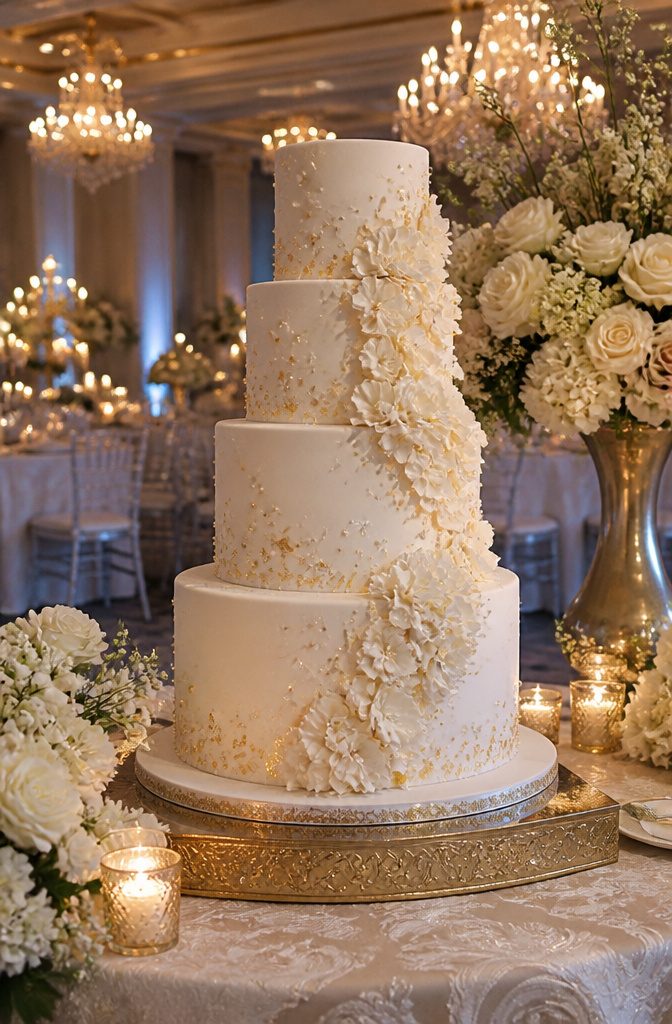
Gold leaf, sugar pearls, and the faintest wash of champagne tone are the three ways to give a white cake presence without pulling it toward color. Each reads as light catching the surface rather than decoration sitting on top.
I would choose sugar pearls for a home kitchen. They are forgiving to place, need no special tool beyond tweezers you already own, and they catch light the way a jeweled comb catches hair.
Gold leaf is the opposite: it tears if you breathe wrong and shows every fingerprint. The effect is real, but only if your hands are steady and the room is still.
Champagne tone sits between them. A drop of ivory gel in the fondant or buttercream warms the white without naming itself as a color, and it photographs softer under reception lighting than pure white does.
Pearls and crystals together edge into glam, which some couples want and others do not. Keep the pearls small, under four millimeters, and scatter rather than line them if you are after the elegant side of the look.
Anemones Accents
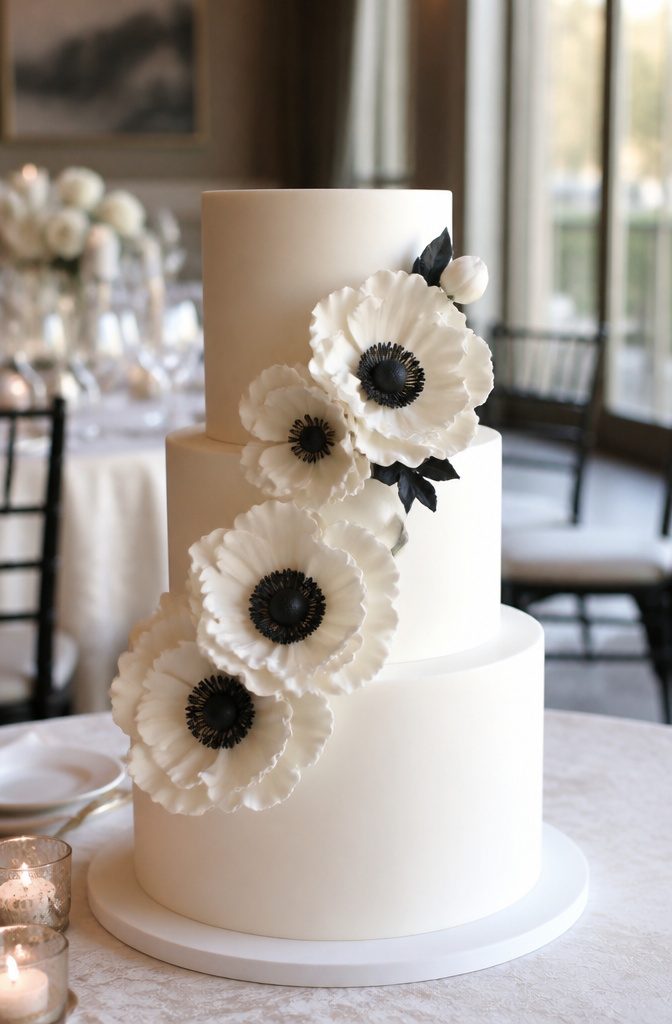
Bold black-centered white anemones give an elegant white wedding cake its sharpest focal point.
The graphic quality of that dark eye against smooth white fondant reads as deliberate, not busy, and the petals’ natural ruffle catches light without needing extra texture elsewhere on the tier.
I place them asymmetrically, usually one large bloom offset high with a bud trailing below, rather than clustering at center. The eye draws the camera, and asymmetry keeps the arrangement from looking stamped on.
Wired stems let you angle each head so the black center faces guests head-on; the flat face of an anemone is its whole advantage over softer, more dimensional flowers.
The black center is painted, not natural, so verify with your florist that the dye is food-safe if the stem will contact cake.
I have used blooms set on drinking straws inserted as barriers, or positioned entirely on a topper base that lifts clear of the surface. Either approach keeps the visual punch without the safety question.
Frequently Asked Questions
Can I make a white wedding cake from a box mix?
Yes, and this recipe is built around a 15.25-ounce box of white cake mix doctored with flour, sugar, sour cream, and egg whites for density and crumb.
The doctored mix yields about 6½ to 7 cups of batter, enough to scale up for tiered layers without the inconsistency scratch recipes can bring to a high-stakes bake.
How long do I bake a white wedding cake?
Bake 30 to 45 minutes depending on pan size, starting your toothpick check at 35 minutes. A 6-inch tier, an 8-inch tier, and a 10-inch tier all fall within this range; pull each when the toothpick shows clean or a few dry crumbs.
What size cake pans should I use for a wedding cake?
Use 6-inch, 8-inch, and 10-inch round pans, each 3 inches deep. You will need roughly 3 cups of batter for the 6-inch, 5 cups for the 8-inch, and 8 cups for the 10-inch, which means tripling the batter recipe to fill all three tiers.
What is the best frosting for a white wedding cake?
Buttercream wins for flavor and workability, with the recipe calling for 1½ cups salted butter, 4½ cups powdered sugar, and clear vanilla if you want a true white finish.
For a smoother, more formal look, Italian or Swiss meringue buttercream pipes cleaner and crusts less than American buttercream.
How do I prevent my cake from drying out?
Brush each layer with simple syrup, made from equal parts sugar and water, before you add frosting.
White cake in particular needs this help to stay moist through a long reception, since it lacks the oil base that keeps some other recipes tender.
What flavor is traditional white wedding cake?
Traditional white wedding cake is vanilla-scented and almond-leaning, with a fine, tender crumb. This recipe hits that profile through a doctored white mix plus vanilla extract, producing what tasters identify as old-fashioned bakery flavor rather than boxed-mix taste.
What are some elegant wedding cake ideas?
Options range from cascading sugar or fresh florals, baby’s breath tucked between tiers, mixed textures like smooth fondant against piped ruffles, whimsical LED lighting between acrylic separators, and sheer wafer paper or shimmer finishes for couture effect.